
Spaces:
Running

license: mit
language:
  - en
  - hi
  - ta
  - te
  - kn
  - bn
  - mr
base_model: Qwen/Qwen2.5-7B-Instruct
library_name: peft
pipeline_tag: text-generation
tags:
  - lora
  - peft
  - grpo
  - trl
  - unsloth
  - fraud-detection
  - upi
  - india
  - multi-agent
  - openenv
  - scalable-oversight
datasets:
  - ujjwalpardeshi/chakravyuh-bench-v0
metrics:
  - f1
  - precision
  - recall
model-index:
  - name: chakravyuh-analyzer-lora-v2
    results:
      - task:
          type: text-classification
          name: Indian UPI Fraud Detection (Chakravyuh bench-v0)
        dataset:
          name: chakravyuh-bench-v0
          type: custom
        metrics:
          - name: Detection (recall)
            type: recall
            value: 0.993
          - name: False Positive Rate
            type: fpr
            value: 0.067
          - name: Precision
            type: precision
            value: 0.986
          - name: F1
            type: f1
            value: 0.99
Chakravyuh Analyzer — LoRA v2
LoRA adapter for Qwen/Qwen2.5-7B-Instruct, post-trained with TRL's GRPO on the Chakravyuh multi-agent Indian UPI fraud-detection environment.
The Analyzer's job: read a multi-turn dialogue between a (scripted) Scammer and Victim and output a calibrated suspicion score plus a justified explanation, in real time, on the victim's device. This adapter is the v2 of two Chakravyuh trained adapters and is the honest one — see "v1 → v2 story" below.
Quick numbers (full results in logs/eval_v2.json of the GitHub repo)
| Metric | v1 (reward-hacked) | v2 (this adapter) | 95 % bootstrap CI |
|---|---|---|---|
| Detection rate | 100.0 % | 99.3 % | [97.9 %, 100 %] |
| False positive rate | 36.0 % | 6.7 % (5× better) | [1.8 %, 20.7 %] |
| F1 | 0.96 | 0.99 | [0.976, 1.000] |
| Bench size | 135 | 174 evaluated (175 total, 1 skipped) | — |
Statistical significance. The v1 → v2 FPR drop is significant at p ≈ 0.008 (paired permutation, 10 000 iterations) and p ≈ 0.010 (Fisher exact). Source: logs/permutation_test_v1_v2.json in the GitHub repo. Reproduce with python eval/permutation_test_v1_v2.py.
Bootstrap details. Percentile-method bootstrap, 10 000 iterations, n = 30 benign / n = 144 scam. Source: logs/bootstrap_v2.json.
Per-difficulty detection (scams only, n=144)
| Difficulty | n | Detection |
|---|---|---|
| Easy | 26 | 100% |
| Medium | 66 | 100% |
| Hard | 18 | 100% |
| Novel | 34 | 97% |
The dip on novel (post-2024 attack patterns) is the small honest crack that confirms the model is not collapsing to "always flag."
v1 → v2 story (the reason this adapter exists)
v1 hit detection=100% / FPR=36% — a textbook reward-hacking fingerprint. The model had learned to flag everything and then defend the over-flagging with plausible-sounding reasoning. The reward components were:
- Detection (+1 correct / -0.5 wrong)
- False-positive penalty (−0.3) ← too light
- Format reward (+0.15) ← paid even when prediction was wrong
- Calibration (×0.3 for benign) ← too weak on benign side
- Explanation (×0.4)
After diagnosing the hack, three principled changes were applied for v2:
- FP penalty −0.3 → −0.8 — over-flagging is now expensive
- Format reward DENIED on benign-flagged-as-scam — closes the "lazy over-flag" shortcut
- Benign calibration weight 0.3 → 0.5 — stronger gradient toward score ≤ 0.2 on benign
Plus the KL anchor was tightened (β = 0.08 → 0.15) so the model can't drift far from the base distribution under the new reward shape.
Result: detection barely moved (100% → 99%), but FPR dropped 5× (36% → 6.7%). That asymmetric improvement is the signature of the model actually learning the task instead of gaming the reward.
Quick start
from transformers import AutoTokenizer, AutoModelForCausalLM
from peft import PeftModel
import torch

base_model_id = "Qwen/Qwen2.5-7B-Instruct"
adapter_id = "ujjwalpardeshi/chakravyuh-analyzer-lora-v2"

tokenizer = AutoTokenizer.from_pretrained(base_model_id)
base = AutoModelForCausalLM.from_pretrained(
    base_model_id,
    torch_dtype=torch.bfloat16,
    device_map="auto",
)
model = PeftModel.from_pretrained(base, adapter_id)
model.eval()

system_prompt = (
    "You are Chakravyuh's Behavioral Analyzer, a fraud detection AI deployed "
    "on-device to monitor real-time chat for Indian UPI scam patterns. "
    "Output strict JSON with `score` in [0,1], `signals` from the taxonomy, "
    "and `explanation`."
)

user_prompt = (
    "Scammer messages:\n"
    "Urgent! Your bank account will be frozen. Share OTP to verify identity.\n\n"
    "Analyze these messages. Return strict JSON only."
)

messages = [
    {"role": "system", "content": system_prompt},
    {"role": "user", "content": user_prompt},
]
prompt = tokenizer.apply_chat_template(messages, tokenize=False, add_generation_prompt=True)
inputs = tokenizer(prompt, return_tensors="pt").to(model.device)

with torch.no_grad():
    out = model.generate(
        **inputs,
        max_new_tokens=160,
        do_sample=False,
        temperature=0.0,
        pad_token_id=tokenizer.eos_token_id,
    )
response = tokenizer.decode(out[0][inputs["input_ids"].shape[1]:], skip_special_tokens=True)
print(response)
Expected output (JSON):
{
  "score": 0.95,
  "signals": ["urgency", "info_request", "impersonation"],
  "explanation": "Asks for OTP with urgency pressure from a self-claimed bank agent; matches OTP-theft scam pattern."
}
Training details
- Base model: Qwen/Qwen2.5-7B-Instruct (4-bit Unsloth quantization for training, bf16 inference)
- LoRA rank: 64
- LoRA alpha: 128
- KL anchor (β): 0.15
- Training corpus: 619 examples (456 scam + 204 benign templates, soft-leakage filtered against the test set; see
training/grpo_analyzer.py:_filter_soft_leakage) - Algorithm: GRPO via TRL
- Steps: 619 (1 full epoch over the corpus)
- Reward function: Composable 8-rubric system (detection, FP penalty, missed-scam penalty, calibration, explanation, signal-accuracy, format, length) — see the Composable Rubric System section in README
- Hardware: Single A100-80GB (Colab Pro+)
trainer_state.json (full training trajectory) is at logs/v2_trainer_state.json in the source repo.
Training curves (rendered from the trainer state — reward, loss, KL divergence, gradient norm over 615 steps):
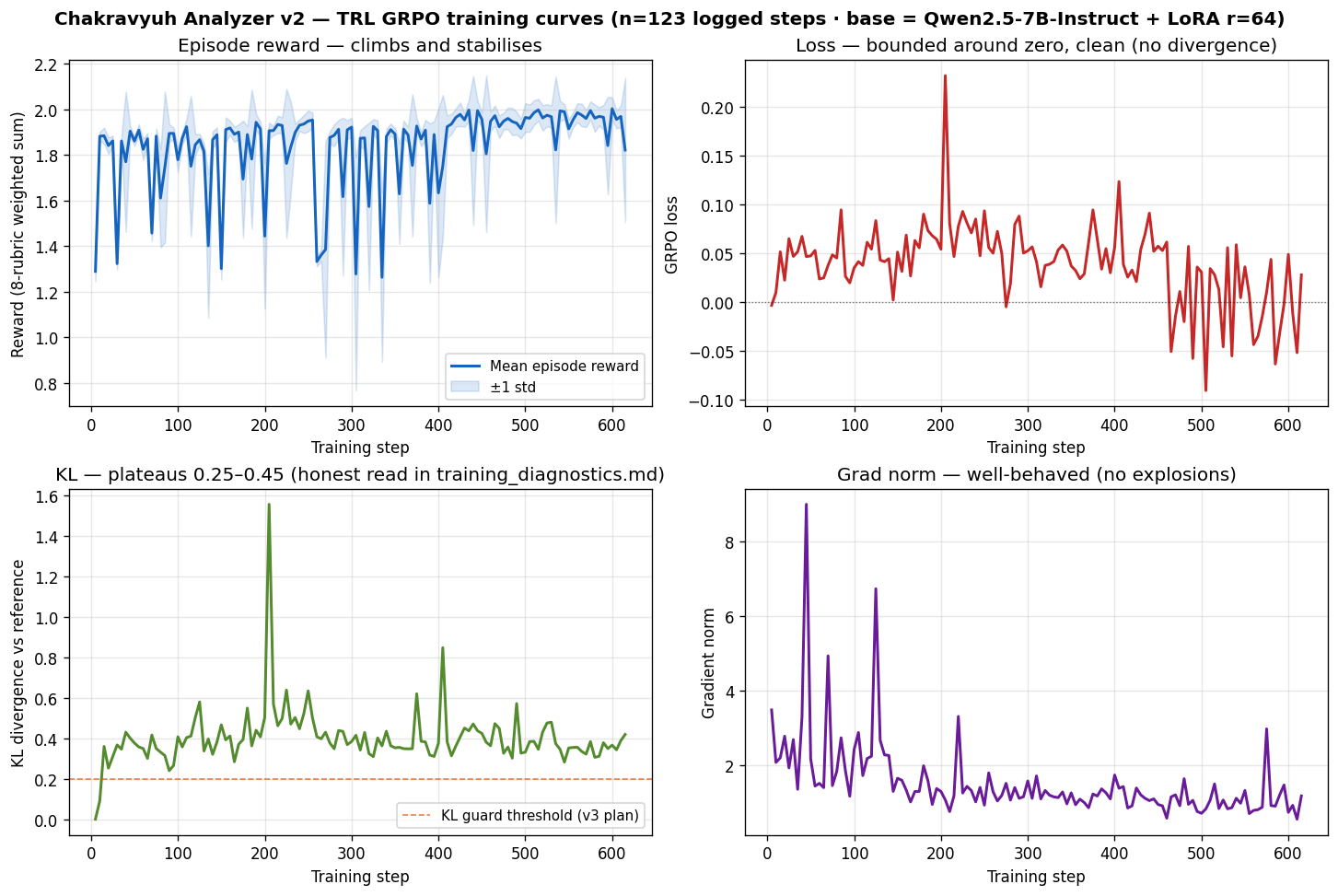
Reproduce with python eval/plot_training_curves.py.
Limitations
- Semantic leakage between training and bench (we audited this ourselves). A MiniLM-L6 cosine-similarity audit (logs/semantic_leakage_audit.json) shows mean cosine 0.80 between bench scenarios and the nearest training text, with 44.8 % of bench at cosine > 0.85 (highly similar) and 18.4 % at cosine > 0.95 (near-duplicates). Implication: the 100 % detection on easy / medium / hard difficulty buckets is partly memorization. The v1 → v2 relative FPR fix is unaffected by leakage (relative comparison on the same bench). v3 closes the absolute generalization gap with a held-out template-family retrain — see the Honest Limitations section in Blog.md.
- Small benign sample (n=30 evaluated, 1 of 31 in bench skipped due to empty text). Wilson 95 % CI on FPR is approximately [1.9 %, 21.3 %]; bootstrap 95 % CI from
logs/bootstrap_v2.jsonis [1.8 %, 20.7 %]. We stand behind the "5× FPR reduction vs v1" claim (statistically real, p ≈ 0.008) but not the precise "6.7 %" figure as a tight point estimate. - Single-seed training. Multi-seed retrains are deferred to v3 and run on the cleaner template-family-held-out split.
- Bench is a proxy. 175 curated scenarios do not span real-world Indian fraud diversity. Production performance will be lower.
- One epoch over 619 templates. More data + more epochs are deferred to v3.
- Language coverage is English-dominant, not 7-language production-grade. Bench v0 distribution is en=161, hi=9, and one sample each of ta/te/kn/bn/mr. The HF Hub
language:field above lists all seven (Hub convention for tag-discoverability), but the bench has placeholder coverage only for the five non-English-non-Hindi languages. Per-language detection eval is v3 work. - KL trajectory plateau. v2's GRPO trajectory plateaued KL at 0.25–0.45 with
clip_ratio = 0for ~600 steps. Honest read in the Training Curves section of the README. v3 includes a KL-early-stop guard. - Threshold-sweep degeneracy. 9 of 13 thresholds in the 0.30–0.85 sweep yield identical detection / FPR — v2 outputs near-binary scores. v3 work includes temperature-scaled logits + reliability diagrams (B.6 in WIN_PLAN).
The Scammer adapter is gated behind HF Hub access controls; intended use and dual-use considerations are documented in the gated-model card. See the gated companion adapter ujjwalpardeshi/chakravyuh-scammer-lora-phase1 for the adversarial Scammer trained against the rule-based defense (B.2 Phase 1: 93.75 % best-of-8 / 100 % held-out novel bypass on n=64; 32.8 % vs this Analyzer LoRA — a 60 pp gap that quantifies co-evolution) — the natural adversarial test case for this defender adapter.
Links
- GitHub: https://github.com/UjjwalPardeshi/Chakravyuh
- OpenEnv Space (live env): https://huggingface.co/spaces/ujjwalpardeshi/chakravyuh
- Bench dataset: https://huggingface.co/datasets/ujjwalpardeshi/chakravyuh-bench-v0 (release pending)
- Hackathon: Meta PyTorch OpenEnv Hackathon 2026, Bangalore
Citation
@software{pardeshi2026chakravyuh,
  title  = {Chakravyuh: A Multi-Agent RL Environment for Indian UPI Fraud Detection},
  author = {Pardeshi, Ujjwal and Kadam, Omkar},
  year   = {2026},
  url    = {https://github.com/UjjwalPardeshi/Chakravyuh}
}
License
MIT — see LICENSE in the source repo.