

problem stringlengths 28 7.48k | solution stringlengths 0 18.5k | answer stringclasses 1
value | problem_type stringclasses 8
values | question_type stringclasses 1
value | source stringclasses 6
values | synthetic bool 1
class | source_dataset stringclasses 1
value | source_split stringclasses 1
value | __index_level_0__ int64 1 111k |
|---|---|---|---|---|---|---|---|---|---|
Problem 3. Triangle $A B C$ is such that $A B<A C$. The perpendicular bisector of side $B C$ intersects lines $A B$ and $A C$ at points $P$ and $Q$, respectively. Let $H$ be the orthocentre of triangle $A B C$, and let $M$ and $N$ be the midpoints of segments $B C$ and $P Q$, respectively. Prove that lines $H M$ and $... |
Solution. We have
$$
\angle A P Q=\angle B P M=90^{\circ}-\angle M B P=90^{\circ}-\angle C B A=\angle H C B
$$
and
$$
\angle A Q P=\angle M Q C=90^{\circ}-\angle Q C M=90^{\circ}-\angle A C B=\angle C B H
$$
From these two equalities, we see that the triangles $A P Q$ and $H C B$ are similar. Moreover, since $M$ a... | proof | Geometry | proof | olympiads | false | nlile/NuminaMath-1.5-proofs-only | train | 1 |
Problem 1. A trapezoid $A B C D(A B \| C D, A B>C D)$ is circumscribed. The incircle of the triangle $A B C$ touches the lines $A B$ and $A C$ at the points $M$ and $N$, respectively. Prove that the incenter of the trapezoid $A B C D$ lies on the line $M N$.
=90^{\circ}-\frac{1}{2} m(\widehat{M A N}) \quad \text { and } \quad m(\widehat{B I C})=90^{\circ}+\frac{1}{2} m(\widehat{M A N})
$$
the quadrilateral $I R N C$ is ... | proof | Geometry | proof | olympiads | false | nlile/NuminaMath-1.5-proofs-only | train | 2 |
Problem 2. Let $a, b$ and $c$ be positive real numbers. Prove that
$$
\frac{8}{(a+b)^{2}+4 a b c}+\frac{8}{(b+c)^{2}+4 a b c}+\frac{8}{(c+a)^{2}+4 a b c}+a^{2}+b^{2}+c^{2} \geq \frac{8}{a+3}+\frac{8}{b+3}+\frac{8}{c+3}
$$
|
Solution. Since $2 a b \leq a^{2}+b^{2}$, it follows that $(a+b)^{2} \leq 2\left(a^{2}+b^{2}\right)$
and $4 a b c \leq 2 c\left(a^{2}+b^{2}\right)$, for any positive reals $a, b, c$.
Adding these inequalities, we find
$$
(a+b)^{2}+4 a b c \leq 2\left(a^{2}+b^{2}\right)(c+1)
$$
so that
$$
\frac{8}{(a+b)^{2}+4 a b ... | proof | Inequalities | proof | olympiads | false | nlile/NuminaMath-1.5-proofs-only | train | 3 |
Problem 4. Let $A B C$ be an acute triangle, $A^{\prime}, B^{\prime}$ and $C^{\prime}$ be the reflections of the vertices $A, B$ and $C$ with respect to $B C, C A$, and $A B$, respectively, and let the circumcircles of triangles $A B B^{\prime}$ and $A C C^{\prime}$ meet again at $A_{1}$. Points $B_{1}$ and $C_{1}$ ar... |
Solution. Let $O_{1}, O_{2}$ and $O$ be the circumcenters of triangles $A B B^{\prime}, A C C^{\prime}$ and $A B C$ respectively. As $A B$ is the perpendicular bisector of the line segment $C C^{\prime}, O_{2}$ is the intersection of the perpendicular bisector of $A C$ with $A B$. Similarly, $O_{1}$ is the intersectio... | proof | Geometry | proof | olympiads | false | nlile/NuminaMath-1.5-proofs-only | train | 4 |
Problem 1. The real numbers $a, b, c, d$ satisfy simultaneously the equations
$$
a b c-d=1, b c d-a=2, c d a-b=3, d a b-c=-6
$$
Prove that $a+b+c+d \neq 0$.
|
Solution. Suppose that $a+b+c+d=0$. Then
$$
a b c+b c d+c d a+d a b=0
$$
If $a b c d=0$, then one of numbers, say $d$, must be 0 . In this case $a b c=0$, and so at least two of the numbers $a, b, c, d$ will be equal to 0 , making one of the given equations impossible. Hence $a b c d \neq 0$ and, from (1),
$$
\frac... | proof | Algebra | proof | olympiads | false | nlile/NuminaMath-1.5-proofs-only | train | 6 |
Problem 3. Let $A B C$ be an acute scalene triangle with circumcenter $O$. Let $D$ be the foot of the altitude from $A$ to the side $B C$. The lines $B C$ and $A O$ intersect at $E$. Let $s$ be the line through $E$ perpendicular to $A O$. The line $s$ intersects $A B$ and $A C$ at $K$ and $L$, respectively. Denote by ... | ## Solution.
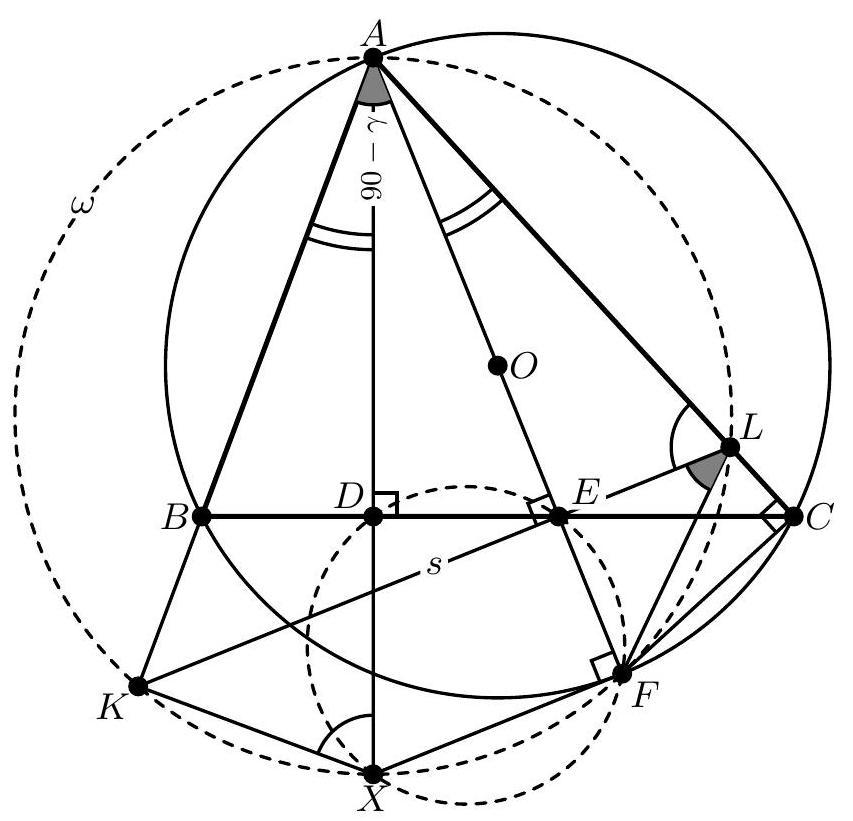
Let us denote angles of triangle $A B C$ with $\alpha, \beta, \gamma$ in a standard way. By basic anglechasing we have
$$
\angle B A D=90^{\circ}-\beta=\angle O A C \text { and ... | proof | Geometry | proof | olympiads | false | nlile/NuminaMath-1.5-proofs-only | train | 8 |
Problem 3. Let $a, b, c$ be positive real numbers such that $a b c=1$. Prove that
$$
\left(a+\frac{1}{b}\right)^{2}+\left(b+\frac{1}{c}\right)^{2}+\left(c+\frac{1}{a}\right)^{2} \geq 3(a+b+c+1)
$$
When does equality hold?
|
Solution 1. By using AM-GM $\left(x^{2}+y^{2}+z^{2} \geq x y+y z+z x\right)$ we have
$$
\begin{aligned}
\left(a+\frac{1}{b}\right)^{2}+\left(b+\frac{1}{c}\right)^{2}+\left(c+\frac{1}{a}\right)^{2} & \geq\left(a+\frac{1}{b}\right)\left(b+\frac{1}{c}\right)+\left(b+\frac{1}{c}\right)\left(c+\frac{1}{a}\right)+\left(c+\... | proof | Inequalities | proof | olympiads | false | nlile/NuminaMath-1.5-proofs-only | train | 9 |
Problem 2. Let $A B C$ be an acute triangle such that $A H=H D$, where $H$ is the orthocenter of $A B C$ and $D \in B C$ is the foot of the altitude from the vertex $A$. Let $\ell$ denote the line through $H$ which is tangent to the circumcircle of the triangle $B H C$. Let $S$ and $T$ be the intersection points of $\... |
Solution 1. In order to prove that $S M$ and $T N$ are parallel, it suffices to prove that both of them are perpendicular to $S T$. Due to symmetry, we will provide a detailed proof of $S M \perp S T$, whereas the proof of $T N \perp S T$ is analogous. In this solution we will use the following notation: $\angle B A C... | proof | Geometry | proof | olympiads | false | nlile/NuminaMath-1.5-proofs-only | train | 10 |
## Problem 2.
Prove that for all non-negative real numbers $x, y, z$, not all equal to 0 , the following inequality holds
$$
\frac{2 x^{2}-x+y+z}{x+y^{2}+z^{2}}+\frac{2 y^{2}+x-y+z}{x^{2}+y+z^{2}}+\frac{2 z^{2}+x+y-z}{x^{2}+y^{2}+z} \geqslant 3
$$
Determine all the triples $(x, y, z)$ for which the equality holds.
|
Solution. Let us first write the expression $L$ on the left hand side in the following way
$$
\begin{aligned}
L & =\left(\frac{2 x^{2}-x+y+z}{x+y^{2}+z^{2}}+2\right)+\left(\frac{2 y^{2}+x-y+z}{x^{2}+y+z^{2}}+2\right)+\left(\frac{2 z^{2}+x+y-z}{x^{2}+y^{2}+z}+2\right)-6 \\
& =\left(2 x^{2}+2 y^{2}+2 z^{2}+x+y+z\right)... | proof | Inequalities | proof | olympiads | false | nlile/NuminaMath-1.5-proofs-only | train | 11 |
Problem 2. Let $\triangle A B C$ be a right-angled triangle with $\angle B A C=90^{\circ}$ and let $E$ be the foot of the perpendicular from $A$ on $B C$. Let $Z \neq A$ be a point on the line $A B$ with $A B=B Z$. Let (c) be the circumcircle of the triangle $\triangle A E Z$. Let $D$ be the second point of intersecti... |
Solution. We will first show that $P A$ is tangent to $(c)$ at $A$.
Since $E, D, Z, A$ are concyclic, then $\angle E D C=\angle E A Z=\angle E A B$. Since also the triangles $\triangle A B C$ and $\triangle E B A$ are similar, then $\angle E A B=\angle B C A$, therefore $\angle E D C=\angle B C A$.
Since $\angle F E... | proof | Geometry | proof | olympiads | false | nlile/NuminaMath-1.5-proofs-only | train | 13 |
Problem 2. Let $x, y, z$ be positive integers such that $x \neq y \neq z \neq x$. Prove that
$$
(x+y+z)(x y+y z+z x-2) \geq 9 x y z
$$
When does the equality hold?
|
Solution. Since $x, y, z$ are distinct positive integers, the required inequality is symmetric and WLOG we can suppose that $x \geq y+1 \geq z+2$. We consider 2 possible cases:
Case 1. $y \geq z+2$. Since $x \geq y+1 \geq z+3$ it follows that
$$
(x-y)^{2} \geq 1, \quad(y-z)^{2} \geq 4, \quad(x-z)^{2} \geq 9
$$
whic... | proof | Inequalities | proof | olympiads | false | nlile/NuminaMath-1.5-proofs-only | train | 14 |
Problem 3. Let $A B C$ be an acute triangle such that $A B \neq A C$, with circumcircle $\Gamma$ and circumcenter $O$. Let $M$ be the midpoint of $B C$ and $D$ be a point on $\Gamma$ such that $A D \perp B C$. Let $T$ be a point such that $B D C T$ is a parallelogram and $Q$ a point on the same side of $B C$ as $A$ su... |
Solution. Let $X^{\prime}$ be symmetric point to $Q$ in line $B C$. Now since $\angle C B A=\angle C Q M=\angle C X^{\prime} M$, $\angle B C A=\angle B Q M=\angle B X^{\prime} M$, we have
$$
\angle B X^{\prime} C=\angle B X^{\prime} M+\angle C X^{\prime} M=\angle C B A+\angle B C A=180^{\circ}-\angle B A C
$$
we hav... | proof | Geometry | proof | olympiads | false | nlile/NuminaMath-1.5-proofs-only | train | 15 |
Problem 3. Let $\triangle A B C$ be an acute triangle. The lines $l_{1}, l_{2}$ are perpendicular to $A B$ at the points $A, B$ respectively. The perpendicular lines from the midpoint $M$ of $A B$ to the sides of the triangle $A C, B C$ intersect the lines $l_{1}, l_{2}$ at the points $E, F$, respectively. If $D$ is t... | ## Solution:
Let $H, G$ be the points of intersection of $M E, M F$ with $A C, B C$ respectively. From the similarity of triangles $\triangle M H A$ and $\triangle M A E$ we get $\frac{M H}{M A}=\frac{M A}{M E}$, thus
$$
M A^{2}=M H \cdot M E
$$
Similarly, from the similarity of triangles $\triangle M B G$ and $\tri... | proof | Geometry | proof | olympiads | false | nlile/NuminaMath-1.5-proofs-only | train | 16 |
A1. Let $a, b, c$ be positive real numbers such that $a+b+c+a b+b c+c a+a b c=7$. Prove that
$$
\sqrt{a^{2}+b^{2}+2}+\sqrt{b^{2}+c^{2}+2}+\sqrt{c^{2}+a^{2}+2} \geq 6
$$
|
Solution. First we see that $x^{2}+y^{2}+1 \geq x y+x+y$. Indeed, this is equivalent to
$$
(x-y)^{2}+(x-1)^{2}+(y-1)^{2} \geq 0
$$
Therefore
$$
\begin{aligned}
& \sqrt{a^{2}+b^{2}+2}+\sqrt{b^{2}+c^{2}+2}+\sqrt{c^{2}+a^{2}+2} \\
\geq & \sqrt{a b+a+b+1}+\sqrt{b c+b+c+1}+\sqrt{c a+c+a+1} \\
= & \sqrt{(a+1)(b+1)}+\sqrt... | proof | Inequalities | proof | olympiads | false | nlile/NuminaMath-1.5-proofs-only | train | 17 |
A3. Let $a, b, c, d$ be real numbers such that $0 \leq a \leq b \leq c \leq d$. Prove the inequality
$$
a b^{3}+b c^{3}+c d^{3}+d a^{3} \geq a^{2} b^{2}+b^{2} c^{2}+c^{2} d^{2}+d^{2} a^{2}
$$
|
Solution. The inequality is equivalent to
$$
\left(a b^{3}+b c^{3}+c d^{3}+d a^{3}\right)^{2} \geq\left(a^{2} b^{2}+b^{2} c^{2}+c^{2} d^{2}+d^{2} a^{2}\right)^{2}
$$
By the Cauchy-Schwarz inequality,
$$
\left(a b^{3}+b c^{3}+c d^{3}+d a^{3}\right)\left(a^{3} b+b^{3} c+c^{3} d+d^{3} a\right) \geq\left(a^{2} b^{2}+b^... | proof | Inequalities | proof | olympiads | false | nlile/NuminaMath-1.5-proofs-only | train | 18 |
A4. Let $x, y, z$ be three distinct positive integers. Prove that
$$
(x+y+z)(x y+y z+z x-2) \geq 9 x y z
$$
When does the equality hold?
|
Solution. Since $x, y, z$ are distinct positive integers, the required inequality is symmetric and WLOG we can suppose that $x \geq y+1 \geq z+2$. We consider 2 possible cases:
Case 1. $y \geq z+2$. Since $x \geq y+1 \geq z+3$ it follows that
$$
(x-y)^{2} \geq 1, \quad(y-z)^{2} \geq 4, \quad(x-z)^{2} \geq 9
$$
whic... | proof | Inequalities | proof | olympiads | false | nlile/NuminaMath-1.5-proofs-only | train | 19 |
G1. Given a parallelogram $A B C D$. The line perpendicular to $A C$ passing through $C$ and the line perpendicular to $B D$ passing through $A$ intersect at point $P$. The circle centered at point $P$ and radius $P C$ intersects the line $B C$ at point $X,(X \neq C)$ and the line $D C$ at point $Y$, $(Y \neq C)$. Pro... |
Solution. Denote the feet of the perpendiculars from $P$ to the lines $B C$ and $D C$ by $M$ and $N$ respectively and let $O=A C \cap B D$. Since the points $O, M$ and $N$ are midpoints of $C A, C X$ and $C Y$ respectively it suffices to prove that $M, N$ and $O$ are collinear. According to Menelaus's theorem for $\tr... | proof | Geometry | proof | olympiads | false | nlile/NuminaMath-1.5-proofs-only | train | 20 |
G2. Let $A B C$ be an acute triangle such that $A B$ is the shortest side of the triangle. Let $D$ be the midpoint of the side $A B$ and $P$ be an interior point of the triangle such that
$$
\Varangle C A P=\Varangle C B P=\Varangle A C B
$$
Denote by $M$ and $N$ the feet of the perpendiculars from $P$ to $B C$ and ... |
Solution. If $\gamma=\Varangle A C B$ then $\Varangle C A P=\Varangle C B P=\Varangle A C B=\gamma$. Let $E=K N \cap A P$ and $F=K M \cap B P$. We show that points $E$ and $F$ are midpoints of $A P$ and $B P$, respectively.
^{2}}{6}
$$
so
|
Solution. By the AM-GM inequality we have $a^{3}+b c \geq 2 \sqrt{a^{3} b c}=2 \sqrt{a^{2}(a b c)}=2 a$ and
$$
\frac{1}{a^{3}+b c} \leq \frac{1}{2 a}
$$
Similarly; $\frac{1}{b^{3}+c a} \leq \frac{1}{2 b} \cdot \frac{1}{c^{3}+a b} \leq \frac{1}{2 c}$ and then
$$
\frac{1}{a^{3}+b c}+\frac{1}{b^{3}+c a}+\frac{1}{c^{3}... | proof | Inequalities | proof | olympiads | false | nlile/NuminaMath-1.5-proofs-only | train | 25 |
A3. Let $a . b$ c ce positue real numbers such that $a+b+c=a^{2}+b^{2}+c^{2}$. Shou that
$$
\frac{a^{2}}{a^{2}+a b}+\frac{b^{2}}{b^{2}+b c}+\frac{c^{2}}{c^{2}+c a} \geq \frac{a+b+c}{2}
$$
|
Solution. By the Cauchy-Schwarz inequality it is
$$
\begin{aligned}
& \left(\frac{a^{2}}{a^{2}+a b}+\frac{b^{2}}{b^{2}+b c}+\frac{c^{2}}{c^{2}+c a}\right)\left(\left(a^{2}+a b\right)+\left(b^{2}+b c\right)+\left(c^{2}+c a\right)\right) \geq(a+b+c)^{2} \\
\Rightarrow & \frac{a^{2}}{a^{2}+a b}+\frac{b^{2}}{b^{2}+b c}+\... | proof | Inequalities | proof | olympiads | false | nlile/NuminaMath-1.5-proofs-only | train | 26 |
G1. Let $A B C$ be an equilateral triangle, and $P$ a point on the circumcircle of the triangle $A B C$ and distinct from $A, B$ and $C$. If the lines through $P$ and parallel to $B C, C A, A B$ intersect the lines $C A, A B, B C$ at $M, N$ and $Q$ respectively, prove that $M, N$ and $Q$ are collinear.
|
Solution. Without any loss of generality, let $P$ be in the minor arc of the chord $A C$ as in Figure 1. Since $\angle P N A=\angle N P M=60^{\circ}$ and $\angle N A M=\angle P M A=120^{\circ}$, it follows that the points $A, M, P$ and $N$ are concyclic. This yields
$$
\angle N M P=\angle N A P
$$
\left(b+2 a+\frac{2}{b+1}\right) \geq 16
$$
for all positive real numbers $a, b$ satisfying $a b \geq 1$.
|
Solution 1. By the AM-GM Inequality we have:
$$
\frac{a+1}{2}+\frac{2}{a+1} \geq 2
$$
Therefore
$$
a+2 b+\frac{2}{a+1} \geq \frac{a+3}{2}+2 b
$$
and, similarly,
$$
b+2 a+\frac{2}{b+1} \geq 2 a+\frac{b+3}{2}
$$
On the other hand,
$$
(a+4 b+3)(b+4 a+3) \geq(\sqrt{a b}+4 \sqrt{a b}+3)^{2} \geq 64
$$
by the Cauchy... | proof | Inequalities | proof | olympiads | false | nlile/NuminaMath-1.5-proofs-only | train | 29 |
G1. Let $A B$ be a diameter of a circle $\omega$ with center $O$ and $O C$ be a radius of $\omega$ which is perpendicular to $A B$. Let $M$ be a point on the line segment $O C$. Let $N$ be the second point of intersection of the line $A M$ with $\omega$, and let $P$ be the point of intersection of the lines tangent to... |
Solution. Since the lines $P N$ and $B P$ are tangent to $\omega, N P=P B$ and $O P$ is the bisector of $\angle N O B$. Therefore the lines $O P$ and $N B$ are perpendicular. Since $\angle A N B=90^{\circ}$, it follows that the lines $A N$ and $O P$ are parallel. As $M O$ and $P B$ are also parallel and $A O=O B$, the... | proof | Geometry | proof | olympiads | false | nlile/NuminaMath-1.5-proofs-only | train | 30 |
G3. Let $D$ be a point on the side $B C$ of an acute triangle $A B C$ such that $\angle B A D=\angle C A O$ where $O$ is the center of the circumcircle $\omega$ of the triangle $A B C$. Let $E$ be the second point of intersection of $\omega$ and the line $A D$. Let $M, N, P$ be the midpoints of the line segments $B E,... |
Solution. We will show that $M O P D$ is a parallelogram. From this it follows that $M, N$, $P$ are collinear.
Since $\angle B A D=\angle C A O=90^{\circ}-\angle A B C, D$ is the foot of the perpendicular from $A$ to side $B C$. Since $M$ is the midpoint of the line segment $B E$, we have $B M=M E=M D$ and hence $\an... | proof | Geometry | proof | olympiads | false | nlile/NuminaMath-1.5-proofs-only | train | 31 |
G4. Let $I$ be the incenter and $A B$ the shortest side of a triangle $A B C$. The circle with center $I$ and passing through $C$ intersects the ray $A B$ at the point $P$ and the ray $B A$ at the point $Q$. Let $D$ be the point where the excircle of the triangle $A B C$ belonging to angle $A$ touches the side $B C$, ... |
Solution. First we will show that points $P$ and $Q$ are not on the line segment $A B$.
Assume that $Q$ is on the line segment $A B$. Since $C I=Q I$ and $\angle I B Q=\angle I B C$, either the triangles $C B I$ and $Q B I$ are congruent or $\angle I C B+\angle I Q B=180^{\circ}$. In the first case, we have $B C=B Q$... | proof | Geometry | proof | olympiads | false | nlile/NuminaMath-1.5-proofs-only | train | 32 |
G5. A circle passing through the midpoint $M$ of the side $B C$ and the vertex $A$ of a triangle $A B C$ intersects the sides $A B$ and $A C$ for the second time at the points $P$ and $Q$, respectively. Show that if $\angle B A C=60^{\circ}$ then
$$
A P+A Q+P Q<A B+A C+\frac{1}{2} B C
$$
|
Solution. Since the quadrilateral $A P M Q$ is cyclic, we have $\angle P M Q=180^{\circ}-\angle P A Q=$ $180^{\circ}-\angle B A C=120^{\circ}$. Therefore $\angle P M B+\angle Q M C=180^{\circ}-\angle P M Q=60^{\circ}$.
Let the point $B^{\prime}$ be the symmetric of the point $B$ with respect to the line $P M$ and the... | proof | Geometry | proof | olympiads | false | nlile/NuminaMath-1.5-proofs-only | train | 33 |
## A5 MKCD
Let $x, y, z$ be positive real numbers that satisfy the equality $x^{2}+y^{2}+z^{2}=3$. Prove that
$$
\frac{x^{2}+y z}{x^{2}+y z+1}+\frac{y^{2}+z x}{y^{2}+z x+1}+\frac{z^{2}+x y}{z^{2}+x y+1} \leq 2
$$
| ## Solution:
We have
$$
\begin{aligned}
& \frac{x^{2}+y z}{x^{2}+y z+1}+\frac{y^{2}+z x}{y^{2}+z x+1}+\frac{z^{2}+x y}{z^{2}+x y+1} \leq 2 \Leftrightarrow \\
& \frac{x^{2}+y z+1}{x^{2}+y z+1}+\frac{y^{2}+z x+1}{y^{2}+z x+1}+\frac{z^{2}+x y+1}{z^{2}+x y+1} \leq 2+\frac{1}{x^{2}+y z+1}+\frac{1}{y^{2}+z x+1}+\frac{1}{z^... | proof | Inequalities | proof | olympiads | false | nlile/NuminaMath-1.5-proofs-only | train | 35 |
## G1 MNE
Around the triangle $A B C$ the circle is circumscribed, and at the vertex $C$ tangent $t$ to this circle is drawn. The line $p$ which is parallel to this tangent intersects the lines $B C$ and $A C$ at the points $D$ and $E$, respectively. Prove that the points $A, B, D, E$ belong to the same circle.
| ## Solution:
Let $O$ be the center of a circumscribed circle $k$ of the triangle $A B C$, and let $F$ and $G$ be the points of intersection of the line $C O$ with the line $p$ and the circle $k$, respectively (see Figure). From $p \| t$ it follows that $p \perp C O$. Furthermore, $\angle A B C=\angle A G C$, because t... | proof | Geometry | proof | olympiads | false | nlile/NuminaMath-1.5-proofs-only | train | 36 |
## G2 MLD
The point $P$ is outside of the circle $\Omega$. Two tangent lines, passing from the point $P$, touch the circle $\Omega$ at the points $A$ and $B$. The median $A M, M \in(B P)$, intersects the circle $\Omega$ at the point $C$ and the line $P C$ intersects again the circle $\Omega$ at the point $D$. Prove th... | ## Solution:
Since $\angle B A C=\angle B A M=\angle M B C$, we have $\triangle M A B \cong \triangle M B C$.
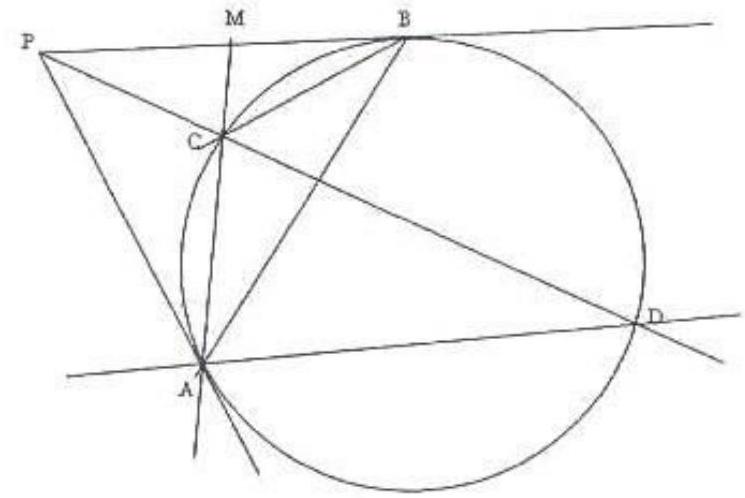
We obtain $\frac{M A}{M B}=\frac{M B}{M C}=\frac{A B}{B C}$. The equality $\qua... | proof | Geometry | proof | olympiads | false | nlile/NuminaMath-1.5-proofs-only | train | 37 |
## G3 GRE
Let $c \equiv c(O, K)$ be a circle with center $O$ and radius $R$ and $A, B$ be two points on it, not belonging to the same diameter. The bisector of the angle $A \hat{B} O$ intersects the circle $c$ at point $C$, the circumcircle of the triangle $A O B$, say ${ }^{c_{1}}$ at point $K$ and the circumcircle o... | ## Solution:
The segments $O B, O C$ are equal, as radii of the circle ${ }^{c}$. Hence $O B C$ is an isosceles triangle and
$$
\hat{B}_{1}=\hat{C}_{1}=\hat{x}
$$
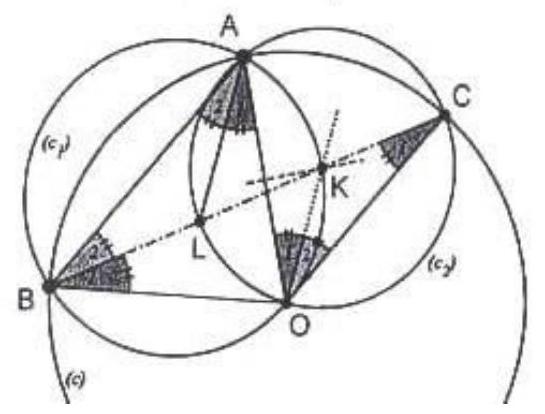
The chord $B C$ is the b... | proof | Geometry | proof | olympiads | false | nlile/NuminaMath-1.5-proofs-only | train | 38 |
G4
CYP
Let $\triangle A B C$ be an acute triangle. The lines $\left(\varepsilon_{1}\right),\left(\varepsilon_{2}\right)$ are perpendicular to $A B$ at the points $A$, $B$, respectively. The perpendicular lines from the midpoint $M$ of $A B$ to the sides of the triangle $A C_{;} B C$ intersect the lines $\left(\varep... | ## Solution:
Let $H, G$ be the points of intersection of $M E, M F$, with $A C, B C$ respectively. From the similarity of triangles $\triangle M H A$ and $\triangle M A E$ we get
$$
\frac{M H}{M A}=\frac{M A}{M E}
$$
thus, $M A^{2}=M H \cdot M E$
Similarly, from the similarity of triangles $\triangle M B G$ and $\t... | proof | Geometry | proof | olympiads | false | nlile/NuminaMath-1.5-proofs-only | train | 39 |
G5 ROU
Let $A B C$ be an acute triangle with $A B \neq A C$. The incircle $\omega$ of the triangle touches the sides $B C, C A$ and $A B$ at $D, E$ and $F$, respectively. The perpendicular line erected at $C$ onto $B C$ meets $E F$ at $M$, and similarly, the perpendicular line erected at $B$ onto $B C$ meets $E F$ at... | ## Solution:
## Proof 1.1.
Let $\{T\}=E F \cap B C$. Applying Menelaus' theorem to the triangle $A B C$ and the transversal line $E-F-T$ we obtain $\frac{T B}{T C} \cdot \frac{E C}{E A} \cdot \frac{F A}{F B}=1$, i.e. $\frac{T B}{T C} \cdot \frac{s-c}{s-a} \cdot \frac{s-a}{s-b}=1$, or $\frac{T B}{T C}=\frac{s-b}{s-c}$... | proof | Geometry | proof | olympiads | false | nlile/NuminaMath-1.5-proofs-only | train | 40 |
NT2 BUL
A positive integer is called a repunit, if it is written only by ones. The repunit with $n$ digits will be denoted by $\underbrace{11 \ldots 1}_{n}$. Prove that:
a) the repunit $\underbrace{11 \ldots 1}_{n}$ is divisible by 37 if and only if $n$ is divisible by 3 ;
b) there exists a positive integer $k$ suc... | ## Solution:
a) Let $n=3 m+r$, where $m$ and $r$ are non-negative integers and $r<3$.
Denote by $\underbrace{00 \ldots 0}_{p}$ a recording with $p$ zeroes and $\underbrace{a b c a b c \ldots a b c}_{p x a b c c}$ recording with $p$ times $a b c$. We
have: $\quad \underbrace{11 \ldots 1}_{n}=\underbrace{11 \ldots 1}_... | proof | Number Theory | proof | olympiads | false | nlile/NuminaMath-1.5-proofs-only | train | 41 |
## NT3 ALB
a) Show that the product of all differences of possible couples of six given positive integers is divisible by 960 (original from Albania).
b) Show that the product of all differences of possible couples of six given positive integers. is divisible by 34560 (modified by problem selecting committee).
| ## Solution:
a) Since we have six numbers then at least two of them have a same residue when divided by 3 , so at least one of the differences in our product is divisible by 3 .
Since we have six numbers then at least two of them have a same residuc when divided by 5 , so at least one of the differences in our produc... | proof | Number Theory | proof | olympiads | false | nlile/NuminaMath-1.5-proofs-only | train | 42 |
A1 Let $a$ be a real positive number such that $a^{3}=6(a+1)$. Prove that the equation $x^{2}+a x+a^{2}-6=0$ has no solution in the set of the real number.
| ## Solution
The discriminant of the equation is $\Delta=3\left(8-a^{2}\right)$. If we accept that $\Delta \geq 0$, then $a \leq 2 \sqrt{2}$ and $\frac{1}{a} \geq \frac{\sqrt{2}}{4}$, from where $a^{2} \geq 6+6 \cdot \frac{\sqrt{2}}{4}=6+\frac{6}{a} \geq 6+\frac{3 \sqrt{2}}{2}>8$ (contradiction).
| proof | Algebra | proof | olympiads | false | nlile/NuminaMath-1.5-proofs-only | train | 43 |
A2 Prove that $\frac{a^{2}-b c}{2 a^{2}+b c}+\frac{b^{2}-c a}{2 b^{2}+c a}+\frac{c^{2}-a b}{2 c^{2}+a b} \leq 0$ for any real positive numbers $a, b, c$.
| ## Solution
The inequality rewrites as $\sum \frac{2 a^{2}+b c-3 b c}{2 a^{2}+b c} \leq 0$, or $3-3 \sum \frac{b c}{2 a^{2}+b c} \leq 0$ in other words $\sum \frac{b c}{2 a^{2}+b c} \geq 1$.
Using Cauchy-Schwarz inequality we have
$$
\sum \frac{b c}{2 a^{2}+b c}=\sum \frac{b^{2} c^{2}}{2 a^{2} b c+b^{2} c^{2}} \geq ... | proof | Inequalities | proof | olympiads | false | nlile/NuminaMath-1.5-proofs-only | train | 44 |
A3 Let $A$ be a set of positive integers containing the number 1 and at least one more element. Given that for any two different elements $m, n$ of $A$ the number $\frac{m+1}{(m+1, n+1)}$ is also an element of $A$, prove that $A$ coincides with the set of positive integers.
| ## Solution
Let $a>1$ be lowest number in $A \backslash\{1\}$. For $m=a, n=1$ one gets $y=\frac{a+1}{(2, a+1)} \in A$. Since $(2, a+1)$ is either 1 or 2 , then $y=a+1$ or $y=\frac{a+1}{2}$.
But $1<\frac{a+1}{2}<a$, hence $y=a+1$. Applying the given property for $m=a+1, n=a$ one has $\frac{a+2}{(a+2, a+1)}=a+2 \in A$,... | proof | Number Theory | proof | olympiads | false | nlile/NuminaMath-1.5-proofs-only | train | 45 |
A4 Let $a$ and $b$ be positive integers bigger than 2. Prove that there exists a positive integer $k$ and a sequence $n_{1}, n_{2}, \ldots, n_{k}$ consisting of positive integers, such that $n_{1}=a$, $n_{k}=b$, and $\left(n_{i}+n_{i+1}\right) \mid n_{i} n_{i+1}$ for all $i=1,2, \ldots, k-1$.
| ## Solution
We write $a \Leftrightarrow b$ if the required sequence exists. It is clear that $\Leftrightarrow$ is equivalence relation, i.e. $a \Leftrightarrow a,(a \Leftrightarrow b$ implies $b \Rightarrow a)$ and $(a \Leftrightarrow b, b \Leftrightarrow c$ imply $a \Leftrightarrow c$ ).
We shall prove that for ever... | proof | Number Theory | proof | olympiads | false | nlile/NuminaMath-1.5-proofs-only | train | 46 |
A5 The real numbers $x, y, z, m, n$ are positive, such that $m+n \geq 2$. Prove that
$$
\begin{gathered}
x \sqrt{y z(x+m y)(x+n z)}+y \sqrt{x z(y+m x)(y+n z)}+z \sqrt{x y(z+m x)(x+n y)} \leq \\
\frac{3(m+n)}{8}(x+y)(y+z)(z+x) .
\end{gathered}
$$
| ## Solution
Using the AM-GM inequality we have
$$
\begin{aligned}
& \sqrt{y z(x+m y)(x+n z)}=\sqrt{(x z+m y z)(x y+n y z)} \leq \frac{x y+x z+(m+n) y z}{2} \\
& \sqrt{x z(y+m x)(y+n z)}=\sqrt{(y z+m x z)(x y+n x z)} \leq \frac{x y+y z+(m+n) x z}{2} \\
& \sqrt{x y(z+m x)(z+n y)}=\sqrt{(y z+m x y)(x z+n x y)} \leq \fra... | proof | Inequalities | proof | olympiads | false | nlile/NuminaMath-1.5-proofs-only | train | 47 |
C1 We call a tiling of an $m \times n$ rectangle with corners (see figure below) "regular" if there is no sub-rectangle which is tiled with corners. Prove that if for some $m$ and $n$ there exists a "regular" tiling of the $m \times n$ rectangular then there exists a "regular" tiling also for the $2 m \times 2 n$ rect... | ## Solution
A corner-shaped tile consists of 3 squares. Let us call "center of the tile" the square that has two neighboring squares. Notice that in a "regular" tiling, the squares situated in the corners of the rectangle have to be covered by the "center" of a tile, otherwise a $2 \times 3$ (or $3 \times 2$ ) rectang... | proof | Combinatorics | proof | olympiads | false | nlile/NuminaMath-1.5-proofs-only | train | 48 |
G1 Let $M$ be an interior point of the triangle $A B C$ with angles $\varangle B A C=70^{\circ}$ and $\varangle A B C=80^{\circ}$. If $\varangle A C M=10^{\circ}$ and $\varangle C B M=20^{\circ}$, prove that $A B=M C$.
| ## Solution
Let $O$ be the circumcenter of the triangle $A B C$. Because the triangle $A B C$ is acute, $O$ is in the interior of $\triangle A B C$. Now we have that $\varangle A O C=2 \varangle A B C=160^{\circ}$, so $\varangle A C O=10^{\circ}$ and $\varangle B O C=2 \varangle B A C=140^{\circ}$, so $\varangle C B O... | proof | Geometry | proof | olympiads | false | nlile/NuminaMath-1.5-proofs-only | train | 50 |
G4 Let $S$ be a point inside $\varangle p O q$, and let $k$ be a circle which contains $S$ and touches the legs $O p$ and $O q$ in points $P$ and $Q$ respectively. Straight line $s$ parallel to $O p$ from $S$ intersects $O q$ in a point $R$. Let $T$ be the point of intersection of the ray $(P S$ and circumscribed circ... | ## Solution
Let $\varangle O P S=\varphi_{1}$ and $\varangle O Q S=\varphi_{2}$. We have that $\varangle O P S=\varangle P Q S=\varphi_{1}$ and $\varangle O Q S=$ $\varangle Q P S=\varphi_{2}$ (tangents to circle $k$ ).
Because $R S \| O P$ we have $\varangle O P S=\varangle R S T=\varphi_{1}$ and $\varangle R Q T=\v... | proof | Geometry | proof | olympiads | false | nlile/NuminaMath-1.5-proofs-only | train | 51 |
NT2 Prove that the equation $x^{2006}-4 y^{2006}-2006=4 y^{2007}+2007 y$ has no solution in the set of the positive integers.
| ## Solution
We assume the contrary is true. So there are $x$ and $y$ that satisfy the equation. Hence we have
$$
\begin{gathered}
x^{2006}=4 y^{2007}+4 y^{2006}+2007 y+2006 \\
x^{2006}+1=4 y^{2006}(y+1)+2007(y+1) \\
x^{2006}+1=\left(4 y^{2006}+2007\right)(y+1)
\end{gathered}
$$
But $4 y^{2006}+2007 \equiv 3(\bmod 4)... | proof | Number Theory | proof | olympiads | false | nlile/NuminaMath-1.5-proofs-only | train | 52 |
NT3 Let $n>1$ be a positive integer and $p$ a prime number such that $n \mid(p-1)$ and $p \mid\left(n^{6}-1\right)$. Prove that at least one of the numbers $p-n$ and $p+n$ is a perfect square.
| ## Solution
Since $n \mid p-1$, then $p=1+n a$, where $a \geq 1$ is an integer. From the condition $p \mid n^{6}-1$, it follows that $p|n-1, p| n+1, p \mid n^{2}+n+1$ or $p \mid n^{2}-n+1$.
- Let $p \mid n-1$. Then $n \geq p+1>n$ which is impossible.
- Let $p \mid n+1$. Then $n+1 \geq p=1+n a$ which is possible only ... | proof | Number Theory | proof | olympiads | false | nlile/NuminaMath-1.5-proofs-only | train | 53 |
NT4 Let $a, b$ be two co-prime positive integers. A number is called good if it can be written in the form $a x+b y$ for non-negative integers $x, y$. Define the function $f: \mathbb{Z} \rightarrow \mathbb{Z}$ as $f(n)=n-n_{a}-n_{b}$, where $s_{t}$ represents the remainder of $s$ upon division by $t$. Show that an int... | ## Solution
If $n$ is good then $n=a x+b y$ also $n_{a}=(b y)_{a}$ and $n_{b}=(a x)_{b}$ so
$$
f(n)=a x-(a x)_{b}+b y-(b y)_{a}=b y^{\prime}+a x^{\prime}
$$
is also good, thus the sequence contains only good numbers which are non-negative.
Now we have to prove that if the sequence contains only non-negative integer... | proof | Number Theory | proof | olympiads | false | nlile/NuminaMath-1.5-proofs-only | train | 54 |
NT5 Let $p$ be a prime number. Show that $7 p+3^{p}-4$ is not a perfect square.
| ## Solution
Assume that for a prime number $p$ greater than $3, m=7 p+3^{p}-4$ is a perfect square. Let $m=n^{2}$ for some $n \in \mathbb{Z}$. By Fermat's Little Theorem,
$$
m=7 p+3^{p}-4 \equiv 3-4 \equiv-1 \quad(\bmod p)
$$
If $p=4 k+3, k \in \mathbb{Z}$, then again by Fermat's Little Theorem
$$
-1 \equiv m^{2 k+... | proof | Number Theory | proof | olympiads | false | nlile/NuminaMath-1.5-proofs-only | train | 55 |
## A3
Let $a, b, c$ be positive real numbers such that $a b c=1$. Prove that:
$$
\left(a+\frac{1}{b}\right)^{2}+\left(b+\frac{1}{c}\right)^{2}+\left(c+\frac{1}{a}\right)^{2} \geq 3(a+b+c+1)
$$
When does equality hold?
|
Solution1. By using AM-GM $\left(x^{2}+y^{2}+z^{2} \geq x y+y z+z x\right)$ we have
$$
\begin{aligned}
\left(a+\frac{1}{b}\right)^{2}+\left(b+\frac{1}{c}\right)^{2}+\left(c+\frac{1}{a}\right)^{2} & \geq\left(a+\frac{1}{b}\right)\left(b+\frac{1}{c}\right)+\left(b+\frac{1}{c}\right)\left(c+\frac{1}{a}\right)+\left(c+\f... | proof | Inequalities | proof | olympiads | false | nlile/NuminaMath-1.5-proofs-only | train | 57 |
## A4
Let $a, b, c$ be positive real numbers such that $a+b+c=1$. Prove that
$$
\frac{7+2 b}{1+a}+\frac{7+2 c}{1+b}+\frac{7+2 a}{1+c} \geq \frac{69}{4}
$$
When does equality hold?
|
Solution1. The inequality can be written as: $\frac{5+2(1+b)}{1+a}+\frac{5+2(1+c)}{1+b}+\frac{5+2(1+a)}{1+c} \geq \frac{69}{4}$.
We substitute $1+a=x, 1+b=y, 1+c=z$.
So, we have to prove the inequality
$$
\frac{5+2 y}{x}+\frac{5+2 z}{y}+\frac{5+2 x}{z} \geq \frac{69}{4} \Leftrightarrow 5\left(\frac{1}{x}+\frac{1}{y... | proof | Inequalities | proof | olympiads | false | nlile/NuminaMath-1.5-proofs-only | train | 58 |
## A6
Let $a, b, c$ be positive real numbers. Prove that
$$
\left(\left(3 a^{2}+1\right)^{2}+2\left(1+\frac{3}{b}\right)^{2}\right)\left(\left(3 b^{2}+1\right)^{2}+2\left(1+\frac{3}{c}\right)^{2}\right)\left(\left(3 c^{2}+1\right)^{2}+2\left(1+\frac{3}{a}\right)^{2}\right) \geq 48^{3}
$$
When does equality hold?
|
Solution. Let $x$ be a positive real number. By AM-GM we have $\frac{1+x+x+x}{4} \geq x^{\frac{3}{4}}$, or equivalently $1+3 x \geq 4 x^{\frac{3}{4}}$. Using this inequality we obtain:
$$
\left(3 a^{2}+1\right)^{2} \geq 16 a^{3} \text { and } 2\left(1+\frac{3}{b}\right)^{2} \geq 32 b^{-\frac{3}{2}}
$$
Moreover, by i... | proof | Inequalities | proof | olympiads | false | nlile/NuminaMath-1.5-proofs-only | train | 59 |
## A8
Let $x, y$ and $z$ be positive real numbers such that $x y z=1$. Prove the inequality
$$
\frac{1}{x(a y+b)}+\frac{1}{y(a z+b)}+\frac{1}{z(a x+b)} \geq 3 \text {, if: }
$$
a) $a=0$ and $b=1$;
b) $a=1$ and $b=0$;
c) $a+b=1$ for $a, b>0$
When does the equality hold true?
|
Solution. a) The inequality reduces to $\frac{1}{x}+\frac{1}{y}+\frac{1}{z} \geq 3$, which follows directly from the AM-GM inequality.
Equality holds only when $x=y=z=1$.
b) Here the inequality reduces to $\frac{1}{x y}+\frac{1}{y z}+\frac{1}{z x} \geq 3$, i.e. $x+y+z \geq 3$, which also follows from the AM-GM inequ... | proof | Inequalities | proof | olympiads | false | nlile/NuminaMath-1.5-proofs-only | train | 60 |
## A9
Let $n$ be a positive integer, and let $x_{1}, \ldots, x_{n}, y_{1}, \ldots, y_{n}$ be positive real numbers such that $x_{1}+\ldots+x_{n}=y_{1}+\ldots+y_{n}=1$. Show that
$$
\left|x_{1}-y_{1}\right|+\ldots\left|x_{n}-y_{n}\right| \leq 2-\min _{1 \leq i \leq n} \frac{x_{i}}{y_{i}}-\min _{1 \leq i \leq n} \frac{... |
Solution. Up to reordering the real numbers $x_{i}$ and $y_{i}$, we may assume that $\frac{x_{1}}{y_{1}} \leq \ldots \leq \frac{x_{n}}{y_{n}}$. Let $A=\frac{x_{1}}{y_{1}}$ and $B=\frac{x_{n}}{y_{n}}$, and $\mathrm{S}=\left|x_{1}-y_{1}\right|+\ldots\left|x_{n}-y_{n}\right|$. Our aim is to prove that $S \leq 2-A-\frac{1... | proof | Inequalities | proof | olympiads | false | nlile/NuminaMath-1.5-proofs-only | train | 61 |
## C1
Several (at least two) segments are drawn on a board. Select two of them, and let $a$ and $b$ be their lengths. Delete the selected segments and draw a segment of length $\frac{a b}{a+b}$. Continue this procedure until only one segment remains on the board. Prove:
a) the length of the last remaining segment doe... |
Solution. a) Observe that $\frac{1}{\frac{a b}{a+b}}=\frac{1}{a}+\frac{1}{b}$. Thus, if the lengths of the initial segments on the board were $a_{1}, a_{2}, \ldots, a_{n}$, and $c$ is the length of the last remaining segment, then $\frac{1}{c}=\frac{1}{a_{1}}+\frac{1}{a_{2}}+\ldots+\frac{1}{a_{n}}$ , proving a).
b) F... | proof | Algebra | proof | olympiads | false | nlile/NuminaMath-1.5-proofs-only | train | 62 |
## G2
Let $A B C$ be an acute triangle with $\overline{A B}<\overline{A C}<\overline{B C}$ and $c(O, R)$ be its circumcircle. Denote with $D$ and $E$ be the points diametrically opposite to the points $B$ and $C$, respectively. The circle $c_{1}(A, \overline{A E})$ intersects $\overline{A C}$ at point $K$, the circle ... |
Solution. Let $\mathrm{M}$ be the point of intersection of the line $D L$ with the circle $c(O, R)$ (we choose $M \equiv D$ if $L D$ is tangent to $c$ and $M$ to be the second intersecting point otherwise). It is
$. Denote the midpoint of the arc $A C$ which contains point BbyM. The circumcircle of the triangle $B D M$ intersects the segment $A B$ at point $K \neq B$, and let $J$ ... | ## Solution1.
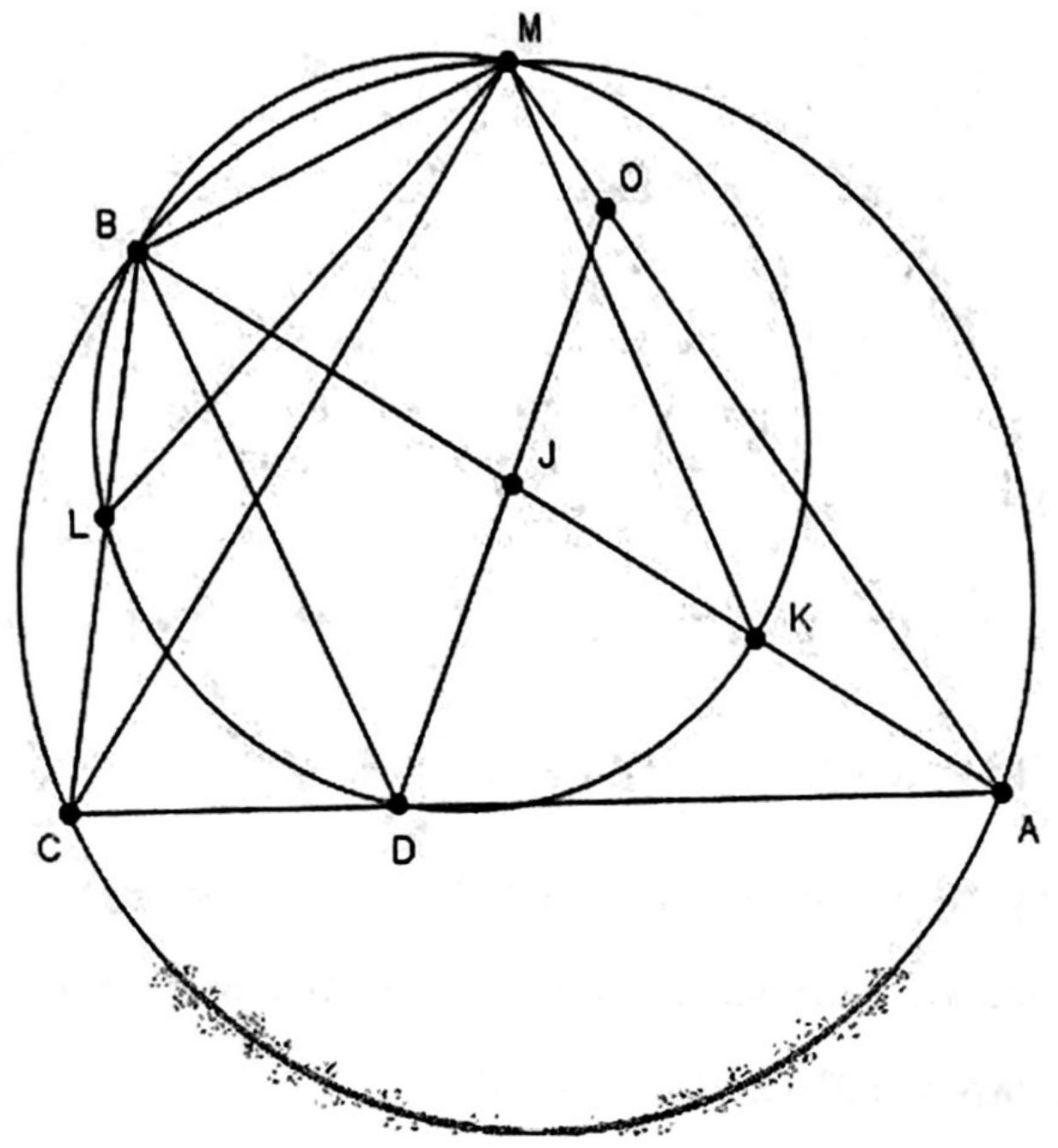
Let the circumcircle of the triangle $B D M$ intersect the line segment $B C$ at point $L \neq B$. From $\measuredangle C B D=\measuredangle D B A$ we have $\overline{D L}=\... | proof | Geometry | proof | olympiads | false | nlile/NuminaMath-1.5-proofs-only | train | 65 |
## G6
Let $A B C D$ be a quadrilateral whose sides $A B$ and $C D$ are not parallel, and let $O$ be the intersection of its diagonals. Denote with $H_{1}$ and $H_{2}$ the orthocenters of the triangles $O A B$ and OCD, respectively. If $M$ and $N$ are the midpoints of the segments $\overline{A B}$ and $\overline{C D}$,... | ## Solution.
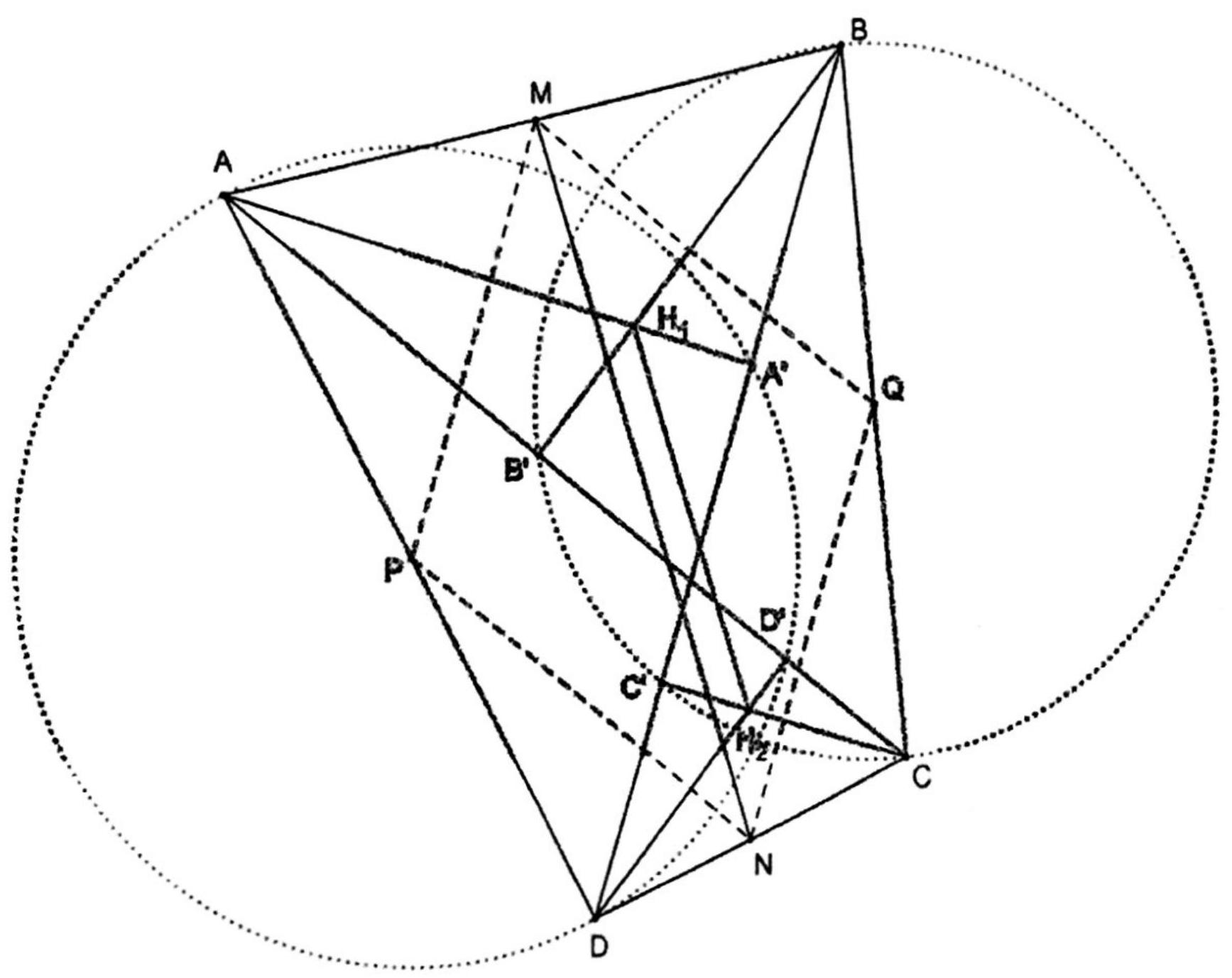
Let $A^{\prime}$ and $B^{\prime}$ be the feet of the altitudes drawn from $A$ and $B$ respectively in the triangle $A O B$, and $C^{\prime}$ and $D^{\prime}$ are the feet of ... | proof | Geometry | proof | olympiads | false | nlile/NuminaMath-1.5-proofs-only | train | 66 |
N4
Prove there are no integers $a$ and $b$ satisfying the following conditions:
i) $16 a-9 b$ is a prime number
ii) $\quad a b$ is a perfect square
iii) $a+b$ is a perfect square
|
Solution. Suppose $a$ and $b$ be integers satisfying the given conditions. Let $p$ be a prime number, $n$ and $m$ be integers. Then we can write the conditions as follows:
$$
\begin{aligned}
& 16 a-9 b=p \\
& a b=n^{2} \\
& a+b=m^{2}
\end{aligned}
$$
Moreover, let $d=g d c(a, b)$ and $a=d x, b=d y$ for some relative... | proof | Number Theory | proof | olympiads | false | nlile/NuminaMath-1.5-proofs-only | train | 67 |
A2. Let $a, b, c$ be positive real numbers such that $a b c=\frac{2}{3}$. Prove that
$$
\frac{a b}{a+b}+\frac{b c}{b+c}+\frac{c a}{c+a} \geqslant \frac{a+b+c}{a^{3}+b^{3}+c^{3}}
$$
|
Solution. The given inequality is equivalent to
$$
\left(a^{3}+b^{3}+c^{3}\right)\left(\frac{a b}{a+b}+\frac{b c}{b+c}+\frac{c a}{c+a}\right) \geqslant a+b+c
$$
By the AM-GM Inequality it follows that
$$
a^{3}+b^{3}=\frac{a^{3}+a^{3}+b^{3}}{3}+\frac{b^{3}+b^{3}+a^{3}}{3} \geqslant a^{2} b+b^{2} a=a b(a+b)
$$
Simil... | proof | Inequalities | proof | olympiads | false | nlile/NuminaMath-1.5-proofs-only | train | 69 |
A4. Let $a, b$ be two distinct real numbers and let $c$ be a positive real number such that
$$
a^{4}-2019 a=b^{4}-2019 b=c
$$
Prove that $-\sqrt{c}<a b<0$.
|
Solution. Firstly, we see that
$$
2019(a-b)=a^{4}-b^{4}=(a-b)(a+b)\left(a^{2}+b^{2}\right)
$$
Since $a \neq b$, we get $(a+b)\left(a^{2}+b^{2}\right)=2019$, so $a+b \neq 0$. Thus
$$
\begin{aligned}
2 c & =a^{4}-2019 a+b^{4}-2019 b \\
& =a^{4}+b^{4}-2019(a+b) \\
& =a^{4}+b^{4}-(a+b)^{2}\left(a^{2}+b^{2}\right) \\
& ... | proof | Algebra | proof | olympiads | false | nlile/NuminaMath-1.5-proofs-only | train | 70 |
A5. Let $a, b, c, d$ be positive real numbers such that $a b c d=1$. Prove the inequality
$$
\frac{1}{a^{3}+b+c+d}+\frac{1}{a+b^{3}+c+d}+\frac{1}{a+b+c^{3}+d}+\frac{1}{a+b+c+d^{3}} \leqslant \frac{a+b+c+d}{4}
$$
|
Solution. From the Cauchy-Schwarz Inequality, we obtain
$$
(a+b+c+d)^{2} \leqslant\left(a^{3}+b+c+d\right)\left(\frac{1}{a}+b+c+d\right)
$$
Using this, together with the other three analogous inequalities, we get
$$
\begin{aligned}
\frac{1}{a^{3}+b+c+d}+\frac{1}{a+b^{3}+c+d}+\frac{1}{a+b+c^{3}+d} & +\frac{1}{a+b+c+... | proof | Inequalities | proof | olympiads | false | nlile/NuminaMath-1.5-proofs-only | train | 71 |
A6. Let $a, b, c$ be positive real numbers. Prove the inequality
$$
\left(a^{2}+a c+c^{2}\right)\left(\frac{1}{a+b+c}+\frac{1}{a+c}\right)+b^{2}\left(\frac{1}{b+c}+\frac{1}{a+b}\right)>a+b+c
$$
|
Solution. By the Cauchy-Schwarz Inequality, we have
$$
\frac{1}{a+b+c}+\frac{1}{a+c} \geqslant \frac{4}{2 a+b+2 c}
$$
and
$$
\frac{1}{b+c}+\frac{1}{a+b} \geqslant \frac{4}{a+2 b+c}
$$
Since
$$
a^{2}+a c+c^{2}=\frac{3}{4}(a+c)^{2}+\frac{1}{4}(a-c)^{2} \geqslant \frac{3}{4}(a+c)^{2}
$$
then, writing $L$ for the Le... | proof | Inequalities | proof | olympiads | false | nlile/NuminaMath-1.5-proofs-only | train | 72 |
A7. Show that for any positive real numbers $a, b, c$ such that $a+b+c=a b+b c+c a$, the following inequality holds
$$
3+\sqrt[3]{\frac{a^{3}+1}{2}}+\sqrt[3]{\frac{b^{3}+1}{2}}+\sqrt[3]{\frac{c^{3}+1}{2}} \leqslant 2(a+b+c)
$$
|
Solution. Using the condition we have
$$
a^{2}-a+1=a^{2}-a+1+a b+b c+c a-a-b-c=(c+a-1)(a+b-1)
$$
Hence we have
$$
\sqrt[3]{\frac{a^{3}+1}{2}}=\sqrt[3]{\frac{(a+1)\left(a^{2}-a+1\right)}{2}}=\sqrt[3]{\left(\frac{a+1}{2}\right)(c+a-1)(a+b-1)}
$$
Using the last equality together with the AM-GM Inequality, we have
$$... | proof | Inequalities | proof | olympiads | false | nlile/NuminaMath-1.5-proofs-only | train | 73 |
C1. Let $S$ be a set of 100 positive integers having the following property:
"Among every four numbers of $S$, there is a number which divides each of the other three or there is a number which is equal to the sum of the other three."
Prove that the set $S$ contains a number which divides each of the other 99 number... |
Solution. Let $a<b$ be the two smallest numbers of $S$ and let $d$ be the largest number of $S$. Consider any two other numbers $x<y$ of $S$. For the quadruples $(a, b, x, d)$ and $(a, b, y, d)$ we cannot get both of $d=a+b+x$ and $d=a+b+y$, since $a+b+x<a+b+y$. From here, we get $a \mid b$ and $a \mid d$.
Consider a... | proof | Number Theory | proof | olympiads | false | nlile/NuminaMath-1.5-proofs-only | train | 74 |
C2. In a certain city there are $n$ straight streets, such that every two streets intersect, and no three streets pass through the same intersection. The City Council wants to organize the city by designating the main and the side street on every intersection. Prove that this can be done in such way that if one goes a... |
Solution. Pick any street $s$ and organize the intersections along $s$ such that the intersections of the two types alternate, as in the statement of the problem.
On every other street $s_{1}$, exactly one intersection has been organized, namely the one where $s_{1}$ intersects $s$. Call this intersection $I_{1}$. We... | proof | Combinatorics | proof | olympiads | false | nlile/NuminaMath-1.5-proofs-only | train | 75 |
G1. Let $A B C$ be a right-angled triangle with $\hat{A}=90^{\circ}$ and $\hat{B}=30^{\circ}$. The perpendicular at the midpoint $M$ of $B C$ meets the bisector $B K$ of the angle $\hat{B}$ at the point $E$. The perpendicular bisector of $E K$ meets $A B$ at $D$. Prove that $K D$ is perpendicular to $D E$.
|
Solution. Let $I$ be the incenter of $A B C$ and let $Z$ be the foot of the perpendicular from $K$ on $E C$. Since $K B$ is the bisector of $\hat{B}$, then $\angle E B C=15^{\circ}$ and since $E M$ is the perpendicular bisector of $B C$, then $\angle E C B=\angle E B C=15^{\circ}$. Therefore $\angle K E C=30^{\circ}$.... | proof | Geometry | proof | olympiads | false | nlile/NuminaMath-1.5-proofs-only | train | 76 |
G2. Let $A B C$ be a triangle and let $\omega$ be its circumcircle. Let $\ell_{B}$ and $\ell_{C}$ be two parallel lines passing through $B$ and $C$ respectively. The lines $\ell_{B}$ and $\ell_{C}$ intersect with $\omega$ for the second time at the points $D$ and $E$ respectively, with $D$ belonging on the arc $A B$, ... |
Solution. We write $\omega_{1}, \omega_{2}$ and $\omega^{\prime}$ for the circumcircles of $A G D, A E F$ and $O O_{1} O_{2}$ respectively. Since $O_{1}$ and $O_{2}$ are the centers of $\omega_{1}$ and $\omega_{2}$, and because $D G$ and $E F$ are parallel, we get that
$$
\angle G A O_{1}=90^{\circ}-\frac{\angle G O_... | proof | Geometry | proof | olympiads | false | nlile/NuminaMath-1.5-proofs-only | train | 77 |
G3. Let $A B C$ be a triangle with incenter $I$. The points $D$ and $E$ lie on the segments $C A$ and $B C$ respectively, such that $C D=C E$. Let $F$ be a point on the segment $C D$. Prove that the quadrilateral $A B E F$ is circumscribable if and only if the quadrilateral $D I E F$ is cyclic.
|
Solution. Since $C D=C E$ it means that $E$ is the reflection of $D$ on the bisector of $\angle A C B$, i.e. the line $C I$. Let $G$ be the reflection of $F$ on $C I$. Then $G$ lies on the segment $C E$, the segment $E G$ is the reflection of the segment $D F$ on the line $C I$. Also, the quadraliteral $D E G F$ is cy... | proof | Geometry | proof | olympiads | false | nlile/NuminaMath-1.5-proofs-only | train | 78 |
G4. Let $A B C$ be a triangle such that $A B \neq A C$, and let the perpendicular bisector of the side $B C$ intersect lines $A B$ and $A C$ at points $P$ and $Q$, respectively. If $H$ is the orthocenter of the triangle $A B C$, and $M$ and $N$ are the midpoints of the segments $B C$ and $P Q$ respectively, prove that... |
Solution. We have
$$
\angle A P Q=\angle B P M=90^{\circ}-\angle M B P=90^{\circ}-\angle C B A=\angle H C B
$$
and
$$
\angle A Q P=\angle M Q C=90^{\circ}-\angle Q C M=90^{\circ}-\angle A C B=\angle C B H
$$
From these two equalities, we see that the triangles $A P Q$ and $H C B$ are similar. Moreover, since $M$ a... | proof | Geometry | proof | olympiads | false | nlile/NuminaMath-1.5-proofs-only | train | 79 |
G5. Let $P$ be a point in the interior of a triangle $A B C$. The lines $A P, B P$ and $C P$ intersect again the circumcircles of the triangles $P B C, P C A$, and $P A B$ at $D, E$ and $F$ respectively. Prove that $P$ is the orthocenter of the triangle $D E F$ if and only if $P$ is the incenter of the triangle $A B C... |
Solution. If $P$ is the incenter of $A B C$, then $\angle B P D=\angle A B P+\angle B A P=\frac{\hat{A}+\hat{B}}{2}$, and $\angle B D P=\angle B C P=\frac{\hat{C}}{2}$. From triangle $B D P$, it follows that $\angle P B D=90^{\circ}$, i.e. that $E B$ is one of the altitudes of the triangle $D E F$. Similarly, $A D$ an... | proof | Geometry | proof | olympiads | false | nlile/NuminaMath-1.5-proofs-only | train | 80 |
G6. Let $A B C$ be a non-isosceles triangle with incenter $I$. Let $D$ be a point on the segment $B C$ such that the circumcircle of $B I D$ intersects the segment $A B$ at $E \neq B$, and the circumcircle of $C I D$ intersects the segment $A C$ at $F \neq C$. The circumcircle of $D E F$ intersects $A B$ and $A C$ at ... |
Solution. Since $B D I E$ is cyclic, and $B I$ is the bisector of $\angle D B E$, then $I D=I E$. Similarly, $I D=I F$, so $I$ is the circumcenter of the triangle $D E F$. We also have
$$
\angle I E A=\angle I D B=\angle I F C
$$
which implies that $A E I F$ is cyclic. We can assume that $A, E, M$ and $A, N, F$ are ... | proof | Geometry | proof | olympiads | false | nlile/NuminaMath-1.5-proofs-only | train | 81 |
G7. Let $A B C$ be a right-angled triangle with $\hat{A}=90^{\circ}$. Let $K$ be the midpoint of $B C$, and let $A K L M$ be a parallelogram with centre $C$. Let $T$ be the intersection of the line $A C$ and the perpendicular bisector of $B M$. Let $\omega_{1}$ be the circle with centre $C$ and radius $C A$ and let $\... |
Solution. Let $M^{\prime}$ be the symmetric point of $M$ with respect to $T$. Observe that $T$ is equidistant from $B$ and $M$, therefore $M$ belongs on $\omega_{2}$ and $M^{\prime} M$ is a diameter of $\omega_{2}$. It suffices to prove that $M^{\prime} A$ is perpendicular to $L M$, or equivalently, to $A K$. To see t... | proof | Geometry | proof | olympiads | false | nlile/NuminaMath-1.5-proofs-only | train | 82 |
G1 Let $A B C$ be an isosceles triangle with $A B=A C$. On the extension of the side $[C A]$ we consider the point $D$ such that $A D<A C$. The perpendicular bisector of the segment $[B D]$ meets the internal and the external bisectors of the angle $\widehat{B A C}$ at the points $E$ and $Z$, respectively. Prove that ... |
Solution 1
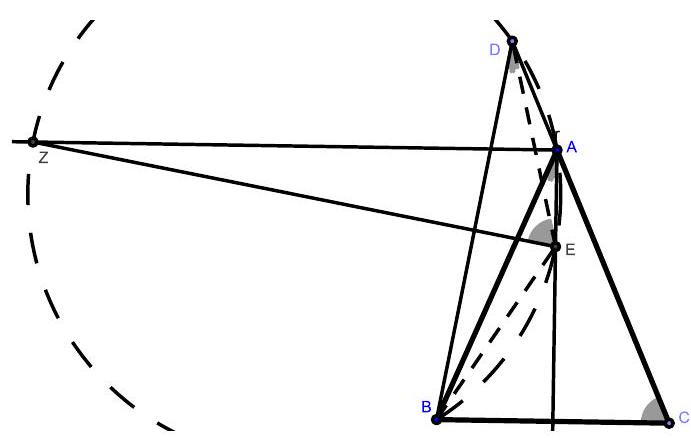
In $\triangle A B D$ the ray $[A Z$ bisects the angle $\widehat{D A B}$ and the line $Z E$ is the perpendicular bisector of the side $[B D]$. Hence $Z$ belongs to the circumcircle... | proof | Geometry | proof | olympiads | false | nlile/NuminaMath-1.5-proofs-only | train | 83 |
G6 Let $A B C D$ be a convex quadrilateral, $E$ and $F$ points on the sides $A B$ and $C D$, respectively, such that $\frac{A B}{A E}=\frac{C D}{D F}=n$. Denote by $S$ the area of the quadrilateral $A E F D$. Prove that $S \leq \frac{A B \cdot C D+n(n-1) \cdot D A^{2}+n \cdot A D \cdot B C}{2 n^{2}}$.
| ## Solution
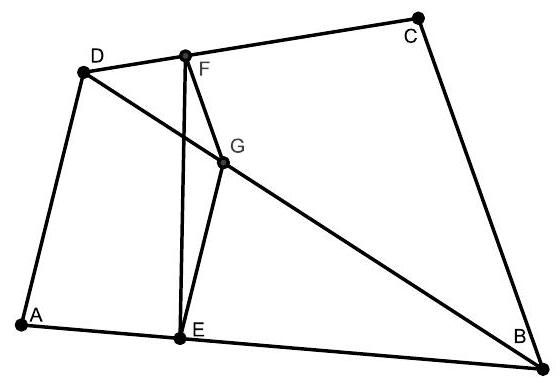
By Ptolemy's Inequality in $A E F D$, we get $S=\frac{A F \cdot D E \cdot \sin (\widehat{A F, D E})}{2} \leq \frac{A F \cdot D E}{2} \leq$ $\frac{A E \cdot D F+A D \cdot E F}{2}=... | proof | Geometry | proof | olympiads | false | nlile/NuminaMath-1.5-proofs-only | train | 84 |
NT1. Let $a, b, p, q$ be positive integers such that $a$ and $b$ are relatively prime, $a b$ is even and $p, q \geq 3$. Prove that
$$
2 a^{p} b-2 a b^{q}
$$
$$
a \text { is even }
$$
cannot be a square of an integer number. | Solution. Without loss of
Let $a=2 a^{\prime}$. If $\vdots$. Without loss of generality, assume that $a$ is even and consequently $b$ is odd.
$$
2 a^{p} b-2 a b^{q}=4 a^{\prime} b\left(a^{p-1}-b^{q-1}\right)
$$
is a square, then $a^{\prime}, b$ and $a^{p-1}-b^{q-1}$ are pairwise coprime.
On the other hand, $a^{p-1}... | proof | Number Theory | proof | olympiads | false | nlile/NuminaMath-1.5-proofs-only | train | 85 |
NT4. If the positive integers $x$ and $y$ are such that both $3 x+4 y$ and $4 x+3 y$ are perfect squares, prove that both $x$ and $y$ are multiples of 7 .
|
Solution. Let
$$
3 x+4 y=m^{2}, \quad 4 x+3 y=n^{2}
$$
Then
$$
7(x+y)=m^{2}+n^{2} \Rightarrow 7 \mid m^{2}+n^{2}
$$
Considering $m=7 k+r, \quad r \in\{0,1,2,3,4,5,6\}$ we find that $m^{2} \equiv u(\bmod 7), \quad u \in$ $\{0,1,2,4\}$ and similarly $n^{2} \equiv v(\bmod 7), \quad v \in\{0,1,2,4\}$. Therefore we hav... | proof | Number Theory | proof | olympiads | false | nlile/NuminaMath-1.5-proofs-only | train | 86 |
A1. Prove that
$$
(1+a b c)\left(\frac{1}{a}+\frac{1}{b}+\frac{1}{c}\right) \geq 3+a+b+c
$$
for any real numbers $a, b, c \geq 1$.
|
Solution. The inequality rewrites as
$$
\left(\frac{1}{a}+\frac{1}{b}+\frac{1}{c}\right)+(b c+a c+a b) \geq 3+a+b+c
$$
or
$$
\left(\frac{\frac{1}{a}+\frac{1}{b}}{2}+\frac{\frac{1}{b}+\frac{1}{c}}{2}+\frac{\frac{1}{a}+\frac{1}{c}}{2}\right)+(b c+a c+a b) \geq 3+a+b+c
$$
which is equivalent to
$$
\frac{(2 a b-(a+b)... | proof | Inequalities | proof | olympiads | false | nlile/NuminaMath-1.5-proofs-only | train | 87 |
A2. Prove that, for all real numbers $x, y, z$ :
$$
\frac{x^{2}-y^{2}}{2 x^{2}+1}+\frac{y^{2}-z^{2}}{2 y^{2}+1}+\frac{z^{2}-x^{2}}{2 z^{2}+1} \leq(x+y+z)^{2}
$$
When the equality holds?
|
Solution. For $x=y=z=0$ the equality is valid.
Since $(x+y+z)^{2} \geq 0$ it is enongh to prove that
$$
\frac{x^{2}-y^{2}}{2 x^{2}+1}+\frac{y^{2}-z^{2}}{2 y^{2}+1}+\frac{z^{2}-x^{2}}{2 z^{2}+1} \leq 0
$$
which is equivalent to the inequality
$$
\frac{x^{2}-y^{2}}{x^{2}+\frac{1}{2}}+\frac{y^{2}-z^{2}}{y^{2}+\frac{1... | proof | Inequalities | proof | olympiads | false | nlile/NuminaMath-1.5-proofs-only | train | 88 |
A3. Prove that for all real $x, y$
$$
\frac{x+y}{x^{2}-x y+y^{2}} \leq \frac{2 \sqrt{2}}{\sqrt{x^{2}+y^{2}}}
$$
|
Solution. The inequality rewrites as
$$
\frac{x+y}{x^{2}-x y+y^{2}} \leq \frac{\sqrt{2\left(x^{2}+y^{2}\right)}}{\frac{x^{2}+y^{2}}{2}}
$$
Now it is enough to prove the next two simple inequalities:
$$
x+y \leq \sqrt{2\left(x^{2}+y^{2}\right)}, \quad x^{2}-x y+y^{2} \geq \frac{x^{2}+y^{2}}{2}
$$
| proof | Inequalities | proof | olympiads | false | nlile/NuminaMath-1.5-proofs-only | train | 89 |
A4. Prove that if $0<\frac{a}{b}<b<2 a$ then
$$
\frac{2 a b-a^{2}}{7 a b-3 b^{2}-2 a^{2}}+\frac{2 a b-b^{2}}{7 a b-3 a^{2}-2 b^{2}} \geq 1+\frac{1}{4}\left(\frac{a}{b}-\frac{b}{a}\right)^{2}
$$
|
Solution. If we denote
$$
u=2-\frac{a}{b}, \quad v=2-\frac{b}{a}
$$
then the inequality rewrites as
$$
\begin{aligned}
& \frac{u}{v+u v}+\frac{v}{u+u v} \geq 1+\frac{1}{4}(u-u)^{2} \\
& \frac{(u-v)^{2}+u v(1-u v)}{u v(u v+u+v+1)} \geq \frac{(u-u)^{2}}{4}
\end{aligned}
$$
$\mathrm{Or}$
Since $u>0, v>0, u+v \leq 2,... | proof | Inequalities | proof | olympiads | false | nlile/NuminaMath-1.5-proofs-only | train | 90 |
G5. Let $A B C$ be a triangle with $\angle C=90^{\circ}$ and $D \in C .4, E \in C^{\prime} B$, and $k_{1}, k_{2}, k_{3}, k_{4}$ semicircles with diameters $C A, C B, C D, C E$ respectively, which have common part with the triangle $A B C$. Let also,
$$
k_{1} \cap k_{2}=\{C, K\}, k_{3} \cap k_{4}=\{C, M\}, k_{2} \cap ... |
Solution. The points $K, L, M, N$ belong to the segments $A B, B D, D E, E A$ respectively, where $C K \perp A B, C L \perp B D, C M \perp D E, C N \perp A E$. Then quadrilaterals $C D L M$ and $C E N M$ are inscribed. Let $\angle C A E=\varphi, \angle D C L=\theta$. Then $\angle E M N=\angle E C N=\varphi$ and $\angl... | proof | Geometry | proof | olympiads | false | nlile/NuminaMath-1.5-proofs-only | train | 93 |
Problem A1. The real numbers $a, b, c, d$ satisfy simultaneously the equations
$$
a b c-d=1, b c d-a=2, c d a-b=3, d a b-c=-6
$$
Prove that $a+b+c+d \neq 0$.
|
Solution. Suppose that $a+b+c+d=0$. Then
$$
a b c+b c d+c d a+d a b=0
$$
If $a b c d=0$, then one of numbers, say $d$, must be 0 . In this case $a b c=0$, and so at least two of the numbers $a, b, c, d$ will be equal to 0 , making one of the given equations impossible. Hence $a b c d \neq 0$ and, from (1),
$$
\frac... | proof | Algebra | proof | olympiads | false | nlile/NuminaMath-1.5-proofs-only | train | 96 |
Problem A4. Let $a, b, c$ be positive real numbers such that $a b c(a+b+c)=3$. Prove the inequality
$$
(a+b)(b+c)(c+a) \geq 8
$$
and determine all cases when equality holds.
|
Solution. We have
$A=(a+b)(b+c)(c+a)=\left(a b+a c+b^{2}+b c\right)(c+a)=(b(a+b+c)+a c)(c+a)$,
so by the given condition
$$
A=\left(\frac{3}{a c}+a c\right)(c+a)=\left(\frac{1}{a c}+\frac{1}{a c}+\frac{1}{a c}+a c\right)(c+a)
$$
Aplying the AM-GM inequality for four and two terms respectively, we get
$$
A \geq 4 ... | proof | Inequalities | proof | olympiads | false | nlile/NuminaMath-1.5-proofs-only | train | 97 |
Problem A5. The real positive numbers $x, y, z$ satisfy the relations $x \leq 2$, $y \leq 3, x+y+z=11$. Prove that $\sqrt{x y z} \leq 6$.
|
Solution. For $x=2, y=3$ and $z=6$ the equality holds.
After the substitutions $x=2-u, y=3-v$ with $u \in[0,2), v \in[0,3)$, we obtain that $z=6+u+v$ and the required inequality becomes
$$
(2-u)(3-v)(6+u+v) \leqslant 36
$$
We shall need the following lemma.
Lemma. If real numbers $a$ and $b$ satisfy the relations ... | proof | Inequalities | proof | olympiads | false | nlile/NuminaMath-1.5-proofs-only | train | 98 |
Problem G1. Consider a triangle $A B C$ with $\angle A C B=90^{\circ}$. Let $F$ be the foot of the altitude from $C$. Circle $\omega$ touches the line segment $F B$ at point $P$, the altitude $C F$ at point $Q$ and the circumcircle of $A B C$ at point $R$. Prove that points $A, Q, R$ are collinear and $A P=A C$.
$ passes through points $B$ and $C$ and meets the sides $A B$ and $A C$ at points $D$ and $E$, respectively. Let $\omega_{2}\left(O_{2}, R_{2}\right)$ be the circumcircle of the triangle $A D E$. Prove that $O_{1} O_{2}$ ... |
Solution. Recall that, in every triangle, the altitude and the diameter of the circumcircle drawn from the same vertex are isogonal. The proof offers no difficulty, being a simple angle chasing around the circumcircle of the triangle.
Let $O$ be the circumcenter of the triangle $A B C$. From the above, one has $\angl... | proof | Geometry | proof | olympiads | false | nlile/NuminaMath-1.5-proofs-only | train | 100 |
A2. Given positive real numbers $a, b, c$, prove that
$$
\frac{8}{(a+b)^{2}+4 a b c}+\frac{8}{(a+c)^{2}+4 a b c}+\frac{8}{(b+c)^{2}+4 a b c}+a^{2}+b^{2}+c^{2} \geq \frac{8}{a+3}+\frac{8}{b+3}+\frac{8}{c+3}
$$
|
Solution. Since $2 a b \leq a^{2}+b^{2}$, it follows that $(a+b)^{2} \leq 2\left(a^{2}+b^{2}\right)$ and $4 a b c \leq 2 c\left(a^{2}+b^{2}\right)$, for any positive reals $a, b, c$. Adding these inequalities, we find
$$
(a+b)^{2}+4 a b c \leq 2\left(a^{2}+b^{2}\right)(c+1)
$$
so that
$$
\frac{8}{(a+b)^{2}+4 a b c}... | proof | Inequalities | proof | olympiads | false | nlile/NuminaMath-1.5-proofs-only | train | 103 |
A4. If $x, y, z$ are non-negative real numbers such that $x^{2}+y^{2}+z^{2}=x+y+z$, then show that:
$$
\frac{x+1}{\sqrt{x^{5}+x+1}}+\frac{y+1}{\sqrt{y^{5}+y+1}}+\frac{z+1}{\sqrt{z^{5}+z+1}} \geq 3
$$
When does the equality hold?
|
Solution. First we factor $x^{5}+x+1$ as follows:
$$
\begin{aligned}
x^{5}+x+1 & =x^{5}-x^{2}+x^{2}+x+1=x^{2}\left(x^{3}-1\right)+x^{2}+x+1=x^{2}(x-1)\left(x^{2}+x+1\right)+x^{2}+x+1 \\
& =\left(x^{2}+x+1\right)\left(x^{2}(x-1)+1\right)=\left(x^{2}+x+1\right)\left(x^{3}-x^{2}+1\right)
\end{aligned}
$$
Using the $A M... | proof | Inequalities | proof | olympiads | false | nlile/NuminaMath-1.5-proofs-only | train | 104 |
A5. Let $x, y, z$ be positive real numbers such that $x+y+z=\frac{1}{x}+\frac{1}{y}+\frac{1}{z}$.
a) Prove the inequality
$$
x+y+z \geq \sqrt{\frac{x y+1}{2}}+\sqrt{\frac{y z+1}{2}}+\sqrt{\frac{z x+1}{2}}
$$
b) (Added by the problem selecting committee) When does the equality hold?
| ## Solution.
a) We rewrite the inequality as
$$
(\sqrt{x y+1}+\sqrt{y z+1}+\sqrt{z x+1})^{2} \leq 2 \cdot(x+y+z)^{2}
$$
and note that, from CBS,
$$
\text { LHS } \leq\left(\frac{x y+1}{x}+\frac{y z+1}{y}+\frac{z x+1}{z}\right)(x+y+z)
$$
But
$$
\frac{x y+1}{x}+\frac{y z+1}{y}+\frac{z x+1}{z}=x+y+z+\frac{1}{x}+\fra... | proof | Inequalities | proof | olympiads | false | nlile/NuminaMath-1.5-proofs-only | train | 105 |
G1. Let $A B C$ be an acute angled triangle, let $O$ be its circumcentre, and let $D, E, F$ be points on the sides $B C, A C, A B$, respectively. The circle $\left(c_{1}\right)$ of radius $F A$, centred at $F$, crosses the segment $(O A)$ at $A^{\prime}$ and the circumcircle (c) of the triangle $A B C$ again at $K$. S... |
Solution. We will prove that the quadrilateral $B K F A^{\prime}$ is cyclic and its circumcircle passes through the center $O$ of the circle (c).
The triangle $A F K$ is isosceles, so $m(\widehat{K F B})=2 m(\widehat{K A B})=m(\widehat{K O B})$. It follows that the quadrilateral $B K F O$ is cyclic.
The triangles $O... | proof | Geometry | proof | olympiads | false | nlile/NuminaMath-1.5-proofs-only | train | 106 |
G2. Let $A B C$ be a triangle with $m(\widehat{B A C})=60^{\circ}$. Let $D$ and $E$ be the feet of the perpendiculars from $A$ to the external angle bisectors of $\widehat{A B C}$ and $\widehat{A C B}$, respectively. Let $O$ be the circumcenter of the triangle $A B C$. Prove that the circumcircles of the triangles $\t... |
Solution. Let $X$ be the intersection of the lines $B D$ and $C E$.
We will prove that $X$ lies on the circumcircles of both triangles $\triangle A D E$ and $\triangle B O C$ and then we will prove that the centers of these circles and the point $X$ are collinear, which is enough for proving that the circles are tang... | proof | Geometry | proof | olympiads | false | nlile/NuminaMath-1.5-proofs-only | train | 107 |
G3. A trapezoid $A B C D(A B \| C D, A B>C D)$ is circumscribed. The incircle of triangle $A B C$ touches the lines $A B$ and $A C$ at $M$ and $N$, respectively. Prove that the incenter of the trapezoid lies on the line $M N$.
=90^{\circ}-\frac{1}{2} m(\widehat{M A N}) \quad \text { and } \quad m(\widehat{B I C})=90^{\circ}+\frac{1}{2} m(\widehat{M A N})
$$
the quadrilateral $I R N C$ is cyclic.
It fo... | proof | Geometry | proof | olympiads | false | nlile/NuminaMath-1.5-proofs-only | train | 108 |
G4. Let $A B C$ be an acute angled triangle whose shortest side is $[B C]$. Consider a variable point $P$ on the side $[B C]$, and let $D$ and $E$ be points on $(A B]$ and $(A C]$, respectively, such that $B D=B P$ and $C P=C E$. Prove that, as $P$ traces $[B C]$, the circumcircle of the triangle $A D E$ passes throug... |
Solution. We claim that the fixed point is the center of the incircle of $A B C$.
Let $I$ be the center of the incircle of $A B C$. Since $B D=B P$ and $[B I$ is the bisector of $\widehat{D B P}$, the line $B I$ is the perpendicular bisector of $[D P]$. This yields $D I=P I$. Analogously we get $E I=P I$. So, the poi... | proof | Geometry | proof | olympiads | false | nlile/NuminaMath-1.5-proofs-only | train | 109 |
G5. Let $A B C$ be an acute angled triangle with orthocenter $H$ and circumcenter $O$. Assume the circumcenter $X$ of $B H C$ lies on the circumcircle of $A B C$. Reflect $O$ across $X$ to obtain $O^{\prime}$, and let the lines $X H$ and $O^{\prime} A$ meet at $K$. Let $L, M$ and $N$ be the midpoints of $[X B],[X C]$ ... |
Solution. The circumcircles of $A B C$ and $B H C$ have the same radius. So, $X B=$ $X C=X H=X O=r$ (where $r$ is the radius of the circle $A B C$ ) and $O^{\prime}$ lies on $C(X, r)$. We conclude that $O X$ is the perpendicular bisector for $[B C]$. So, $B O X$ and $C O X$ are equilateral triangles.
It is known that... | proof | Geometry | proof | olympiads | false | nlile/NuminaMath-1.5-proofs-only | train | 110 |
G6. Given an acute triangle $A B C$, erect triangles $A B D$ and $A C E$ externally, so that $m(\widehat{A D B})=m(\widehat{A E C})=90^{\circ}$ and $\widehat{B A D} \equiv \widehat{C A E}$. Let $A_{1} \in B C, B_{1} \in A C$ and $C_{1} \in A B$ be the feet of the altitudes of the triangle $A B C$, and let $K$ and $L$ ... |
Solution. Let $M, P$ and $Q$ be the midpoints of $[B C],[C A]$ and $[A B]$, respectively.
The circumcircle of the triangle $A_{1} B_{1} C_{1}$ is the Euler's circle. So, the point $M$ lies on this circle.
It is enough to prove now that $\left[A_{1} M\right]$ is a common chord of the three circles $\left(A_{1} B_{1} ... | proof | Geometry | proof | olympiads | false | nlile/NuminaMath-1.5-proofs-only | train | 111 |
G7. Let $[A B]$ be a chord of a circle $(c)$ centered at $O$, and let $K$ be a point on the segment $(A B)$ such that $A K<B K$. Two circles through $K$, internally tangent to (c) at $A$ and $B$, respectively, meet again at $L$. Let $P$ be one of the points of intersection of the line $K L$ and the circle (c), and let... |
Solution. Let $\left(c_{1}\right)$ and $\left(c_{2}\right)$ be circles through $K$, internally tangent to (c) at $A$ and $B$, respectively, and meeting again at $L$, and let the common tangent to $\left(c_{1}\right)$ and $(c)$ meet the common tangent to $\left(c_{2}\right)$ and $(c)$ at $Q$. Then the point $Q$ is the ... | proof | Geometry | proof | olympiads | false | nlile/NuminaMath-1.5-proofs-only | train | 112 |
C 2. Viktor and Natalia bought 2020 buckets of ice-cream and want to organize a degustation schedule with 2020 rounds such that:
- In every round, each one of them tries 1 ice-cream, and those 2 ice-creams tried in a single round are different from each other.
- At the end of the 2020 rounds, each one of them has tri... |
Solution. If we fix the order in which Natalia tries the ice-creams, we may consider 2 types of fair schedules:
1) Her last 1010 ice-creams get assigned as Viktor's first 1010 ice-creams, and vice versa: Viktor's first 1010 ice-creams are assigned as Natalia's last 1010 ice-creams. This generates (1010!) $)^{2}$ dist... | proof | Combinatorics | proof | olympiads | false | nlile/NuminaMath-1.5-proofs-only | train | 113 |
G 1. Let $\triangle A B C$ be an acute triangle. The line through $A$ perpendicular to $B C$ intersects $B C$ at $D$. Let $E$ be the midpoint of $A D$ and $\omega$ the the circle with center $E$ and radius equal to $A E$. The line $B E$ intersects $\omega$ at a point $X$ such that $X$ and $B$ are not on the same side ... |
Solution. Denote by $s$ the line $A D$. Let $T$ be the second intersection point of the circumcircles of $\triangle B D X$ and $\triangle C D Y$. Then $T$ is on the line $s$. Note that $C D Y T$ and $B D X T$ are cyclic. Using this and the fact that $A D$ is perpendicular to $B C$ we obtain:
$$
\angle T Y E=\angle T ... | proof | Geometry | proof | olympiads | false | nlile/NuminaMath-1.5-proofs-only | train | 114 |
End of preview. Expand in Data Studio
NuminaMath-1.5-proofs-only-strict
A strictly filtered version of the NuminaMath-1.5-proofs-only dataset, containing ONLY validated mathematical proof problems.
📊 Filtering Results
Original dataset: Numina1.5 -> filter for proofs -> 110,998 rows
Filters applied:
- ✓ Kept rows where
answer = "proof"(proof problems only) - ✓ Kept rows where
solution_is_valid = "Yes" - ✓ Kept rows where
problem_is_valid = "Yes" - ✓ Dropped validation columns after filtering
- ✓ Kept rows where
Filtered dataset: 58,088 rows (removed 52,910 rows)
📦 Dataset
- Columns preserved:
problem- The mathematical problem statement requiring a proofsolution- Step-by-step proof/solutionanswer- Always "proof" (filtered to contain only proof problems)problem_type- Type of mathematical problemquestion_type- Question format/stylesource- Original source of the problemsynthetic- Whether the problem is synthetically generatedsource_dataset- Source dataset identifiersource_split- Dataset split (train/test/val)
This strict version contains only validated mathematical proof problems, perfect for training models on formal mathematical reasoning and proof generation.
- Downloads last month
- 3,071