| # Runner |
|
|
| Deep learning algorithms usually share similar pipelines for training, validation and testing. |
| Therefore, MMengine designed `Runner` to simplify the construction of these pipelines. |
| In most cases, users can use our default `Runner` directly. |
| If you find it not feasible to implement your ideas, you can also modify it or customize your own runner. |
|
|
| Before introducing the design of `Runner`, let's walk through some examples to better understand why we should use runner. |
| Below is a few lines of pseudo codes for training models in PyTorch: |
|
|
| ```python |
| model = ResNet() |
| optimizer = SGD(model.parameters(), lr=0.01, momentum=0.9) |
| train_dataset = ImageNetDataset(...) |
| train_dataloader = DataLoader(train_dataset, ...) |
| |
| for i in range(max_epochs): |
| for data_batch in train_dataloader: |
| optimizer.zero_grad() |
| outputs = model(data_batch) |
| loss = loss_func(outputs, data_batch) |
| loss.backward() |
| optimizer.step() |
| ``` |
|
|
| Pseudo codes for model validation in PyTorch: |
|
|
| ```python |
| model = ResNet() |
| model.load_state_dict(torch.load(CKPT_PATH)) |
| model.eval() |
| |
| test_dataset = ImageNetDataset(...) |
| test_dataloader = DataLoader(test_dataset, ...) |
| |
| for data_batch in test_dataloader: |
| outputs = model(data_batch) |
| acc = calculate_acc(outputs, data_batch) |
| ``` |
|
|
| Pseudo codes for model inference in PyTorch: |
|
|
| ```python |
| model = ResNet() |
| model.load_state_dict(torch.load(CKPT_PATH)) |
| model.eval() |
| |
| for img in imgs: |
| prediction = model(img) |
| ``` |
|
|
| The observation from the above 3 pieces of codes is that they are similar. |
| They can all be divided into some distinct steps, such as model construction, data loading and loop iterations. |
| Although the above examples are based on image classification tasks, the same holds for many other tasks as well, including object detection, image segmentation, etc. |
| Based on the observation above, we propose runner, which structures the training, validation and testing pipeline. |
| With runner, the only thing you need to do is to prepare necessary components (models, data, etc.) of your pipeline, and leave the schedule and execution to `Runner`. |
| You are free of constructing similar pipelines one and another time. |
| You are free of annoying details like the differences between distributed and non-distributed training. |
| You can focus on your own awesome ideas. |
| These are all achieved by runner and various practical modules in MMEngine. |
|
|
|  |
|
|
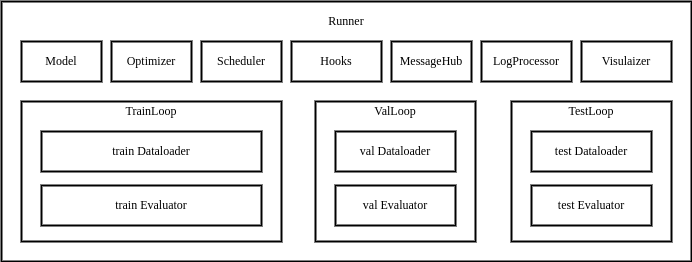
| The `Runner` in MMEngine contains various modules required for training, testing and validation, as well as loop controllers(`Loop`) and [Hook](../tutorials/hook.md), as shown in the figure above. |
| It provides 3 APIs for users: `train`, `val` and `test`, each correspond to a specific `Loop`. |
| You can use `Runner` either by providing a config file, or by providing manually constructed modules. |
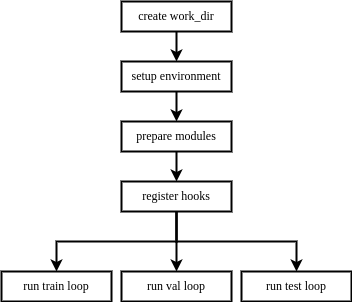
| Once activated, the `Runner` will automatically setup the runtime environment, build/compose your modules, execute the loop iterations in `Loop` and call registered hooks during iterations. |
|
|
| The execution order of `Runner` is as follows: |
|
|
|  |
|
|
| A feature of `Runner` is that it will always lazily initialize modules managed by itself. |
| To be specific, `Runner` won't build every module on initialization, and it won't build a module until it is needed in current `Loop`. |
| Therefore, if you are running only one of the `train`, `val`, or `test` pipelines, you only need to provide the relevant configs/modules. |
|
|
| ## Loop |
|
|
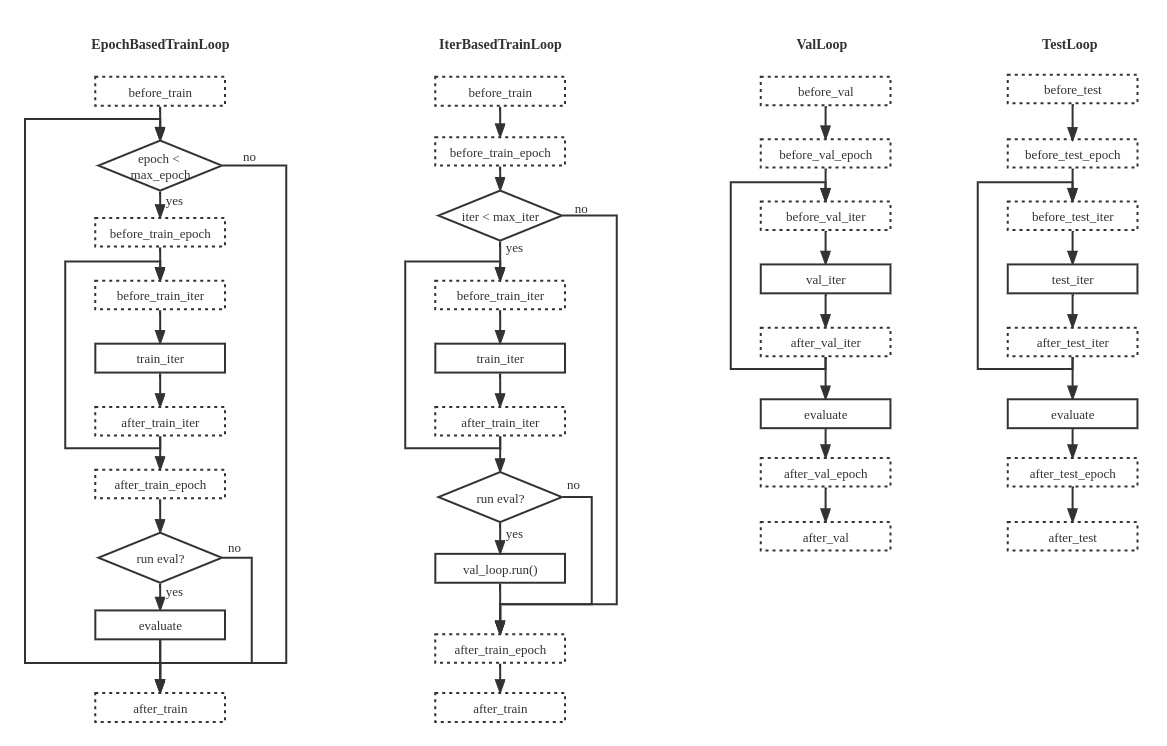
| In MMEngine, we abstract the execution process of the task into `Loop`, based on the observation that most deep learning tasks can be summarized as a model iterating over datasets. |
| We provide 4 built-in loops in MMEngine: |
|
|
| - EpochBasedTrainLoop |
| - IterBasedTrainLoop |
| - ValLoop |
| - TestLoop |
|
|
|  |
|
|
| The built-in runner and loops are capable of most deep learning tasks, but surely not all. |
| Some tasks need extra modifications and refactorizations. |
| Therefore, we make it possible for users to customize their own pipelines for model training, validation and testing. |
|
|
| You can write your own pipeline by subclassing [BaseLoop](mmengine.runner.BaseLoop), which needs 2 arguments for initialization: 1) `runner` the Runner instance, and 2) `dataloader` the dataloader used in this loop. |
| You are free to add more arguments to your own loop subclass. |
| After defining your own loop subclass, you should register it to LOOPS(mmengine.registry.LOOPS), and specify it in config files by `type` field in `train_cfg`, `val_cfg` and `test_cfg`. |
| In fact, you can write any execution order, any hook position in your own loop. |
| However, built-in hooks may not work if you change hook positions, which may lead to inconsistent behavior during training. |
| Therefore, we strongly recommend you to implement you subclass with similar execution order illustrated in the figure above, and with the same hook positions defined in [hook documentation](../tutorials/hook.md). |
|
|
| ```python |
| from mmengine.registry import LOOPS, HOOKS |
| from mmengine.runner import BaseLoop |
| from mmengine.hooks import Hook |
| |
| |
| # Customized validation loop |
| @LOOPS.register_module() |
| class CustomValLoop(BaseLoop): |
| def __init__(self, runner, dataloader, evaluator, dataloader2): |
| super().__init__(runner, dataloader, evaluator) |
| self.dataloader2 = runner.build_dataloader(dataloader2) |
| |
| def run(self): |
| self.runner.call_hooks('before_val_epoch') |
| for idx, data_batch in enumerate(self.dataloader): |
| self.runner.call_hooks( |
| 'before_val_iter', batch_idx=idx, data_batch=data_batch) |
| outputs = self.run_iter(idx, data_batch) |
| self.runner.call_hooks( |
| 'after_val_iter', batch_idx=idx, data_batch=data_batch, outputs=outputs) |
| metric = self.evaluator.evaluate() |
| |
| # add extra loop for validation purpose |
| for idx, data_batch in enumerate(self.dataloader2): |
| # add new hooks |
| self.runner.call_hooks( |
| 'before_valloader2_iter', batch_idx=idx, data_batch=data_batch) |
| self.run_iter(idx, data_batch) |
| # add new hooks |
| self.runner.call_hooks( |
| 'after_valloader2_iter', batch_idx=idx, data_batch=data_batch, outputs=outputs) |
| metric2 = self.evaluator.evaluate() |
| |
| ... |
| |
| self.runner.call_hooks('after_val_epoch') |
| |
| |
| # Define a hook with extra hook positions |
| @HOOKS.register_module() |
| class CustomValHook(Hook): |
| def before_valloader2_iter(self, batch_idx, data_batch): |
| ... |
| |
| def after_valloader2_iter(self, batch_idx, data_batch, outputs): |
| ... |
| |
| ``` |
|
|
| The example above shows how to implement a different validation loop. |
| The new loop validates on two different validation datasets. |
| It also defines a new hook position in the second validation. |
| You can easily use it by setting `type='CustomValLoop'` in `val_cfg` in your config file. |
|
|
| ```python |
| # Customized validation loop |
| val_cfg = dict(type='CustomValLoop', dataloader2=dict(dataset=dict(type='ValDataset2'), ...)) |
| # Customized hook with extra hook position |
| custom_hooks = [dict(type='CustomValHook')] |
| ``` |
|
|
| ## Customize Runner |
|
|
| Moreover, you can write your own runner by subclassing `Runner` if the built-in `Runner` is not feasible. |
| The method is similar to writing other modules: write your subclass inherited from `Runner`, overrides some functions, register it to [RUNNERS](mmengine.registry.RUNNERS) and access it by assigning `runner_type` in your config file. |
|
|
| ```python |
| from mmengine.registry import RUNNERS |
| from mmengine.runner import Runner |
| |
| @RUNNERS.register_module() |
| class CustomRunner(Runner): |
| |
| def setup_env(self): |
| ... |
| ``` |
|
|
| The example above shows how to implement a customized runner which overrides the `setup_env` function and is registered to RUNNERS. |
| Now `CustomRunner` is prepared to be used by setting `runner_type='CustomRunner'` in your config file. |
|
|
| Further readings: [Runner tutorial](../tutorials/runner.md) and [Runner API documentations](mmengine.runner.Runner) |
|
|

