

problem stringlengths 68 1.09k | solution_hint stringlengths 10 5.49k | answer stringlengths 1 117 | question_type stringclasses 2
values | isqwen7bcorrect bool 1
class | solution stringlengths 13 129 |
|---|---|---|---|---|---|
2. Given the ellipse $\frac{x^{2}}{9}+\frac{y^{2}}{8}=1$, with foci $F_{1}, F_{2}$, and $P$ as any point on the ellipse (but $P$ is not on the $x$-axis), the incenter of $\triangle P F_{1} F_{2}$ is $I$. A line parallel to the $x$-axis through $I$ intersects $P F_{1}, P F_{2}$ at $A$,
$B$. Then $\frac{S_{\triangle P A ... | 2. $\frac{9}{16}$. Given, $a=3, b^{2}=8, c=1$, then
$$
\left|P F_{1}\right|+\left|P F_{2}\right|=2 a=6,\left|F_{1} F_{2}\right|=2 c=2 \text {. }
$$
The perimeter of $\triangle P F_{1} F_{2}$ is 8.
Let the inradius of $\triangle P F_{1} F_{2}$ be $r$, and point $P(x, y)$.
By $\triangle P A B \backsim \triangle P F_{1} F... | \frac{9}{16} | math-word-problem | false | \(\boxed{\frac{9}{16}}\) |
13.327. A total of 24 liters of liquid is distributed among three vessels. First, from the first vessel, as much liquid was poured into the other two as was already in each of them. Then, from the second vessel, as much liquid was poured into the other two as was in each of them after the first pouring. Finally, from t... | Solution.
Let's fill in the table:
| Vessel | Initially | After the first transfer | After the second transfer | After the third transfer |
| :--- | :---: | :---: | :---: | :---: |
| First | $x$ | $x-y-z$ | $2(x-y-z)$ | $4(x-y-z)$ |
| Second | $y$ | $2 y$ | $3 y-x-z$ | $6 y-2 x-2 z$ |
| Third | $z$ | $2 z$ | $4 z$... | 13,7,4 | math-word-problem | false | \(\boxed{13,7,4}\) |
15. Real numbers $x_{1}, x_{2}, \cdots, x_{2001}$ satisfy $\sum_{k=1}^{2000}\left|x_{k}-x_{k+1}\right|=2001$, let $y_{k}=\frac{1}{k}\left(x_{1}+\right.$ $\left.x_{2}+\cdots+x_{k}\right), k=1,2, \cdots, 2001$. Find the maximum possible value of $\sum_{k=1}^{2000}\left|y_{k}-y_{k+1}\right|$. | 15. 2000 .
$$
\begin{array}{l}
\left|y_{k}-y_{k+1}\right|=\left|\frac{x_{1}+x_{2}+\cdots+x_{k}}{k}-\frac{x_{1}+x_{2}+\cdots+x_{k+1}}{k+1}\right|=\left|\frac{x_{1}+x_{2}+\cdots+x_{k}-k x_{k+1}}{k(k+1)}\right| \\
=\frac{\left|\left(x_{1}-x_{2}\right)+2\left(x_{2}-x_{3}\right)+3\left(x_{3}-x_{4}\right)+\cdots+k\left(x_{k}... | 2000 | math-word-problem | false | \(\boxed{2000}\) |
18. (12 points) To investigate the mathematics exam scores of students citywide, 10 students each from Class A and Class B of a certain middle school were randomly selected, and the following scores (in points) were obtained.
$$
\begin{aligned}
\text { Class A: } & 132,108,112,121,113,121,118, \\
& 128,118,129; \\
\tex... | 18. (1) Stem-and-leaf plot omitted, Class B has a higher average level.
(2) The number of excellent students in Class A is 5, and the number of excellent students in Class B is 6.
Let the event that none of the three randomly selected students are excellent be $A_{1}$; the event that one of the three randomly selected... | \frac{33}{20} | math-word-problem | false | \(\boxed{\frac{33}{20}}\) |
Example 6 Given $A(-2,2)$, and $B$ is a moving point on the ellipse $\frac{x^{2}}{25}+\frac{y^{2}}{16}=1$, $F$ is the left focus. When $\mid A B \mid +\frac{5}{3}|B F|$ takes the minimum value, find the coordinates of $B$.
(1999, National High School Mathematics Competition) | Let the semi-major axis, semi-minor axis, and semi-focal distance of the ellipse be denoted as $a$, $b$, and $c$, respectively, and the eccentricity as $e$. Then, $a=5$, $b=4$, $c=\sqrt{a^{2}-b^{2}}=3$, $e=\frac{c}{a}=\frac{3}{5}$, and the left directrix is $x=-\frac{25}{3}$.
As shown in Figure 4, draw a perpendicular... | B\left(-\frac{5}{2} \sqrt{3}, 2\right) | math-word-problem | false | \(\boxed{B\left(-\frac{5}{2} \sqrt{3}, 2\right)}\) |
8. There are 17 students standing in a row, counting from 1. The teacher asks the students who report odd numbers to step out. The remaining students then start counting from 1 again, and the teacher continues to ask the students who report odd numbers to step out. After several rounds, only 1 student is left. The numb... | Answer: 16 | 16 | math-word-problem | false | \(\boxed{16}\) |
24. If the inequality $\cos ^{2} x+2 p \sin x-2 p-2<0$ holds for any real number $x$, find the range of $p$.
| 24. The range of values for $p$ is $(1-\sqrt{2},+\infty)$. | (1-\sqrt{2},+\infty) | math-word-problem | false | \(\boxed{(1-\sqrt{2},+\infty)}\) |
5. In the spatial quadrilateral $ABCD$, it is known that $AB=2, BC=3, CD=4, DA=5$, then $\overrightarrow{AC} \cdot \overrightarrow{BD}=$ | $$
\begin{array}{l}
\overrightarrow{A C}=\overrightarrow{A B}+\overrightarrow{B C}=\overrightarrow{A D}+\overrightarrow{D C}, \overrightarrow{B D}=\overrightarrow{B A}+\overrightarrow{A D}=\overrightarrow{B C}+\overrightarrow{C D}, \\
\text { then } 4 \overrightarrow{A C} \cdot \overrightarrow{B D}=(\overrightarrow{A B... | 7 | math-word-problem | false | \(\boxed{7}\) |
15. Given that $\alpha, \beta$ are the two distinct real roots of the equation $4 x^{2}-4 t x-1=0(t \in \mathbf{R})$, and the function $f(x)=\frac{2 x-t}{x^{2}+1}$ has the domain $[\alpha, \beta]$.
(1) Find $g(t)=\max f(x)-\min f(x)$;
(2) Prove: For $u_{i} \in\left(0, \frac{\pi}{2}\right)(i=1,2,3)$, if $\sin u_{1}+\sin... | (1) According to the problem, $\alpha+\beta=t, \alpha \beta=-\frac{1}{4}$.
Since $f^{\prime}(x)=\frac{2\left(x^{2}+1\right)-2 x(2 x-t)}{\left(x^{2}+1\right)^{2}}=\frac{2\left(-x^{2}+t x+1\right)}{\left(x^{2}+1\right)^{2}}=\frac{-2\left(x^{2}-t x-1\right)}{\left(x^{2}+1\right)^{2}}$ $=\frac{-2\left[x^{2}-(\alpha+\beta)... | \frac{1}{(\tanu_{1})}+\frac{1}{(\tanu_{2})}+\frac{1}{(\tanu_{3})}<\frac{3\sqrt{6}}{4} | math-word-problem | false | \(\boxed{\frac{1}{(\tanu_{1})}+\frac{1}{(\tanu_{2})}+\frac{1}{(\tanu_{3})}<\frac{3\sqrt{6}}{4}}\) |
How many solutions does the equation $\tan(2x)=\cos(\tfrac{x}{2})$ have on the interval $[0,2\pi]?$
$\textbf{(A)}\ 1\qquad\textbf{(B)}\ 2\qquad\textbf{(C)}\ 3\qquad\textbf{(D)}\ 4\qquad\textbf{(E)}\ 5$ | We count the intersections of the graphs of $y=\tan(2x)$ and $y=\cos\left(\frac x2\right):$
The graph of $y=\tan(2x)$ has a period of $\frac{\pi}{2},$ asymptotes at $x=\frac{\pi}{4}+\frac{k\pi}{2},$ and zeros at $x=\frac{k\pi}{2}$ for some integer $k.$
On the interval $[0,2\pi],$ the graph has five branches: \[\bigg... | 5 | MCQ | false | \(\boxed{5}\) |
$4 \cdot 31$ Given $\left\{a_{n}\right\}$ is a sequence of positive integers
$$
a_{n+3}=a_{n+2}\left(a_{n+1}+2 a_{n}\right) \quad(n \in N), \quad a_{6}=2288 .
$$
Find $a_{1}, a_{2}, a_{3}$.
(China Sichuan Province High School Mathematics Competition, 1988) | [Solution]From the recursive formula,
$$
\begin{array}{l}
a_{4}=a_{3}\left(a_{2}+2 a_{1}\right), \\
a_{5}=a_{3}\left(a_{2}+2 a_{1}\right)\left(a_{3}+2 a_{2}\right), \\
a_{6}=a_{3}^{2}\left(a_{2}+2 a_{1}\right)\left(a_{3}+2 a_{2}\right)\left(a_{2}+2 a_{1}+2\right) .
\end{array}
$$
Also, $a_{6}=2288=2^{4} \cdot 11 \cdot... | a_{1}=5,a_{2}=1,a_{3}=2 | math-word-problem | false | \(\boxed{a_{1}=5,a_{2}=1,a_{3}=2}\) |
Suppose that $c\in\left(\frac{1}{2},1\right)$. Find the least $M$ such that for every integer $n\ge 2$ and real numbers $0<a_1\le a_2\le\ldots \le a_n$, if $\frac{1}{n}\sum_{k=1}^{n}ka_{k}=c\sum_{k=1}^{n}a_{k}$, then we always have that $\sum_{k=1}^{n}a_{k}\le M\sum_{k=1}^{m}a_{k}$ where $m=[cn]$ | 1. **Claim**: The least \( M \) such that for every integer \( n \ge 2 \) and real numbers \( 0 < a_1 \le a_2 \le \ldots \le a_n \), if \(\frac{1}{n}\sum_{k=1}^{n}ka_{k}=c\sum_{k=1}^{n}a_{k}\), then we always have \(\sum_{k=1}^{n}a_{k}\le M\sum_{k=1}^{m}a_{k}\) where \( m = \lfloor cn \rfloor \), is \( M = \frac{1}{1-c... | \frac{1}{1-c} | math-word-problem | false | \(\boxed{\frac{1}{1-c}}\) |
4. Given the sequence $\left\{x_{n}\right\}$ satisfies $x_{1}=1$, for $n \geqslant 1$, we have
$$
\begin{array}{l}
4\left(x_{1} x_{n}+2 x_{2} x_{n-1}+3 x_{3} x_{n-2}+\cdots+n x_{n} x_{1}\right) \\
=(n+1)\left(x_{1} x_{2}+x_{2} x_{3}+\cdots+x_{n} x_{n+1}\right) .
\end{array}
$$
Find the general term formula for $\left\... | For $n=1$, substituting into equation (1) yields $4 x_{1}^{2}=2 x_{1} x_{2}$, thus $x_{2}=2$.
For $n=2$, substituting into equation (1) yields
$4\left(x_{1} x_{2}+2 x_{2} x_{1}\right)=3\left(x_{1} x_{2}+x_{2} x_{3}\right)$, thus $x_{3}=3$.
Assume $x_{k}=k$, where $1 \leqslant k \leqslant n$. From
$$
4 \sum_{k=1}^{n} k ... | x_{n}=n | math-word-problem | false | \(\boxed{x_{n}=n}\) |
16. Given an angle of magnitude $\alpha$ with vertex at $A$ and a point $B$ at distances $a$ and $b$ from the sides of the angle. Find the length of $A B$. | 16. If $M$ and $N$ are the bases of the perpendiculars dropped from $B$ to the sides of the angle, then the quadrilateral $A M B N$ is cyclic, and $A B$ is the diameter of the circle circumscribed around $\triangle M B N$, so $\widehat{M B N}=\pi-\alpha$ if $B$ is inside the given angle or its vertical, and $\widehat{M... | |AB|=\frac{\sqrt{^{2}+b^{2}+2\cos\alpha}}{\sin\alpha}, | math-word-problem | false | \(\boxed{|AB|=\frac{\sqrt{^{2}+b^{2}+2\cos\alpha}}{\sin\alpha},}\) |
The sequence of positive integers $a_1, a_2, \dots$ has the property that $\gcd(a_m, a_n) > 1$ if and only if $|m - n| = 1$. Find the sum of the four smallest possible values of $a_2$. | 1. **Understanding the problem**: We need to find the sum of the four smallest possible values of \(a_2\) in a sequence of positive integers \(a_1, a_2, \dots\) such that \(\gcd(a_m, a_n) > 1\) if and only if \(|m - n| = 1\).
2. **Analyzing the condition**: The condition \(\gcd(a_m, a_n) > 1\) if and only if \(|m - n|... | 42 | math-word-problem | false | \(\boxed{42}\) |
25. Let prime $p>2, \delta_{p}(a)=4$. Find the least positive residue of $(a+1)^{4}$ modulo $p$.
| 25. There must be $a^{4} \equiv 1(\bmod p), a^{2} \equiv-1(\bmod p), a^{3} \equiv-a(\bmod p)$. Therefore, $(1+a)^{4}=$ $a^{4}+4 a^{3}+6 a^{2}+4 a+1 \equiv-4(\bmod p)$. The smallest positive residue is $p-4$. | p-4 | math-word-problem | false | \(\boxed{p-4}\) |
Satisfy $m n \geqslant 0, m^{3}+n^{3}+99 m n=33^{3}$ the historical integer pairs $(m, n)$ are $\qquad$ pairs. | 12. 35
If $m+n=s$, then
$$
\begin{array}{c}
m^{3}+n^{3}+3 m n(m+n)=s^{3} \\
m^{3}+n^{3}+99 m n=33^{3}
\end{array}
$$
Subtracting (2) from (1) gives $s^{4}-33^{3}=3 m n s-99 m n$, which means $(s-33)\left(s^{2}+33 s+3 s^{2}-3 m n\right)=0$, so $s=$ 33 or $s^{2}+33 s-33^{2}-3 m n=0$.
If $m+n=33$ and $m n \geqslant 0$,... | 35 | math-word-problem | false | \(\boxed{35}\) |
A rectangular parallelepiped has three edges meeting at a vertex: $a, b, c$, and $a>b>c$. On each face of the body, we place a roof-shaped body whose 4 sides are inclined at a $45^{\circ}$ angle to the base. How many faces, edges, and vertices does the resulting body have? What shapes are the faces? What is the volume ... | It is evident that each roof-shaped body (excluding the base, its edges, and vertices) has 4 side faces, 5 edges, and 2 vertices. One of the edges is parallel to the base, called the ridge - its endpoints are the vertices. The two longer base edges are connected by a symmetrical trapezoid, and the shorter ones by isosc... | +\frac{1}{2}(^{2}+^{2}+^{2})-\frac{b^{3}}{6}-\frac{^{3}}{3} | math-word-problem | false | \(\boxed{+\frac{1}{2}(^{2}+^{2}+^{2})-\frac{b^{3}}{6}-\frac{^{3}}{3}}\) |
8.3.18 In isosceles $\wedge A B C$, $A B=A C$, $\odot O$ is the incircle of $\triangle A B C$, touching the sides $B C$, $C A$, and $A B$ at points $K$, $L$, and $M$ respectively. Let $N$ be the intersection of line $O L$ and $K M$, $Q$ be the intersection of line $B N$ and $C A$, and $P$ be the foot of the perpendicul... | (1) First prove that $Q$ is the midpoint of segment $A C$.
As shown in Figure $\mathrm{a}$, let the line through point $N$ parallel to $A C$ intersect $A B$ and $B C$ at points $M_{1}$ and $K_{1}$, respectively. Since $\angle A L O=\angle M_{1} N O=\angle O M M_{1}=90^{\circ}$, quadrilateral $M M_{1} N O$ is a cyclic q... | \frac{\sqrt{2}}{2} | math-word-problem | false | \(\boxed{\frac{\sqrt{2}}{2}}\) |
1. (2002 National High School Competition Question) The function $f(x)=\frac{x}{1-2^{x}}-\frac{x}{2}(\quad)$.
A. is an even function but not an odd function
B. is an odd function but not an even function
C. is both an even function and an odd function
D. is neither an even function nor an odd function | 1. A. Reason: The domain of the function $f(x)$ is $(-\infty, 0) \cup(0,+\infty)$. When $x \neq 0$, since $f(-x)=\frac{-x}{1-2^{-x}}- \frac{-x}{2}=\frac{-2^{x} \cdot x}{2^{x}-1}+\frac{x}{2}=\frac{x+x\left(2^{x}-1\right)}{1-2^{x}}+\frac{x}{2}=\frac{x}{1-2^{x}}-\frac{x}{2}=f(x)$, therefore, $f(x)$ is an even function. Cl... | A | MCQ | false | \(\boxed{A}\) |
In the diagram, $\triangle P Q R$ is right-angled at $Q$ and has $\angle Q P R=54^{\circ}$. Also, point $S$ lies on $P Q$ such that $\angle P R S=\angle Q R S$. What is the measure of $\angle R S Q$ ?
(A) $36^{\circ}$
(B) $54^{\circ}$
(C) $108^{\circ}$
(D) $18^{\circ}$
(E) $72^{\circ}$
=18^{\circ}$.
Since $\triangle R Q S$ is right-angled at $Q$, then $\angle R S ... | 72 | MCQ | false | \(\boxed{72}\) |
3. Let there be a non-empty set $A \subseteq\{1,2, \cdots, 7\}$, and when $a \in A$, it must also be that $8-a \in A$. Then the number of such sets $A$ is $\qquad$ . | 3. 15 .
Find the single element or binary element set that is congruent to $8-a$ in $A$:
$$
\begin{array}{l}
A_{1}=\{4\}, A_{2}=\{1,7\}, \\
A_{3}=\{2,6\}, A_{4}=\{3,5\} .
\end{array}
$$
The problem is equivalent to finding the number of non-empty subsets of $\left\{A_{1}, A_{2}, A_{3}, A_{4}\right\}$.
Thus, there are... | 15 | math-word-problem | false | \(\boxed{15}\) |
In triangle $ABC$, points $E$ and $F$ lie on side $AB$. The area of triangle $AEC$ is $1 \, \text{cm}^2$, the area of triangle $EFC$ is $3 \, \text{cm}^2$, and the area of triangle $FBC$ is $2 \, \text{cm}^2$. Point $T$ is the centroid of triangle $AFC$, and point $G$ is the intersection of line $CT$ and $AB$. Point $R... | The conditions of the problem are satisfied by a unique arrangement of points $E$ and $F$ on segment $A B$, see the figure. The area of triangle $A B C$ is equal to the sum of the areas of triangles $A E C$, $E F C$, and $F B C$, i.e.,
$$
S_{A B C}=S_{A E C}+S_{E F C}+S_{F B C}=1+3+2=6\left(\mathrm{~cm}^{2}\right) .
$... | 1.5\,^2 | math-word-problem | false | \(\boxed{1.5\,^2}\) |
Task B-1.1. How many zeros does the number $N=x^{3}+3 x^{2}-9 x-27$ end with, if $x=999997$? | ## First solution.
We can write the expression in the form
$$
N=x^{3}+3 x^{2}-9 x-27=x^{2}(x+3)-9(x+3)=(x+3)\left(x^{2}-9\right)=(x+3)^{2}(x-3) \text { (3 points) }
$$
Then for $x=999997$ we get
$$
N=(999997+3)^{2}(999997-3)=10^{12} \cdot 999994
$$
which means that the number $\mathrm{N}$ ends with $\mathrm{12}$ z... | 12 | math-word-problem | false | \(\boxed{12}\) |
6. Find the ordered quadruple of digits $(A, B, C, D)$, with $A>B>C>D$, such that
$$
\begin{aligned}
& A B C D \\
-\quad & D C B A \\
= & B D A C .
\end{aligned}
$$ | Solution: $(7,6,4,1)$
Since $D<A$, when $A$ is subtracted from $D$ in the ones' column, there will be a borrow from $C$ in the tens' column. Thus, $D+10-A=C$. Next, consider the subtraction in the tens' column, $(C-1)-B$. Since $C<B$, there will be a borrow from the hundreds' column, so $(C-1+10)-B=A$. In the hundreds'... | (7,6,4,1) | math-word-problem | false | \(\boxed{(7,6,4,1)}\) |
Given $a b c t \neq 0$, satisfying
$$
\left\{\begin{array}{l}
a=t b+c, \\
b=c\left(1+t+t^{2}\right) .
\end{array}\right.
$$
(1) Prove that $a$ is a root of the quadratic equation
$$
c x^{2}+c(b-2 c) x-(b-c)\left(b^{2}+c^{2}\right)=0
$$
When both real roots of the equation are $a$, find the value of $t$.
(2) When $a=15... | (1) It is known that $a, b, c, t$ are all non-zero, so we have
$$
\begin{array}{l}
\left\{\begin{array}{l}
t=\frac{a-c}{b}, \\
b=c\left(1+t+t^{2}\right)
\end{array}\right. \\
\Rightarrow b=c\left[1+\frac{a-c}{b}+\left(\frac{a-c}{b}\right)^{2}\right] \\
\Rightarrow b^{3}=b^{2} c+b c(a-c)+c\left(a^{2}-2 a c+c^{2}\right) ... | t=-\frac{1}{2}, c=1, t=2 | math-word-problem | false | \(\boxed{t=-\frac{1}{2}, c=1, t=2}\) |
2. How much did the US dollar exchange rate change over the 2014 year (from January 1, 2014 to December 31, 2014)? Give your answer in rubles, rounding to the nearest whole number. | Answer: 24. On January 1, 2014, the dollar was worth 32.6587, and on December 31, it was 56.2584.
$56.2584-32.6587=23.5997 \approx 24$.
Note: This problem could have been solved using the internet. For example, the website https://news.yandex.ru/quotes/region/23.html | 24 | math-word-problem | false | \(\boxed{24}\) |
4. In triangle $A B C$, medians $B D$ and $C E$ intersect at point $K$. The circle constructed on segment $C K$ as a diameter passes through vertex $B$ and is tangent to line $D E$. It is known that $D K=3$. Find the height $A H$ of triangle $A B C$, the radius of the circle, and the area of triangle $A B C$. | Answer: $A H=18, R=6, S_{A B C}=54 \sqrt{3}$.
Solution. Let the center of the circle be denoted as $O$, the point of tangency of the line $D E$ with the circle as $T$, and the radius of the circle as $R$. Since the medians intersect at a point dividing them in the ratio $2: 1$ from the vertex,
“Phystech-2016", mathem... | AH=18,R=6,S_{ABC}=54\sqrt{3} | math-word-problem | false | \(\boxed{AH=18,R=6,S_{ABC}=54\sqrt{3}}\) |
Triangle $ABC$ has side lengths $AB = 11, BC=24$, and $CA = 20$. The bisector of $\angle{BAC}$ intersects $\overline{BC}$ in point $D$, and intersects the circumcircle of $\triangle{ABC}$ in point $E \ne A$. The circumcircle of $\triangle{BED}$ intersects the line $AB$ in points $B$ and $F \ne B$. What is $CF$?
$\textb... | [2021AMC12BFallP24.png](https://artofproblemsolving.com/wiki/index.php/File:2021AMC12BFallP24.png)
By the Law of Cosine $\cos A = \frac{AC^2 + AB^2 - BC^2}{ 2 \cdot AC \cdot AB} = \frac{20^2 + 11^2 - 24^2}{2\cdot20\cdot11} = -\frac18$
As $ABEC$ is a cyclic quadrilateral, $\angle CEA = \angle CBA$. As $BDEF$ is a cyclic... | 30 | MCQ | false | \(\boxed{30}\) |
A square with side length $x$ is inscribed in a right triangle with sides of length $3$, $4$, and $5$ so that one vertex of the square coincides with the right-angle vertex of the triangle. A square with side length $y$ is inscribed in another right triangle with sides of length $3$, $4$, and $5$ so that one side of th... | Analyze the first right triangle.
Note that $\triangle ABC$ and $\triangle FBE$ are similar, so $\frac{BF}{FE} = \frac{AB}{AC}$. This can be written as $\frac{4-x}{x}=\frac{4}{3}$. Solving, $x = \frac{12}{7}$.
Now we analyze the second triangle.
[asy] pair A,B,C; pair q, R, S, T; A = (0,0); B = (4,0); C = (0,3); q =... | \frac{37}{35} | MCQ | false | \(\boxed{\frac{37}{35}}\) |
10. Let the sequence $\left\{a_{n}\right\}$ satisfy $a_{1}=\sqrt{3}, a_{n+1}=\left[a_{n}\right]+\frac{1}{\left\{a_{n}\right\}}$, find the general term formula for $a_{n}$. | 10. Analysis: It is easy to know that $a_{1}=\sqrt{3}, a_{2}=[\sqrt{3}]+\frac{1}{\{\sqrt{3}\}}=1+\frac{1}{\sqrt{3}-1}=\frac{3+\sqrt{3}}{2}$, so $a_{2} \in(2,3)$. Therefore, $a_{3}=2+\frac{2}{\sqrt{3}-1}=3+\sqrt{3}$, so $a_{3} \in(4,5), a_{4}=4+\frac{1}{\sqrt{3}-1}=\frac{9+\sqrt{3}}{2}$, and $a_{4} \in(5,6)$. Hence
(1) ... | a_{n}={\begin{pmatrix}\frac{3n-3+2\sqrt{3}}{2},&n\text{isodd}\\\frac{3n-3+\sqrt{3}}{2},&n\text{iseven}\end{pmatrix}.} | math-word-problem | false | \(\boxed{a_{n}={\begin{pmatrix}\frac{3n-3+2\sqrt{3}}{2},&n\text{isodd}\\\frac{3n-3+\sqrt{3}}{2},&n\text{iseven}\end{pmatrix}.}}\) |
## Task 1.
Determine all triples of real numbers $(x, y, z)$ for which
$$
\begin{aligned}
& x(x y-1)=2(y z-1) \\
& y(y z-1)=2(z x-1) \\
& z(z x-1)=2(x y-1)
\end{aligned}
$$ | ## Solution.
Multiply all three given equations and we see that
$$
x y z(x y-1)(z y-1)(z x-1)=8(x y-1)(y z-1)(z x-1)
$$
If $x y-1=0$, then from the first equation we conclude that $y z-1=0$, and then from the second that $z x-1=0$. Similarly, we conclude if $y z-1=0$ or if $z x-1=0$. Therefore, if one of the numbers... | (1,1,1),(-1,-1,-1),(2,2,2) | math-word-problem | false | \(\boxed{(1,1,1),(-1,-1,-1),(2,2,2)}\) |
8. (10 points) Three households, A, B, and C, plan to subscribe to newspapers. There are 5 different newspapers available. It is known that each household subscribes to two different newspapers, and any two households have exactly one newspaper in common. How many different subscription methods are there for the three ... | 8. (10 points) Households A, B, and C plan to subscribe to newspapers, with 5 different newspapers available for selection. It is known that each household subscribes to two different newspapers, and it is also known that each pair of households subscribes to exactly one common newspaper. How many different subscriptio... | 180 | math-word-problem | false | \(\boxed{180}\) |
Example 5 Find all $3<x<200(x \in Z)$, such that $x^{2}+(x+1)^{2}$ is a perfect square. | 【Analysis】Inequality Estimation.
Let $x^{2}+(x+1)^{2}=y^{2}$.
By $(x, x+1)=1$, using the general solution formula of the Pythagorean equation, we get
$$
\left\{\begin{array}{l}
x=a^{2}-b^{2}, \\
x+1=2 a b, \text {, or }\left\{\begin{array}{l}
x+1=a^{2}-b^{2}, \\
y=a^{2}+b^{2}
\end{array} \quad\right. \text { ab, } \\
y... | 119or20 | math-word-problem | false | \(\boxed{119or20}\) |
Example 2 Let $S=\{1,2, \cdots, n\}, A$ be an arithmetic sequence with at least two terms and a positive common difference, all of whose terms are in $S$, and adding any other element of $S$ to $A$ does not form an arithmetic sequence with the same common difference as $A$. Find the number of such $A$ (here, a sequence... | When $n=2 k$, for each sequence $A$ that satisfies the problem's requirements, there are two consecutive terms, such that the former term is in the set $\{1,2, \cdots, k\}$, and the latter term is in the set $\{k+1, k+2, \cdots, 2 k\}$; conversely, taking one number from $\{1,2, \cdots, k\}$ and one from $\{k+1, k+2, \... | [\frac{n^{2}}{4}] | math-word-problem | false | \(\boxed{[\frac{n^{2}}{4}]}\) |
1. The solution set of the inequality $x^{3}+\left(1-x^{2}\right)^{\frac{3}{2}} \geqslant 1$ is | 1. $\{0,1\}$.
Let $\sqrt{1-x^{2}}=y$, then the inequality becomes
$$
x^{2}+y^{2}=1, x^{3}+y^{3} \geqslant 1 \text {. }
$$
Thus, $0 \leqslant x^{3}+y^{3}-x^{2}-y^{2}$
$$
\begin{array}{l}
=x^{2}(x-1)+y^{2}(y-1) \\
=\left(1-y^{2}\right)(x-1)+\left(1-x^{2}\right)(y-1) \\
=-\left(y^{2}-1\right)(x-1)-\left(x^{2}-1\right)(y-... | \{0,1\} | math-word-problem | false | \(\boxed{\{0,1\}}\) |
1. If the set $M=\left\{x \left\lvert\, x^{2}-\frac{5}{4} x+a1\right., x \in \mathbf{R}\right\}
$
is an empty set, then the range of values for $a$ is ( ).
(A) $a \leqslant-\frac{3}{2}$
(B) $a \geqslant-\frac{3}{2}$
(C) $a \leqslant \frac{1}{4}$
(D) $a \geqslant \frac{1}{4}$ | $$
\begin{array}{l}
\text {-.1.D. } \\
N=\left\{x \left\lvert\, \frac{1}{2-x}>1\right., x \in \mathbf{R}\right\} \\
=\{x \mid 1<x<2, x \in \mathbf{R}\} .
\end{array}
$$
From $M \cap N=\varnothing$, we get that $x^{2}-\frac{5}{4} x+a<0$ has no solution in $1<x<2$, which means $x^{2}-\frac{5}{4} x+a \geqslant 0$ always ... | D | MCQ | false | \(\boxed{D}\) |
4. In the region
$$
\left\{\begin{array}{l}
\frac{x^{2}}{9}+y^{2} \leqslant 1 \\
x \geqslant 0
\end{array}\right.
$$
the maximum radius of the circle that can be contained is $\qquad$ . | 4. $\frac{2 \sqrt{2}}{3}$ | \frac{2 \sqrt{2}}{3} | math-word-problem | false | \(\boxed{\frac{2 \sqrt{2}}{3}}\) |
Equilateral triangle $ABC$ has side length $840$. Point $D$ lies on the same side of line $BC$ as $A$ such that $\overline{BD} \perp \overline{BC}$. The line $\ell$ through $D$ parallel to line $BC$ intersects sides $\overline{AB}$ and $\overline{AC}$ at points $E$ and $F$, respectively. Point $G$ lies on $\ell$ such t... | By angle chasing, we conclude that $\triangle AGF$ is a $30^\circ\text{-}30^\circ\text{-}120^\circ$ triangle, and $\triangle BED$ is a $30^\circ\text{-}60^\circ\text{-}90^\circ$ triangle.
Let $AF=x.$ It follows that $FG=x$ and $EB=FC=840-x.$ By the side-length ratios in $\triangle BED,$ we have $DE=\frac{840-x}{2}$ and... | 336 | math-word-problem | false | \(\boxed{336}\) |
In the multiplication question, the sum of the digits in the
four boxes is
[img]http://services.artofproblemsolving.com/download.php?id=YXR0YWNobWVudHMvNy83L2NmMTU0MzczY2FhMGZhM2FjMjMwZDcwYzhmN2ViZjdmYjM4M2RmLnBuZw==&rn=U2NyZWVuc2hvdCAyMDE3LTAyLTI1IGF0IDUuMzguMjYgUE0ucG5n[/img]
$\textbf{(A)}\ 13 \qquad \textbf{(B)}\ 1... | 1. First, we need to identify the digits in the four boxes from the multiplication problem. The image shows the multiplication of two numbers, resulting in a product. The digits in the boxes are the individual digits of the product.
2. Let's assume the multiplication problem is \( 12 \times 12 \). The product of \( 12... | 12 | MCQ | false | \(\boxed{ 12 }\) |
8-81 Let $a_{1}, a_{2}, \cdots$ and $b_{1}, b_{2}, \cdots$ be two arithmetic sequences, and their sums of the first $n$ terms are $A_{n}$ and $B_{n}$, respectively. It is known that for all $n \in N$,
$$
\frac{A_{n}}{B_{n}}=\frac{2 n-1}{3 n+1} .
$$
Try to write the expression for $\frac{a_{n}}{b_{n}}$ for all $n \in N... | [Solution] Let the common difference of $a_{1}, a_{2}, \cdots$ be $d_{1}$; the common difference of $b_{1}, b_{2}, \cdots$ be $d_{2}$. Then
$$
\begin{array}{l}
A_{n}=n a_{1}+\frac{n(n-1)}{2} d_{1}, \\
B_{n}=n b_{1}+\frac{n(n-1)}{2} d_{2}, \\
\frac{A_{n}}{B_{n}}=\frac{2 a_{1}+(n-1) d_{1}}{2 b_{1}+(n-1) d_{2}} .
\end{arr... | \frac{4n-3}{6n-2} | math-word-problem | false | \(\boxed{\frac{4n-3}{6n-2}}\) |
Example 15 (2004 National High School Competition Question) The rules of a "level-passing game" stipulate: on the $n$-th level, a die must be rolled $n$ times. If the sum of the points from these $n$ rolls is greater than $2^{n}$, then the level is passed. The questions are:
(1) What is the maximum number of levels a p... | Solution: Since the dice is a uniform cube, the possibility of each number appearing after tossing is the same.
(1) Because the maximum number on the dice is 6, and $6 \cdot 4 > 2^{4}, 6 \cdot 5 < 2^{5}$, therefore when $n \geqslant 5$, the sum of the numbers appearing $n$ times being greater than $2^{n}$ is impossible... | \frac{100}{243} | math-word-problem | false | \(\boxed{\frac{100}{243}}\) |
$605$ spheres of same radius are divided in two parts. From one part, upright "pyramid" is made with square base. From the other part, upright "pyramid" is made with equilateral triangle base. Both "pyramids" are put together from equal numbers of sphere rows. Find number of spheres in every "pyramid" | 1. Let's denote the number of rows in the square-based pyramid as \( n \) and the number of rows in the triangular-based pyramid as \( m \).
2. The total number of spheres in a square-based pyramid with \( n \) rows is given by the sum of the first \( n \) squares:
\[
S_n = \sum_{k=1}^n k^2 = \frac{n(n+1)(2n+1)}... | n = 10 | math-word-problem | false | \(\boxed{ n = 10 }\) |
## Task 2 - 180712
Calculate
$$
\begin{aligned}
& a=1.25: \frac{13}{12} \cdot \frac{91}{60} \\
& b=2.225-\frac{5}{9}-\frac{5}{6} \\
& c=\frac{32}{15}: \frac{14}{15}+6+\left(\frac{45}{56}-0.375\right) \\
& d=c-\frac{b}{a}
\end{aligned}
$$
without using approximate values! | $$
\begin{gathered}
a=\frac{5}{4}: \frac{13}{12} \cdot \frac{91}{60}=\frac{5 \cdot 12 \cdot 91}{4 \cdot 13 \cdot 60}=\frac{7}{4} \\
b=\frac{89}{40}-\frac{5}{9}-\frac{5}{6}=\frac{801-200-300}{360}=\frac{301}{360} \\
c=\frac{32 \cdot 15}{15 \cdot 14}+6+\left(\frac{45}{56}-\frac{3}{8}\right)=\frac{17}{6}+6+\frac{45-21}{56... | \frac{5189}{630} | math-word-problem | false | \(\boxed{\frac{5189}{630}}\) |
The first two elements of the sequence $x_{n}$ are $x_{1}=1001, x_{2}=1003$ and if $n \geq 1$, then $x_{n+2}=\frac{x_{n+1}-2004}{x_{n}}$. What is the sum of the first 2004 elements of the sequence? | Solution. Let's use the fact that $x_{1}+x_{2}=2004$, so the recursion can be written in the following form:
$$
x_{n+2}=\frac{x_{n+1}-x_{1}-x_{2}}{x_{n}}
$$
Let's write out the first few terms of the sequence:
$1001 ; \quad 1003 ; \quad x_{3}=\frac{x_{2}-x_{1}-x_{2}}{x_{1}}=-1 ; \quad x_{4}=\frac{x_{3}-x_{1}-x_{2}}{... | 1338004 | math-word-problem | false | \(\boxed{1338004}\) |
Let $a$ and $b$ be two distinct natural numbers. It is known that $a^2+b|b^2+a$ and that $b^2+a$ is a power of a prime number. Determine the possible values of $a$ and $b$. | 1. According to the given information, \(a \neq b\) are two natural numbers and there is a prime \(p\) and a natural number \(k\) satisfying:
\[
a^2 + b \mid b^2 + a
\]
and
\[
b^2 + a = p^k.
\]
2. Combining these conditions, we obtain:
\[
a^2 + b \mid p^k,
\]
implying there is a natura... | (a, b) = (2, 5) | math-word-problem | false | \(\boxed{ (a, b) = (2, 5) }\) |
Example 3. A combination of two inverted cones sharing the same base, the lateral development radius of one cone is 15, and the central angle is $288^{\circ}$, the lateral development radius of the other cone is 13, find the volume of its inscribed sphere. | Let the axial section of the composite body be SMVN (as shown in the figure), A be the area of the face of $v_{\mathrm{i}}$ SMVN, and C be the perimeter, then $2 \pi \cdot \mathrm{MO}$
$$
\begin{array}{l}
=2 \pi \cdot \mathrm{SM}_{360^{\circ}}^{288^{\circ}} \\
\quad \therefore \quad \mathrm{MO}=15 \times \frac{4}{5}=12... | 288 \pi | math-word-problem | false | \(\boxed{288 \pi}\) |
3.55. A truncated cone is described around a sphere, with the area of one base being 4 times larger than the area of the other. Find the angle between the slant height of the cone and the plane of its base.
## Group B | 3.55. The axial section of the figure is an isosceles trapezoid \( L M M_{1} L_{1} \), in which a circle with center \( O \) is inscribed
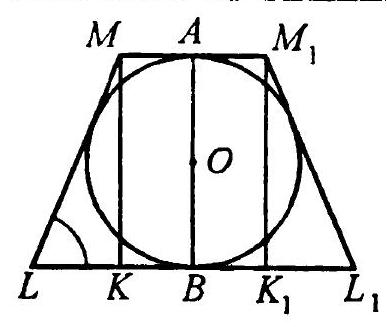
Fig. 3.57
(Fig. 3.57). By the problem statement, \(... | \arccos\frac{1}{3} | math-word-problem | false | \(\boxed{\arccos\frac{1}{3}}\) |
Given $ABCD$ is a unit square, $O$ is its center, $P$ is a point on $CD$, line $AP$ intersects the extension of $BC$ at point $Q$, intersects $DO$ at point $E$, and $OQ$ intersects $PC$ at point $F$. If $EF \| AC$, find the length of $AP$. | Solution: As shown in Figure 1, let $DP$
$$
=x(0<x<1), CQ=y,
$$
then $AP=\sqrt{1+x^{2}}, PC=$
1 - $x$. From the similarity of Rt $\triangle PCQ \sim \text{Rt}$
$\triangle PDA$, we get $\frac{CQ}{AD}=\frac{PC}{PD}$.
Therefore, $CQ=y=$
$$
\frac{AD \cdot PC}{PD}=\frac{1-x}{x}.
$$
Since $EF \parallel AC$, we have $\frac{... | \frac{\sqrt{5}}{2} | math-word-problem | false | \(\boxed{\frac{\sqrt{5}}{2}}\) |
# Problem 2. (2 points)
The sum of the sines of five angles from the interval $\left[0 ; \frac{\pi}{2}\right]$ is 3. What are the greatest and least integer values that the sum of their cosines can take?
# | # Answer: $2 ; 4$
## Solution:
Notice that $\sin x+\cos x=\sqrt{2} \sin \left(x+\frac{\pi}{4}\right)$. The argument of the sine function ranges from $\frac{\pi}{4}$ to $\frac{3 \pi}{4}$, so $\frac{\sqrt{2}}{2} \leqslant \sin \left(x+\frac{\pi}{4}\right) \leqslant 1$. Therefore, $1 \leqslant \sin x+\cos x \leqslant \s... | 2;4 | math-word-problem | false | \(\boxed{2;4}\) |
XXVIII - II - Task 3
In a hat, there are 7 slips of paper. On the $ n $-th slip, the number $ 2^n-1 $ is written ($ n = 1, 2, \ldots, 7 $). We draw slips randomly until the sum exceeds 124. What is the most likely value of this sum? | The sum of the numbers $2^0, 2^1, \ldots, 2^6$ is $127$. The sum of any five of these numbers does not exceed $2^2 + 2^3 + 2^4 + 2^5 + 2^6 = 124$. Therefore, we must draw at least six slips from the hat.
Each of the events where we draw six slips from the hat, and the seventh slip with the number $2^{n-1}$ ($n = 1, 2, ... | 127 | math-word-problem | false | \(\boxed{127}\) |
6.71. Find the sum of the squares of the lengths of all sides and diagonals of a regular $n$-gon inscribed in a circle of radius $R$. | 6.71. Let $S_{k}$ denote the sum of the squares of the distances from vertex $A_{k}$ to all other vertices. Then
$$
\begin{aligned}
S_{k}= & A_{k} A_{1}^{2}+A_{k} A_{2}^{2}+\ldots+A_{k} A_{n}^{2}= \\
& =A_{k} O^{2}+2\left(\overrightarrow{A_{k} O}, \overrightarrow{O A}_{1}\right)+A_{1} O^{2}+\ldots+A_{k} O^{2}+2\left(\... | n^{2}R^{2} | math-word-problem | false | \(\boxed{n^{2}R^{2}}\) |
Exercise 14. Let $A B C D$ be a rectangle and $M$ the midpoint of the segment $[C D]$. A line parallel to $(A B)$ intersects the segments $[A D],[A M],[B M],[B C]$ at points $P, Q, R$ and $S$, respectively. The line $(D R)$ intersects the segment $[A M]$ at $X$ and the segment $[B C]$ at $Y$. If $D X=6$ and $X R=4$, wh... | ## Solution alternative $n^{\circ} 1$
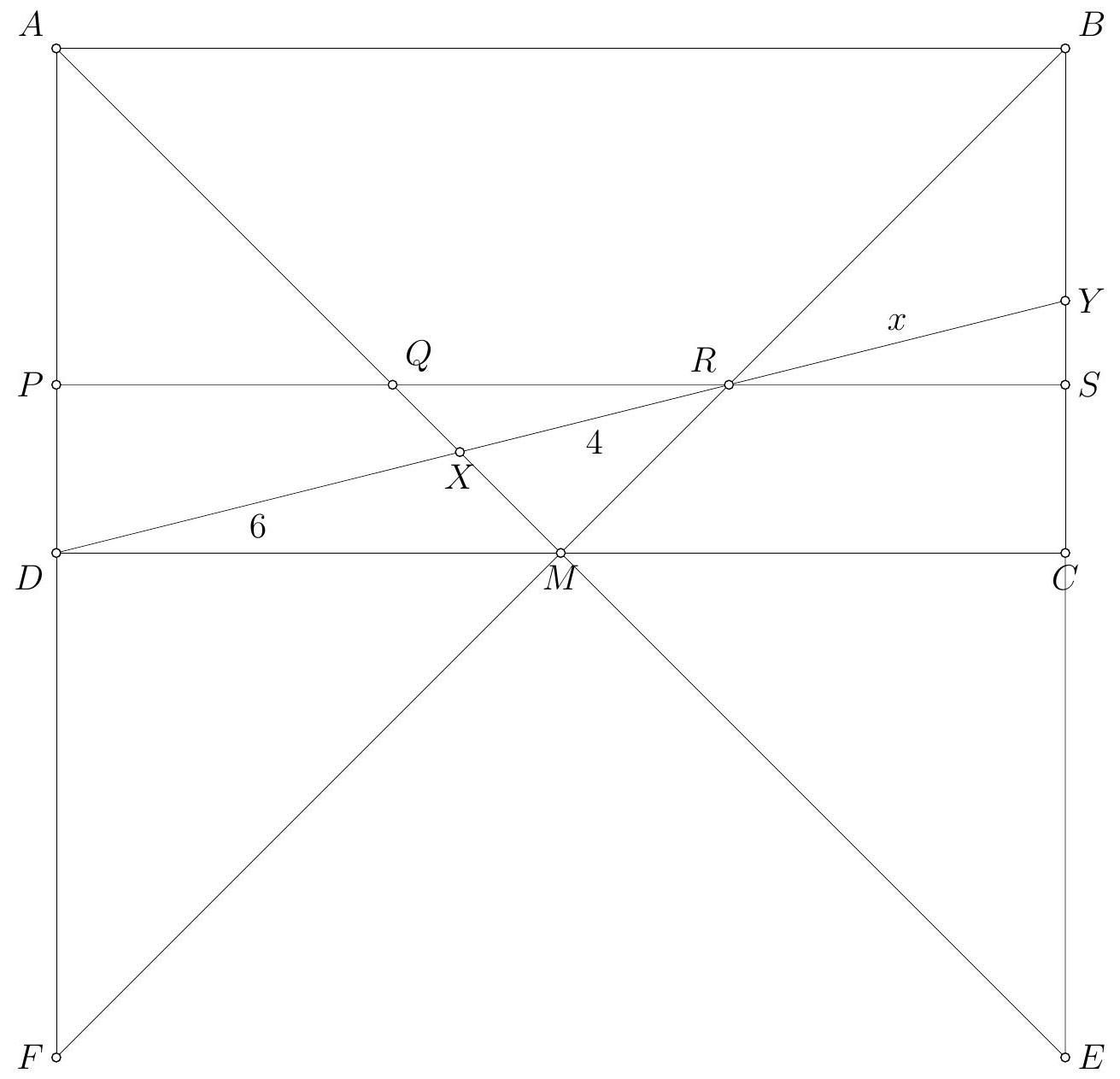
We propose a solution using Thales' theorem in two other "butterflies."
We introduce $E$ as the intersection point of the lines $(A M)$ and $(B C)$, ... | 5 | math-word-problem | false | \(\boxed{5}\) |
75. The least common multiple of three different two-digit numbers can be divided by the 16 natural numbers from $1 \sim 16$. The sum of these three two-digit numbers is . $\qquad$ | Answer: 270 | 270 | math-word-problem | false | \(\boxed{270}\) |
$19 \cdot 13$ (1)From $x^{2}-y^{2}=0$, we can get $\left\{\begin{array}{l}x+y=0, \\ x-y=0 \text {. }\end{array}\right.$
(2) If a line has two points that are equidistant from another line, then the two lines are parallel.
(3) If two triangles have two corresponding sides equal, and their areas are also equal, then they... | [Solution] (1) From $x^{2}-y^{2}=0$ we get $x+y=0$ or $x-y=0$, so the original statement is not true.
(2) As shown in the right figure (1), the original statement is not true.
(3) As shown in figure (2), $AD$ is the median to the base $BC$ of $\triangle ABC$, $\triangle ABD$ and $\triangle ADC$ satisfy the given condit... | 1 | MCQ | false | \(\boxed{1}\) |
Problem 1. The sum of the first three terms of an arithmetic progression, as well as the sum of the first six terms, are natural numbers. In addition, its first term $d_{1}$ satisfies the inequality $d_{1} \geqslant \frac{1}{2}$. What is the smallest value that $d_{1}$ can take? | Answer: $5 / 9$
Solution. Let $d_{n}$ be the $n$-th term of the progression, $d$ be the common difference of the progression, and $S_{n}=d_{1}+d_{2}+\ldots+d_{n}$ be the sum of the first $n$ terms of the progression.
Express $d_{1}$ in terms of $S_{3}$ and $S_{6}$. Note that $S_{3}=3 d_{1}+3 d, S_{6}=6 d_{1}+15 d$, f... | \frac{5}{9} | math-word-problem | false | \(\boxed{\frac{5}{9}}\) |
3. Given an isosceles trapezoid $A B C D$ with legs $A B=C D=a, A C \perp B D, \angle A B C=\alpha$. Then the area of this trapezoid is ( )
(A) $2 a \sin \alpha$
(B) $a^{2} \sin ^{2} a$
(C) $2 a \cos \alpha$
(D) $a^{2} \cos \alpha$ | 3. (B).
As shown in Figure 3, draw $A E \perp B C$, with $E$ as the foot of the perpendicular. Note that $\triangle B O C$ is an isosceles right triangle, so $\triangle A E C$ is also an isosceles right triangle, hence
$$
E C=A E=a \sin \alpha .
$$
$S_{\text {square } A \text { ABDC }}=a^{2} \sin ^{2} \alpha$. | B | MCQ | false | \(\boxed{B}\) |
Transform the fraction
$$
\frac{5 \sqrt[3]{6}-2 \sqrt[3]{12}}{4 \sqrt[3]{12}+2 \sqrt[3]{6}}
$$
so that the denominator is a rational number. | I. Solution: In our expression, $\sqrt[3]{6}$ can be factored out from every term in the numerator and the denominator:
$$
\frac{5 \sqrt[3]{6}-2 \sqrt[3]{12}}{4 \sqrt[3]{12}+2 \sqrt[3]{6}}=\frac{\sqrt[3]{6}(5-2 \sqrt[3]{2})}{\sqrt[3]{6}(4 \sqrt[3]{2}+2)}=\frac{5-2 \sqrt[3]{2}}{2(2 \sqrt[3]{2}+1)}
$$
The denominator w... | \frac{24\sqrt[3]{4}-12\sqrt[3]{2}-11}{34} | math-word-problem | false | \(\boxed{\frac{24\sqrt[3]{4}-12\sqrt[3]{2}-11}{34}}\) |
Example 3. As shown in Figure 3, from a point $Q(2,0)$ outside the circle $x^{2}+y^{2}=1$, a secant is drawn intersecting the circle at points $A$ and $B$. Find the equation of the locus of the midpoint of chord $\mathrm{AB}$. | Connect $\mathrm{OP}$,
then $O P \perp A B$, that is, $\angle \mathrm{OPQ}$ is always a right angle.
Since $OQ$ is a fixed line segment, by the locus theorem of plane geometry:
point $P$ lies on the circle with $O Q$ as its diameter.
Since $\mathrm{P}$ is the midpoint of chord $\mathrm{AB}$, point $\mathrm{P}$ must be... | (x-1)^{2}+y^{2}=1\left(x^{2}+y^{2}<1\right) | math-word-problem | false | \(\boxed{(x-1)^{2}+y^{2}=1\left(x^{2}+y^{2}<1\right)}\) |
7.2 Find all solutions to the numerical puzzle
$$
\mathrm{AX}+\mathrm{YX}=\mathrm{YPA}
$$
(different letters correspond to different digits, and the same letters correspond to the same digits). | Solution. It is clear that $\mathrm{Y}=1$ and A is an even digit. A cannot be less than 8, otherwise the result will not be a three-digit number. Therefore, $\mathrm{A}=8$.
$+\frac{$| $8 \mathrm{X}$ |
| :--- |
| $1 \mathrm{X}$ |}{$+1 \mathrm{P} 8$}
We see that when adding, there must be a carry of 1 from the units pl... | 89+19=108 | math-word-problem | false | \(\boxed{89+19=108}\) |
14. [25] Rachel and Brian are playing a game in a grid with 1 row of 2011 squares. Initially, there is one white checker in each of the first two squares from the left, and one black checker in the third square from the left. At each stage, Rachel can choose to either run or fight. If Rachel runs, she moves the black c... | Answer: 2009 Both operations, run and fight, move the black checker exactly one square to the right, so the game will end after exactly 2008 moves regardless of Brian's choices. Furthermore, it is easy to see that the order of the operations does not matter, so two games with the same number of fights will end up in th... | 2009 | math-word-problem | false | \(\boxed{2009}\) |
A1. The number $M$ consists of 2007 ones written consecutively, $M=111 \cdots 111$.
What is the sum of the digits of the number you get when you multiply $M$ by 2007?
(A) 2007
(B) 18036
(C) 18063
(D) 18084
(E) 4028049 | A1. If $M$ consists of four ones, then $2007 \times M=2229777$, so the sum of the digits is $3 \times(2+7)+9=4 \times 9$. If $M$ consists of five ones, then $2007 \times M=22299777$; the sum of the digits is then $3 \times(2+7)+9+9=5 \times 9$. If $M$ consists of 2007 ones, then the sum of the digits is $2007 \times 9=... | 18063 | MCQ | false | \(\boxed{18063}\) |
6. Given the equation
$$
2(a-b) x^{2}+(2 b-a b) x+(a b-2 a)=0
$$
has two equal real roots. Then $\frac{2}{b}-\frac{1}{a}=(\quad)$.
(A) 0
(B) $\frac{1}{2}$
(C) 1
(D) 2 | 6. B.
Since $\Delta=4 b^{2}-4 a b^{2}+a^{2} b^{2}-8(a-b)(a b-2 a)=0$, after rearrangement we get
$$
4 b^{2}+4 a b^{2}+a^{2} b^{2}-8 a^{2} b+16 a^{2}-16 a b=0 .
$$
Given that $a \neq 0, b \neq 0$. Therefore, we have
$$
\begin{array}{l}
\frac{4}{a^{2}}+\frac{4}{a}+1-\frac{8}{b}+\frac{16}{b^{2}}-\frac{16}{a b}=0 \\
\Rig... | B | MCQ | false | \(\boxed{B}\) |
Example 22([39.4]) Find all positive integer pairs $\{a, b\}$, such that $a^{2} b+a+b$ is divisible by $a b^{2}+b+7$.
| (i) First, analyze the size relationship between $a$ and $b$. Since it must be that $a^{2} b + a + b \geqslant a b^{2} + b + 7$, we have
$$a - 7 \geqslant a b (b - a).$$
This implies that (why)
$$a \geqslant b \geqslant 1.$$
We need to subtract a multiple of $a b^{2} + b + 7$ from $a^{2} b + a + b$ so that the absolu... | \{a, b\} = \{7 t^{2}, 7 t\}, \quad t \text{ is any positive integer.} | math-word-problem | false | \(\boxed{\{a, b\} = \{7 t^{2}, 7 t\}, \quad t \text{ is any positive integer.}}\) |
12. A competition has $n \geqslant 2$ participants, and each day the scores of the participants are exactly the set $\{1,2, \cdots, n\}$. If at the end of the $k$-th day, the total score of every pair of participants is 52 points, find all pairs $(n, k)$ that make this possible. | 12. On the one hand, the total score of all players at the end of $k$ days is $k(1+2+\cdots+n)=\frac{1}{2} k n(n+1)$. On the other hand, since the total score of any two players at the end of $k$ days is 52 points, the total score of all players at the end of $k$ days is also equal to $\frac{1}{n-1} C_{n}^{2} \cdot 52=... | (25,2),(12,4),(3,13) | math-word-problem | false | \(\boxed{(25,2),(12,4),(3,13)}\) |
4. The major axis of the ellipse is 6, the left vertex is on the circle $(x-3)^{2}+(y-2)^{2}$ $=4$, and the left directrix is the $y$-axis. Then the range of the eccentricity $e$ of the ellipse is ( ).
(A) $\frac{3}{8} \leqslant e \leqslant \frac{3}{4}$
(B) $\frac{1}{4} \leqslant e \leqslant \frac{3}{8}$
(C) $\frac{1}{... | 4. A.
Since $a=3$, let the left vertex be $(m, n)$, the center of the ellipse is $(m+3, n)$, and the $y$-axis is the directrix, $\frac{a^{2}}{c}=m+3$. Therefore, $c=\frac{9}{m+3}$, and $e=\frac{c}{a}=\frac{3}{m+3}$.
Since the vertex lies on the circle $(x-3)^{2}+(y-2)^{2}=4$, we have $1 \leqslant m \leqslant 5$, so $... | A | MCQ | false | \(\boxed{A}\) |
At each vertex of a tetrahedron, there sits an ant. At a given moment, each of them starts to move along a randomly chosen edge and crosses over to the adjacent vertex. What is the probability that two ants meet either on the way or at the end of their journey? | Solution. Let's number the vertices of the tetrahedron from 1 to 4. A position change can be represented by a sequence of four numbers from 1 to 4. For example, the sequence $(2,3,2,1)$ means that the ant at vertex 1 moves to vertex 2, the ant at vertex 2 moves to vertex 3, the ant at vertex 3 moves to vertex 2, and th... | \frac{25}{27} | math-word-problem | false | \(\boxed{\frac{25}{27}}\) |
8.1. A dandelion blooms in the morning, remains yellow for this and the next day, turns white on the third morning, and by evening of the third day, it has lost its petals. Yesterday afternoon, there were 20 yellow and 14 white dandelions on the meadow, and today there are 15 yellow and 11 white. How many yellow dandel... | Solution: All yellow dandelions the day before yesterday are the white dandelions of yesterday and the white dandelions of today. Therefore, the day before yesterday there were $14+11=25$ yellow dandelions.
Answer: 25 dandelions.
Note: The number of yellow dandelions yesterday and today is not needed for solving the ... | 25 | math-word-problem | false | \(\boxed{25}\) |
42. Suppose hypothetically that a certain, very corrupt political entity in a universe holds an election with two candidates, say $A$ and $B$. A total of $5,825,043$ votes are cast, but, in a sudden rainstorm, all the ballots get soaked. Undaunted, the election officials decide to guess what the ballots say. Each ballo... | Answer: 510
Solution: Let $N=2912521$, so that the number of ballots cast is $2 N+1$. Let $P$ be the probability that $B$ wins, and let $\alpha=51 \%$ and $\beta=49 \%$ and $\gamma=\beta / \alpha<1$. We have
$$
10^{-X}=P=\sum_{i=0}^{N}\binom{2 N+1}{N-i} \alpha^{N-i} \beta^{N+1+i}=\alpha^{N} \beta^{N+1} \sum_{i=0}^{N}\b... | 510 | math-word-problem | false | \(\boxed{510}\) |
1.034. $\frac{((7-6.35): 6.5+9.9) \cdot \frac{1}{12.8}}{\left(1.2: 36+1 \frac{1}{5}: 0.25-1 \frac{5}{6}\right) \cdot 1 \frac{1}{4}}: 0.125$. | ## Solution.
$$
\frac{((7-6.35): 6.5+9.9) \cdot \frac{1}{12.8}}{\left(1.2: 36+1 \frac{1}{5}: 0.25-1 \frac{5}{6}\right) \cdot 1 \frac{1}{4}}: 0.125=\frac{(0.65: 6.5+9.9) \cdot \frac{5}{64} \cdot 8}{\left(\frac{6}{5} \cdot \frac{1}{36}+\frac{6}{5} \cdot 4-\frac{11}{6}\right) \cdot \frac{5}{4}}=
$$
$$
=\frac{(0.1+9.9) \... | \frac{5}{3} | math-word-problem | false | \(\boxed{\frac{5}{3}}\) |
5. In the number $2016 * * * * 02 *$, each of the 5 asterisks needs to be replaced with any of the digits $0,2,4,5,7,9$ (digits can be repeated) so that the resulting 11-digit number is divisible by 15. In how many ways can this be done? | Answer: 864.
Solution. For a number to be divisible by 15, it is necessary and sufficient that it is divisible by 5 and by 3. To ensure divisibility by 5, we can choose 0 or 5 as the last digit from the available options (2 ways).
To ensure divisibility by three, we proceed as follows. We will choose three digits arb... | 864 | math-word-problem | false | \(\boxed{864}\) |
Example 21 (2002 Anhui Province Competition Question) Two people, A and B, agree to meet at a certain place within 10 days. It is agreed that the one who arrives first will wait for the other, but will leave after waiting for 3 days. If they are equally likely to arrive at the destination within the limit, then the pro... | Solve: Fill in $\frac{51}{100}$. Reason: Let A and B arrive at a certain place on the $x$-th and $y$-th day respectively, $0 \leqslant x \leqslant 10, 0 \leqslant$ $y \leqslant 10$. The necessary and sufficient condition for them to meet is $|x-y| \leqslant 3$. Therefore, the point $(x, y)$ is distributed within the sq... | \frac{51}{100} | math-word-problem | false | \(\boxed{\frac{51}{100}}\) |
Problem 6. Calculate $2 \operatorname{arctg} 3+\arcsin \frac{3}{5}$. | Answer: $\pi$.
Solution. First solution. Let $\operatorname{arctg} 3$ be denoted by $\alpha$, and $\arcsin 3 / 5$ by $\beta$. Note that $\beta \in(0, \pi / 2)$, $\mathrm{a} \operatorname{tg}^{2} \beta=\sin ^{2} \beta /\left(1-\sin ^{2} \beta\right)=3^{2} / 4^{2}$, from which $\operatorname{tg} \beta=3 / 4$; also $\ope... | \pi | math-word-problem | false | \(\boxed{\pi}\) |
12. Suppose $x=\frac{13}{\sqrt{19+8 \sqrt{3}}}$. Find the exact value of
$$
\frac{x^{4}-6 x^{3}-2 x^{2}+18 x+23}{x^{2}-8 x+15} .
$$ | 12. Answer: 5 .
Note that $x=\frac{1}{13 \sqrt{(4+\sqrt{3})^{2}}}=\frac{13(4-\sqrt{3})}{(4-\sqrt{3})(4+\sqrt{3})}=4-\sqrt{3}$. So $(x-4)^{2}=3$. That is,
$$
x^{2}-8 x+15=2 \text {. }
$$
It follows that
$$
\begin{aligned}
\frac{x^{4}-6 x^{3}-2 x^{2}+18 x+23}{x^{2}-8 x+15} & =x^{2}+2 x-1+\frac{38-20 x}{x^{2}-8 x+15} \\
... | 5 | math-word-problem | false | \(\boxed{5}\) |
19. Fill in the following squares with $0, 1, 2, 3, 4, 5, 6, 7, 8, 9$ respectively, so that the sum of the two five-digit numbers is 99999. The number of different addition equations is ( $\quad$ ). $(a+b$ and $b+a$ are considered the same equation) | 【Analysis】Let $\overline{A B C D E}+\overline{\text { abcde }}=99999$
First, determine if there is a carry,
$\mathrm{A}+\mathrm{B}+\mathrm{C}+\mathrm{D}+\mathrm{E}+\mathrm{a}+\mathrm{b}+\mathrm{c}+\mathrm{d}+\mathrm{e}$
$=0+1+2+3+4+5+6+7+8+9=45=9+9+9+9+9$, no carry.
(You can also determine no carry by $8+9=17$, which c... | 1536 | math-word-problem | false | \(\boxed{1536}\) |
The side of the base of a regular triangular prism $A B C A_1 B_1 C_1$ is 4, and the lateral edge is 3. On the edge $B B_1$, a point $F$ is taken, and on the edge $C C_1$, a point $G$ is taken such that $B_1 F=1, C G=\frac{2}{3}$. Points $E$ and $D$ are the midpoints of edges $A C$ and $B_1 C_1$ respectively. Find the ... | Note that for any fixed position of point $P$, the sum $E P+P Q$ will be the smallest if $P Q \perp F G$. Through the line $A 1 D$, we draw a plane perpendicular to the line $F G$. This can be done since the lines $A 1 D$ and $F G$ are perpendicular (the line $F G$ lies in the plane of the face $B B 1 C 1 C$, and the l... | \sqrt{\frac{51}{2}} | math-word-problem | false | \(\boxed{\sqrt{\frac{51}{2}}}\) |
How many ordered triples $(x,y,z)$ of positive integers satisfy $\text{lcm}(x,y) = 72, \text{lcm}(x,z) = 600 \text{ and lcm}(y,z)=900$?
$\textbf{(A)}\ 15\qquad\textbf{(B)}\ 16\qquad\textbf{(C)}\ 24\qquad\textbf{(D)}\ 27\qquad\textbf{(E)}\ 64$ | We prime factorize $72,600,$ and $900$. The prime factorizations are $2^3\times 3^2$, $2^3\times 3\times 5^2$ and $2^2\times 3^2\times 5^2$, respectively. Let $x=2^a\times 3^b\times 5^c$, $y=2^d\times 3^e\times 5^f$ and $z=2^g\times 3^h\times 5^i$. We know that \[\max(a,d)=3\] \[\max(b,e)=2\] \[\max(a,g)=3\] \[\max(b,h... | 15 | MCQ | false | \(\boxed{15}\) |
4. Use a 1-meter long iron wire to enclose a rectangle with both length and width being integer centimeters, there are $\qquad$ different ways to do so. The maximum area of the rectangle is $\qquad$ square centimeters. | 【Answer】 25 ways, 625 square centimeters
【Key Points】Perimeter of a Rectangle, Maximum Value Problem
【Analysis】
1 meter $=100$ centimeters, which is the perimeter of the rectangle, so the length + width of the rectangle $=100 \div 2=50$ centimeters;
Different ways to enclose: $50=49+1=48+2=47+3=\ldots=25+25$, a total o... | 25 | math-word-problem | false | \(\boxed{25}\) |
2. In trapezoid $A B C D$, $A D / / B C, A B=A C$, $B C=B D=(\sqrt{2}+1) C D$. Then the degree measure of $\angle B A C+\angle B D C$ is $\qquad$ . | 2.180 .
As shown in Figure 5, draw $A E \perp B C$ at $E$ and $D F \perp B C$ at $F$. Then
$$
\begin{array}{l}
B E=E C=\frac{1}{2} B C, \\
\angle C A E=\frac{1}{2} \angle B A C,
\end{array}
$$
and quadrilateral $A E F D$ is a rectangle. | 180 | math-word-problem | false | \(\boxed{180}\) |
Find the minimum and maximum value of the function
\begin{align*} f(x,y)=ax^2+cy^2 \end{align*}
Under the condition $ax^2-bxy+cy^2=d$, where $a,b,c,d$ are positive real numbers such that $b^2 -4ac <0$ | 1. We start with the given function \( f(x,y) = ax^2 + cy^2 \) and the constraint \( ax^2 - bxy + cy^2 = d \), where \( a, b, c, d \) are positive real numbers and \( b^2 - 4ac < 0 \).
2. To simplify the problem, we introduce the variable \( z = \frac{x}{y} \). This allows us to rewrite the constraint in terms of \( z... | \frac{2d\sqrt{ac}}{b + 2\sqrt{ac}} \leq f(x,y) \leq \frac{2d\sqrt{ac}}{b - 2\sqrt{ac}} | math-word-problem | false | \(\boxed{\frac{2d\sqrt{ac}}{b + 2\sqrt{ac}} \leq f(x,y) \leq \frac{2d\sqrt{ac}}{b - 2\sqrt{ac}}}\) |
README.md exists but content is empty.
- Downloads last month
- 7