

The full dataset viewer is not available (click to read why). Only showing a preview of the rows.
Error code:   DatasetGenerationError
Exception:    IndexError
Message:      list index out of range
Traceback:    Traceback (most recent call last):
                File "/usr/local/lib/python3.12/site-packages/datasets/builder.py", line 1898, in _prepare_split_single
                  original_shard_lengths[original_shard_id] += len(table)
                  ~~~~~~~~~~~~~~~~~~~~~~^^^^^^^^^^^^^^^^^^^
              IndexError: list index out of range

              The above exception was the direct cause of the following exception:

              Traceback (most recent call last):
                File "/src/services/worker/src/worker/job_runners/config/parquet_and_info.py", line 1347, in compute_config_parquet_and_info_response
                  parquet_operations = convert_to_parquet(builder)
                                       ^^^^^^^^^^^^^^^^^^^^^^^^^^^
                File "/src/services/worker/src/worker/job_runners/config/parquet_and_info.py", line 980, in convert_to_parquet
                  builder.download_and_prepare(
                File "/usr/local/lib/python3.12/site-packages/datasets/builder.py", line 884, in download_and_prepare
                  self._download_and_prepare(
                File "/usr/local/lib/python3.12/site-packages/datasets/builder.py", line 947, in _download_and_prepare
                  self._prepare_split(split_generator, **prepare_split_kwargs)
                File "/usr/local/lib/python3.12/site-packages/datasets/builder.py", line 1736, in _prepare_split
                  for job_id, done, content in self._prepare_split_single(
                                               ^^^^^^^^^^^^^^^^^^^^^^^^^^^
                File "/usr/local/lib/python3.12/site-packages/datasets/builder.py", line 1919, in _prepare_split_single
                  raise DatasetGenerationError("An error occurred while generating the dataset") from e
              datasets.exceptions.DatasetGenerationError: An error occurred while generating the dataset
Need help to make the dataset viewer work? Make sure to review how to configure the dataset viewer, and open a discussion for direct support.
year string | tier string | problem_label string | problem_type string | exam string | problem string | solution string | metadata dict |
|---|---|---|---|---|---|---|---|
1989 | T1 | 1 | null | APMO | Let $x_{1}, x_{2}, \ldots, x_{n}$ be positive real numbers, and let
$$
S=x_{1}+x_{2}+\cdots+x_{n}
$$
Prove that
$$
\left(1+x_{1}\right)\left(1+x_{2}\right) \cdots\left(1+x_{n}\right) \leq 1+S+\frac{S^{2}}{2!}+\frac{S^{3}}{3!}+\cdots+\frac{S^{n}}{n!}
$$ | Let $\sigma_{k}$ be the $k$ th symmetric polynomial, namely
$$
\sigma_{k}=\sum_{\substack{|S|=k \\ S \subseteq\{1,2, \ldots, n\}}} \prod_{i \in S} x_{i},
$$
and more explicitly
$$
\sigma_{1}=S, \quad \sigma_{2}=x_{1} x_{2}+x_{1} x_{3}+\cdots+x_{n-1} x_{n}, \quad \text { and so on. }
$$
Then
$$
\left(1+x_{1}\right)... | {
"resource_path": "APMO/segmented/en-apmo1989_sol.jsonl",
"problem_match": "# Problem 1",
"solution_match": "# Solution 1"
} |
1989 | T1 | 1 | null | APMO | Let $x_{1}, x_{2}, \ldots, x_{n}$ be positive real numbers, and let
$$
S=x_{1}+x_{2}+\cdots+x_{n}
$$
Prove that
$$
\left(1+x_{1}\right)\left(1+x_{2}\right) \cdots\left(1+x_{n}\right) \leq 1+S+\frac{S^{2}}{2!}+\frac{S^{3}}{3!}+\cdots+\frac{S^{n}}{n!}
$$ | By AM-GM,
$$
\left(1+x_{1}\right)\left(1+x_{2}\right) \cdots\left(1+x_{n}\right) \leq\left(\frac{\left(1+x_{1}\right)+\left(1+x_{2}\right)+\cdots+\left(1+x_{n}\right)}{n}\right)^{n}=\left(1+\frac{S}{n}\right)^{n}
$$
By the binomial theorem,
$$
\left(1+\frac{S}{n}\right)^{n}=\sum_{k=0}^{n}\binom{n}{k}\left(\frac{S}{n... | {
"resource_path": "APMO/segmented/en-apmo1989_sol.jsonl",
"problem_match": "# Problem 1",
"solution_match": "# Solution 2"
} |
1989 | T1 | 2 | null | APMO | Prove that the equation
$$
6\left(6 a^{2}+3 b^{2}+c^{2}\right)=5 n^{2}
$$
has no solutions in integers except $a=b=c=n=0$. | We can suppose without loss of generality that $a, b, c, n \geq 0$. Let $(a, b, c, n)$ be a solution with minimum sum $a+b+c+n$. Suppose, for the sake of contradiction, that $a+b+c+n>0$. Since 6 divides $5 n^{2}, n$ is a multiple of 6 . Let $n=6 n_{0}$. Then the equation reduces to
$$
6 a^{2}+3 b^{2}+c^{2}=30 n_{0}^{2... | {
"resource_path": "APMO/segmented/en-apmo1989_sol.jsonl",
"problem_match": "# Problem 2",
"solution_match": "# Solution\n\n"
} |
1989 | T1 | 3 | null | APMO | Let $A_{1}, A_{2}, A_{3}$ be three points in the plane, and for convenience,let $A_{4}=A_{1}, A_{5}=A_{2}$. For $n=1,2$, and 3 , suppose that $B_{n}$ is the midpoint of $A_{n} A_{n+1}$, and suppose that $C_{n}$ is the midpoint of $A_{n} B_{n}$. Suppose that $A_{n} C_{n+1}$ and $B_{n} A_{n+2}$ meet at $D_{n}$, and that ... | Let $G$ be the centroid of triangle $A B C$, and also the intersection point of $A_{1} B_{2}, A_{2} B_{3}$, and $A_{3} B_{1}$ 。
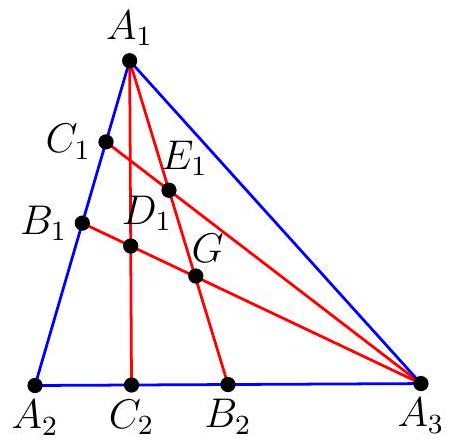
By Menelao's theorem on triangle $B_{1} A_{2} A_{3}$ and line $A... | {
"resource_path": "APMO/segmented/en-apmo1989_sol.jsonl",
"problem_match": "# Problem 3",
"solution_match": "\nSolution\n"
} |
1989 | T1 | 4 | null | APMO | Let $S$ be a set consisting of $m$ pairs $(a, b)$ of positive integers with the property that $1 \leq a<$ $b \leq n$. Show that there are at least
$$
4 m \frac{\left(m-\frac{n^{2}}{4}\right)}{3 n}
$$
triples $(a, b, c)$ such that $(a, b),(a, c)$, and $(b, c)$ belong to $S$. | Call a triple $(a, b, c)$ good if and only if $(a, b),(a, c)$, and $(b, c)$ all belong to $S$. For $i$ in $\{1,2, \ldots, n\}$, let $d_{i}$ be the number of pairs in $S$ that contain $i$, and let $D_{i}$ be the set of numbers paired with $i$ in $S$ (so $\left|D_{i}\right|=d_{i}$ ). Consider a pair $(i, j) \in S$. Our g... | {
"resource_path": "APMO/segmented/en-apmo1989_sol.jsonl",
"problem_match": "# Problem 4",
"solution_match": "# Solution\n\n"
} |
1989 | T1 | 5 | null | APMO | Determine all functions $f$ from the reals to the reals for which
(1) $f(x)$ is strictly increasing,
(2) $f(x)+g(x)=2 x$ for all real $x$, where $g(x)$ is the composition inverse function to $f(x)$.
(Note: $f$ and $g$ are said to be composition inverses if $f(g(x))=x$ and $g(f(x))=x$ for all real x.)
Answer: $f(x)=x+c... | Denote by $f_{n}$ the $n$th iterate of $f$, that is, $f_{n}(x)=\underbrace{f(f(\ldots f}_{n \text { times }}(x)))$.
Plug $x \rightarrow f_{n+1}(x)$ in (2): since $g\left(f_{n+1}(x)\right)=g\left(f\left(f_{n}(x)\right)\right)=f_{n}(x)$,
$$
f_{n+2}(x)+f_{n}(x)=2 f_{n+1}(x)
$$
that is,
$$
f_{n+2}(x)-f_{n+1}(x)=f_{n+1}(... | {
"resource_path": "APMO/segmented/en-apmo1989_sol.jsonl",
"problem_match": "# Problem 5",
"solution_match": "# Solution\n\n"
} |
1990 | T1 | 1 | null | APMO | In $\triangle A B C$, let $D, E, F$ be the midpoints of $B C, A C, A B$ respectively and let $G$ be the centroid of the triangle.
For each value of $\angle B A C$, how many non-similar triangles are there in which $A E G F$ is a cyclic quadrilateral? | Let $I$ be the intersection of $A G$ and $E F$.
Let $\delta=A I . I G-F I$ IE. Then
$$
A I=A D / 2, \quad I G=A D / 6, \quad F I=B C / 4=I E
$$
Further, applying the cosine rule to triangles $A B D, A C D$ we get
$$
\begin{aligned}
A B^{2} & =B C^{2} / 4+A D^{2}-A D \cdot B C \cdot \cos \angle B D A, \\
A C^{2} & =B... | {
"resource_path": "APMO/segmented/en-apmo1990_sol.jsonl",
"problem_match": "# Question 1 ",
"solution_match": "# FIRST SOLUTION\n\n"
} |
1990 | T1 | 1 | null | APMO | In $\triangle A B C$, let $D, E, F$ be the midpoints of $B C, A C, A B$ respectively and let $G$ be the centroid of the triangle.
For each value of $\angle B A C$, how many non-similar triangles are there in which $A E G F$ is a cyclic quadrilateral? | (Mr Marcus Brazil, La Trobe University, Bundoora, Melbourne, Australia):
We require, as above,
$$
A I \cdot I G=E I \cdot I F
$$
(which by (1) is equivalent to $A D^{2} / 3=C D^{2}$, i.e. $A D=C D \cdot \sqrt{3}$ ).
Let, without loss of generality, $C D=1$. Then $A$ lies on the circle of radius $\sqrt{3}$ with centre... | {
"resource_path": "APMO/segmented/en-apmo1990_sol.jsonl",
"problem_match": "# Question 1 ",
"solution_match": "\nSECOND SOLUTION "
} |
1990 | T1 | 1 | null | APMO | In $\triangle A B C$, let $D, E, F$ be the midpoints of $B C, A C, A B$ respectively and let $G$ be the centroid of the triangle.
For each value of $\angle B A C$, how many non-similar triangles are there in which $A E G F$ is a cyclic quadrilateral? | in the figure as shown below, we first show that it is necessary that $\angle A$ is less than $90^{\circ}$ if the quadrilateral $A E G F$ ; cyclic.
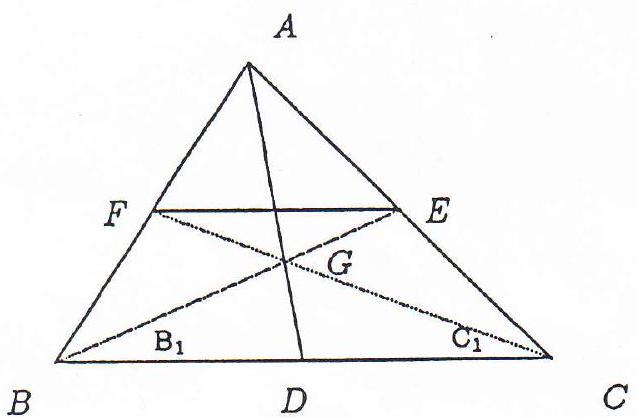
Now, since $E F \| B C$, we get
$$
\begin{... | {
"resource_path": "APMO/segmented/en-apmo1990_sol.jsonl",
"problem_match": "# Question 1 ",
"solution_match": "\nTHIRD SOLUTION\n"
} |
1990 | T1 | 2 | null | APMO | Let $a_{1}, a_{2}, \ldots, a_{n}$ be positive real numbers, and let $S_{k}$ be the sum of products of $a_{1}, a_{2}, \ldots, a_{n}$ taken $k$ at a time.
Show that
$$
S_{k} S_{n-k} \geq\binom{ n}{k}^{2} a_{1} a_{2} \ldots a_{n}, \quad \text { for } \quad k=1,2, \ldots, n-1
$$ | $$
\binom{n}{k} a_{1} a_{2} \ldots a_{n}
$$
$2=\sum_{1 \leq i_{1}<i_{2}<\ldots<i_{k} \leq n} a_{i_{1}} a_{i_{2}} \ldots a_{i_{k}} \cdot a_{1} a_{2} \ldots a_{n} / a_{i_{1}} a_{i_{2}} \ldots a_{i_{k}}$
(and using the Cauchy-Schwarz inequality)
$$
\begin{aligned}
& \leq\left(\sum_{1 \leq i_{1}<i_{2}<\ldots<i_{k} \leq n... | {
"resource_path": "APMO/segmented/en-apmo1990_sol.jsonl",
"problem_match": "# Question 2",
"solution_match": "# FIRST SOLUTION\n\n"
} |
1990 | T1 | 2 | null | APMO | Let $a_{1}, a_{2}, \ldots, a_{n}$ be positive real numbers, and let $S_{k}$ be the sum of products of $a_{1}, a_{2}, \ldots, a_{n}$ taken $k$ at a time.
Show that
$$
S_{k} S_{n-k} \geq\binom{ n}{k}^{2} a_{1} a_{2} \ldots a_{n}, \quad \text { for } \quad k=1,2, \ldots, n-1
$$ | (provided by the Canadian Problems Committee).
Write $S_{k}$ as $\sum_{i=1}^{\binom{n}{k}} t_{i}$. Then
주
$$
S_{n-k}=\left(\prod_{m=1}^{n} a_{m}\right)\left(\sum_{i=1}^{\binom{n}{k}} \frac{1}{t_{i}}\right)
$$
$$
\text { so that } \left.\begin{array}{rl}
S_{k} S_{n-k} & =\left(\prod_{m=1}^{n} a_{m}\right) \cdot\left(\... | {
"resource_path": "APMO/segmented/en-apmo1990_sol.jsonl",
"problem_match": "# Question 2",
"solution_match": "\nSECOND SOLUTION "
} |
1990 | T1 | 3 | null | APMO | Consider all the triangles $A B C$ which have a fixed base $A B$ and whose altitude from $C$ is a constant $h$. For which of these triangles is the product of its altitudes a maximum? | Let $h_{a}$ and $h_{b}$ be the altitudes from $A$ and $B$, respectively. Then
$$
\begin{aligned}
A B \cdot h \cdot A C \cdot h_{b} \cdot B C \cdot h_{a} & =8 . \text { area of } \triangle A B C)^{3} \\
& =(A B \cdot h)^{3},
\end{aligned}
$$
园
which is a constant. So the product $h . h_{a} \cdot h_{b}$ attains its max... | {
"resource_path": "APMO/segmented/en-apmo1990_sol.jsonl",
"problem_match": "# Question 3",
"solution_match": "# SOLUTION:"
} |
1990 | T1 | 4 | null | APMO | A set of 1990 persons is divided into non-intersecting subsets in such a way that
(a) no one in a subset knows all the others in the subset;
(b) among any three persons in a subset, there are always at least two who do not know each other; and
(c) for any two persons in a subset who do not know each other, there is exa... | (i) Let $S$ be a subset of persons satisfying conditions (a), (b) and (c). Let $x \in S$ be one who knows the maximum number of persons in $S$.
Assume that $x$ knows $x_{1}, x_{2}, \ldots, x_{n}$. By (b), $x_{i}$ and $x_{j}$ are strangers if $i \neq j$. For each $x_{i}$, let $N_{i}$ be the set of persons in $S$ who kno... | {
"resource_path": "APMO/segmented/en-apmo1990_sol.jsonl",
"problem_match": "# Question 4",
"solution_match": "# SOLUTION:"
} |
1990 | T1 | 5 | null | APMO | Show that for every integer $n \geq 6$, there exists a convex hexagon which can be dissected into exactly $n$ congruent triangles. | (provided by the Canadian Problems Committee).
The basic building blocks will be right angled triangles with sides $p, q$ (which are positive integers) adjacent to the right angle.
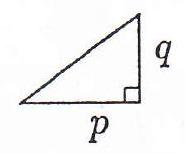
In the fir... | {
"resource_path": "APMO/segmented/en-apmo1990_sol.jsonl",
"problem_match": "# Question 5",
"solution_match": "\nFIRST SOLUTION "
} |
1990 | T1 | 5 | null | APMO | Show that for every integer $n \geq 6$, there exists a convex hexagon which can be dissected into exactly $n$ congruent triangles. | (provided by the Canadian Problems Committee):
The basic building blocks will be right angled triangles with sides $m, n$ (which are positive integers) adjacent to the right angle.
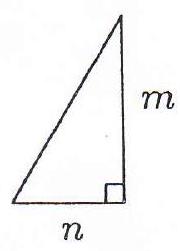
We constru... | {
"resource_path": "APMO/segmented/en-apmo1990_sol.jsonl",
"problem_match": "# Question 5",
"solution_match": "\nSECOND SOLUTION "
} |
1991 | T1 | 1 | null | APMO | Let $G$ be the centroid of triangle $A B C$ and $M$ be the midpoint of $B C$. Let $X$ be on $A B$ and $Y$ on $A C$ such that the points $X, Y$, and $G$ are collinear and $X Y$ and $B C$ are parallel. Suppose that $X C$ and $G B$ intersect at $Q$ and $Y B$ and $G C$ intersect at $P$. Show that triangle $M P Q$ is simila... | Let $R$ be the midpoint of $A C$; so $B R$ is a median and contains the centroid $G$.
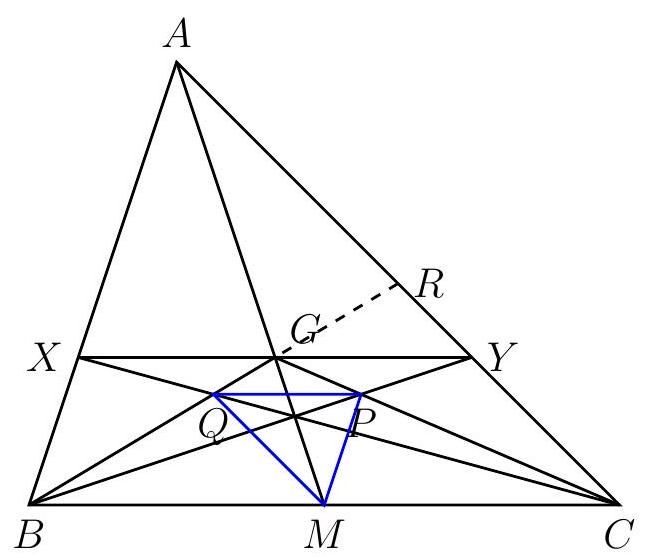
It is well known that $\frac{A G}{A M}=\frac{2}{3}$; thus the ratio of the similarity between $A X Y$ and ... | {
"resource_path": "APMO/segmented/en-apmo1991_sol.jsonl",
"problem_match": "# Problem 1",
"solution_match": "# Solution 1"
} |
1991 | T1 | 1 | null | APMO | Let $G$ be the centroid of triangle $A B C$ and $M$ be the midpoint of $B C$. Let $X$ be on $A B$ and $Y$ on $A C$ such that the points $X, Y$, and $G$ are collinear and $X Y$ and $B C$ are parallel. Suppose that $X C$ and $G B$ intersect at $Q$ and $Y B$ and $G C$ intersect at $P$. Show that triangle $M P Q$ is simila... | Let $S$ and $R$ be the midpoints of $A B$ and $A C$, respectively. Since $G$ is the centroid, it lies in the medians $B R$ and $C S$.
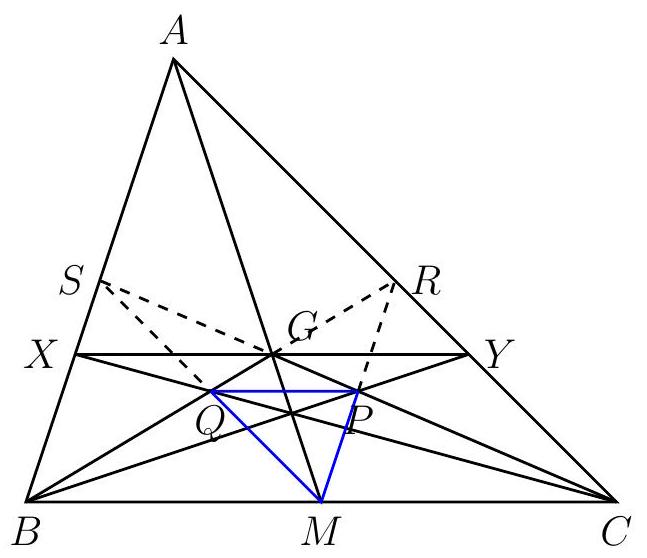
Due to the similarity between triangles $Q B C$ and $Q G ... | {
"resource_path": "APMO/segmented/en-apmo1991_sol.jsonl",
"problem_match": "# Problem 1",
"solution_match": "# Solution 2"
} |
1991 | T1 | 2 | null | APMO | Suppose there are 997 points given in a plane. If every two points are joined by a line segment with its midpoint coloured in red, show that there are at least 1991 red points in the plane. Can you find a special case with exactly 1991 red points? | Embed the points in the cartesian plane such that no two points have the same $y$-coordinate. Let $P_{1}, P_{2}, \ldots, P_{997}$ be the points and $y_{1}<y_{2}<\ldots<y_{997}$ be their respective $y$-coordinates. Then the $y$-coordinate of the midpoint of $P_{i} P_{i+1}, i=1,2, \ldots, 996$ is $\frac{y_{i}+y_{i+1}}{2}... | {
"resource_path": "APMO/segmented/en-apmo1991_sol.jsonl",
"problem_match": "# Problem 2",
"solution_match": "# Solution\n\n"
} |
1991 | T1 | 3 | null | APMO | Let $a_{1}, a_{2}, \ldots, a_{n}, b_{1}, b_{2}, \ldots, b_{n}$ be positive real numbers such that $a_{1}+a_{2}+\cdots+a_{n}=b_{1}+b_{2}+$ $\cdots+b_{n}$. Show that
$$
\frac{a_{1}^{2}}{a_{1}+b_{1}}+\frac{a_{2}^{2}}{a_{2}+b_{2}}+\cdots+\frac{a_{n}^{2}}{a_{n}+b_{n}} \geq \frac{a_{1}+a_{2}+\cdots+a_{n}}{2}
$$ | By the Cauchy-Schwartz inequality,
$$
\left(\frac{a_{1}^{2}}{a_{1}+b_{1}}+\frac{a_{2}^{2}}{a_{2}+b_{2}}+\cdots+\frac{a_{n}^{2}}{a_{n}+b_{n}}\right)\left(\left(a_{1}+b_{1}\right)+\left(a_{2}+b_{2}\right)+\cdots+\left(a_{n}+b_{n}\right)\right) \geq\left(a_{1}+a_{2}+\cdots+a_{n}\right)^{2} .
$$
Since $\left(\left(a_{1}+... | {
"resource_path": "APMO/segmented/en-apmo1991_sol.jsonl",
"problem_match": "# Problem 3",
"solution_match": "# Solution\n\n"
} |
1991 | T1 | 4 | null | APMO | During a break, $n$ children at school sit in a circle around their teacher to play a game. The teacher walks clockwise close to the children and hands out candies to some of them according to the following rule. He selects one child and gives him a candy, then he skips the next child and gives a candy to the next one,... | Number the children from 0 to $n-1$. Then the teacher hands candy to children in positions $f(x)=1+2+\cdots+x \bmod n=\frac{x(x+1)}{2} \bmod n$. Our task is to find the range of $f: \mathbb{Z}_{n} \rightarrow \mathbb{Z}_{n}$, and to verify whether the range is $\mathbb{Z}_{n}$, that is, whether $f$ is a bijection.
If $... | {
"resource_path": "APMO/segmented/en-apmo1991_sol.jsonl",
"problem_match": "# Problem 4",
"solution_match": "# Solution 1"
} |
1991 | T1 | 4 | null | APMO | During a break, $n$ children at school sit in a circle around their teacher to play a game. The teacher walks clockwise close to the children and hands out candies to some of them according to the following rule. He selects one child and gives him a candy, then he skips the next child and gives a candy to the next one,... | We give a full description of $a_{n}$, the size of the range of $f$.
Since congruences modulo $n$ are defined, via Chinese Remainder Theorem, by congruences modulo $p^{\alpha}$ for all prime divisors $p$ of $n$ and $\alpha$ being the number of factors $p$ in the factorization of $n, a_{n}=\prod_{p^{\alpha} \| n} a_{p^{... | {
"resource_path": "APMO/segmented/en-apmo1991_sol.jsonl",
"problem_match": "# Problem 4",
"solution_match": "# Solution 2"
} |
1991 | T1 | 5 | null | APMO | Given are two tangent circles and a point $P$ on their common tangent perpendicular to the lines joining their centres. Construct with ruler and compass all the circles that are tangent to these two circles and pass through the point $P$. | Throughout this problem, we will assume that the given circles are externally tangent, since the problem does not have a solution otherwise.
Let $\Gamma_{1}$ and $\Gamma_{2}$ be the given circles and $T$ be their tangency point. Suppose $\omega$ is a circle that is tangent to $\Gamma_{1}$ and $\Gamma_{2}$ and passes th... | {
"resource_path": "APMO/segmented/en-apmo1991_sol.jsonl",
"problem_match": "# Problem 5",
"solution_match": "# Solution\n\n"
} |
1992 | T1 | 1 | null | APMO | A triangle with sides $a, b$, and $c$ is given. Denote by $s$ the semiperimeter, that is $s=(a+b+c) / 2$. Construct a triangle with sides $s-a, s-b$, and $s-c$. This process is repeated until a triangle can no longer be constructed with the sidelengths given.
For which original triangles can this process be repeated in... | The perimeter of each new triangle constructed by the process is $(s-a)+(s-b)+(s-c)=$ $3 s-(a+b+c)=3 s-2 s=s$, that is, it is halved. Consider a new equivalent process in which a similar triangle with sidelengths $2(s-a), 2(s-b), 2(s-c)$ is constructed, so the perimeter is kept invariant.
Suppose without loss of genera... | {
"resource_path": "APMO/segmented/en-apmo1992_sol.jsonl",
"problem_match": "# Problem 1",
"solution_match": "# Solution\n\n"
} |
1992 | T1 | 2 | null | APMO | In a circle $C$ with centre $O$ and radius $r$, let $C_{1}, C_{2}$ be two circles with centres $O_{1}, O_{2}$ and radii $r_{1}, r_{2}$ respectively, so that each circle $C_{i}$ is internally tangent to $C$ at $A_{i}$ and so that $C_{1}, C_{2}$ are externally tangent to each other at $A$.
Prove that the three lines $O A... | Because of the tangencies, the following triples of points (two centers and a tangency point) are collinear:
$$
O_{1} ; O_{2} ; A, \quad O ; O_{1} ; A_{1}, \quad O ; O_{2} ; A_{2}
$$
Because of that we can ignore the circles and only draw their centers and tangency points.
 Show that if we choose all three numbers greater than $n / 2$, then t... | In both items, the smallest chosen number is at least 2: in part (a), $n / 2>1$ and in part (b), $p$ is a prime. So let $1<x<y<z$ be the chosen numbers. Then all possible combinations are
$$
x+y+z, \quad x+y z, \quad x y+z, \quad y+z x, \quad(x+y) z, \quad(z+x) y, \quad(x+y) z, \quad x y z
$$
Since, for $1<m<n$ and $... | {
"resource_path": "APMO/segmented/en-apmo1992_sol.jsonl",
"problem_match": "# Problem 3",
"solution_match": "# Solution\n\n"
} |
1992 | T1 | 4 | null | APMO | Determine all pairs $(h, s)$ of positive integers with the following property: If one draws $h$ horizontal lines and another $s$ lines which satisfy
(i) they are not horizontal,
(ii) no two of them are parallel,
(iii) no three of the $h+s$ lines are concurrent,
then the number of regions formed by these $h+s$ lines is ... | Let $a_{h, s}$ the number of regions formed by $h$ horizontal lines and $s$ another lines as described in the problem. Let $\mathcal{F}_{h, s}$ be the union of the $h+s$ lines and pick any line $\ell$. If it intersects the other lines in $n$ (distinct!) points then $\ell$ is partitioned into $n-1$ line segments and 2 r... | {
"resource_path": "APMO/segmented/en-apmo1992_sol.jsonl",
"problem_match": "# Problem 4",
"solution_match": "# Solution\n\n"
} |
1992 | T1 | 5 | null | APMO | Find a sequence of maximal length consisting of non-zero integers in which the sum of any seven consecutive terms is positive and that of any eleven consecutive terms is negative.
Answer: The maximum length is 16 . There are several possible sequences with this length; one such sequence is $(-7,-7,18,-7,-7,-7,18,-7,-7... | Suppose it is possible to have more than 16 terms in the sequence. Let $a_{1}, a_{2}, \ldots, a_{17}$ be the first 17 terms of the sequence. Consider the following array of terms in the sequence:
| $a_{1}$ | $a_{2}$ | $a_{3}$ | $a_{4}$ | $a_{5}$ | $a_{6}$ | $a_{7}$ | $a_{8}$ | $a_{9}$ | $a_{10}$ | $a_{11}$ |
| :---: |... | {
"resource_path": "APMO/segmented/en-apmo1992_sol.jsonl",
"problem_match": "# Problem 5",
"solution_match": "# Solution\n\n"
} |
1993 | T1 | 1 | null | APMO | Let $A B C D$ be a quadrilateral such that all sides have equal length and angle $\angle A B C$ is 60 degrees. Let $\ell$ be a line passing through $D$ and not intersecting the quadrilateral (except at $D)$. Let $E$ and $F$ be the points of intersection of $\ell$ with $A B$ and $B C$ respectively. Let $M$ be the point ... | 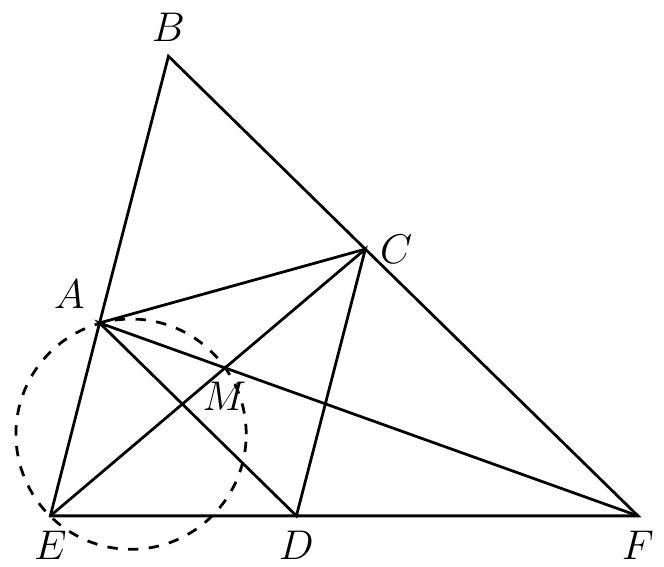
Triangles $A E D$ and $C D F$ are similar, because $A D \| C F$ and $A E \| C D$. Thus, since $A B C$ and $A C D$ are equilateral triangles,
$$
\frac{A E}{C D}=\frac{A D}{C F} \Longleftrighta... | {
"resource_path": "APMO/segmented/en-apmo1993_sol.jsonl",
"problem_match": "# Problem 1",
"solution_match": "# Solution\n\n"
} |
1993 | T1 | 2 | null | APMO | Find the total number of different integer values the function
$$
f(x)=[x]+[2 x]+\left[\frac{5 x}{3}\right]+[3 x]+[4 x]
$$
takes for real numbers $x$ with $0 \leq x \leq 100$.
Note: $[t]$ is the largest integer that does not exceed $t$.
Answer: 734. | Note that, since $[x+n]=[x]+n$ for any integer $n$,
$$
f(x+3)=[x+3]+[2(x+3)]+\left[\frac{5(x+3)}{3}\right]+[3(x+3)]+[4(x+3)]=f(x)+35,
$$
one only needs to investigate the interval $[0,3)$.
The numbers in this interval at which at least one of the real numbers $x, 2 x, \frac{5 x}{3}, 3 x, 4 x$ is an integer are
- $0,... | {
"resource_path": "APMO/segmented/en-apmo1993_sol.jsonl",
"problem_match": "# Problem 2",
"solution_match": "# Solution\n\n"
} |
1993 | T1 | 3 | null | APMO | Let
$$
f(x)=a_{n} x^{n}+a_{n-1} x^{n-1}+\cdots+a_{0} \quad \text { and } \quad g(x)=c_{n+1} x^{n+1}+c_{n} x^{n}+\cdots+c_{0}
$$
be non-zero polynomials with real coefficients such that $g(x)=(x+r) f(x)$ for some real number $r$. If $a=\max \left(\left|a_{n}\right|, \ldots,\left|a_{0}\right|\right)$ and $c=\max \left(... | Expanding $(x+r) f(x)$, we find that $c_{n+1}=a_{n}, c_{k}=a_{k-1}+r a_{k}$ for $k=1,2, \ldots, n$, and $c_{0}=r a_{0}$. Consider three cases:
- $r=0$. Then $c_{0}=0$ and $c_{k}=a_{k-1}$ for $k=1,2, \ldots, n$, and $a=c \Longrightarrow \frac{a}{c}=1 \leq n+1$.
- $|r| \geq 1$. Then
$$
\begin{gathered}
\left|a_{0}\righ... | {
"resource_path": "APMO/segmented/en-apmo1993_sol.jsonl",
"problem_match": "# Problem 3",
"solution_match": "# Solution\n\n"
} |
1993 | T1 | 4 | null | APMO | Determine all positive integers $n$ for which the equation
$$
x^{n}+(2+x)^{n}+(2-x)^{n}=0
$$
has an integer as a solution.
## Answer: $n=1$. | If $n$ is even, $x^{n}+(2+x)^{n}+(2-x)^{n}>0$, so $n$ is odd.
For $n=1$, the equation reduces to $x+(2+x)+(2-x)=0$, which has the unique solution $x=-4$.
For $n>1$, notice that $x$ is even, because $x, 2-x$, and $2+x$ have all the same parity. Let $x=2 y$, so the equation reduces to
$$
y^{n}+(1+y)^{n}+(1-y)^{n}=0 .
$$... | {
"resource_path": "APMO/segmented/en-apmo1993_sol.jsonl",
"problem_match": "# Problem 4",
"solution_match": "# Solution\n\n"
} |
1993 | T1 | 5 | null | APMO | Let $P_{1}, P_{2}, \ldots, P_{1993}=P_{0}$ be distinct points in the $x y$-plane with the following properties:
(i) both coordinates of $P_{i}$ are integers, for $i=1,2, \ldots, 1993$;
(ii) there is no point other than $P_{i}$ and $P_{i+1}$ on the line segment joining $P_{i}$ with $P_{i+1}$ whose coordinates are both i... | Call a point $(x, y) \in \mathbb{Z}^{2}$ even or odd according to the parity of $x+y$. Since there are an odd number of points, there are two points $P_{i}=(a, b)$ and $P_{i+1}=(c, d), 0 \leq i \leq 1992$ with the same parity. This implies that $a+b+c+d$ is even. We claim that the midpoint of $P_{i} P_{i+1}$ is the des... | {
"resource_path": "APMO/segmented/en-apmo1993_sol.jsonl",
"problem_match": "# Problem 5",
"solution_match": "# Solution\n\n"
} |
1994 | T1 | 1 | null | APMO | Let $f: \mathbb{R} \rightarrow \mathbb{R}$ be a function such that
(i) For all $x, y \in \mathbb{R}$,
$$
f(x)+f(y)+1 \geq f(x+y) \geq f(x)+f(y)
$$
(ii) For all $x \in[0,1), f(0) \geq f(x)$,
(iii) $-f(-1)=f(1)=1$.
Find all such functions $f$.
Answer: $f(x)=\lfloor x\rfloor$, the largest integer that does not exceed $... | Plug $y \rightarrow 1$ in (i):
$$
f(x)+f(1)+1 \geq f(x+1) \geq f(x)+f(1) \Longleftrightarrow f(x)+1 \leq f(x+1) \leq f(x)+2
$$
Now plug $y \rightarrow-1$ and $x \rightarrow x+1$ in (i):
$$
f(x+1)+f(-1)+1 \geq f(x) \geq f(x+1)+f(-1) \Longleftrightarrow f(x) \leq f(x+1) \leq f(x)+1
$$
Hence $f(x+1)=f(x)+1$ and we onl... | {
"resource_path": "APMO/segmented/en-apmo1994_sol.jsonl",
"problem_match": "# Problem 1",
"solution_match": "# Solution\n\n"
} |
1994 | T1 | 2 | null | APMO | Given a nondegenerate triangle $A B C$, with circumcentre $O$, orthocentre $H$, and circumradius $R$, prove that $|O H|<3 R$. | Embed $A B C$ in the complex plane, with $A, B$ and $C$ in the circle $|z|=R$, so $O$ is the origin. Represent each point by its lowercase letter. It is well known that $h=a+b+c$, so
$$
O H=|a+b+c| \leq|a|+|b|+|c|=3 R .
$$
The equality cannot occur because $a, b$, and $c$ are not collinear, so $O H<3 R$. | {
"resource_path": "APMO/segmented/en-apmo1994_sol.jsonl",
"problem_match": "# Problem 2",
"solution_match": "# Solution 1"
} |
1994 | T1 | 2 | null | APMO | Given a nondegenerate triangle $A B C$, with circumcentre $O$, orthocentre $H$, and circumradius $R$, prove that $|O H|<3 R$. | Suppose with loss of generality that $\angle A<90^{\circ}$. Let $B D$ be an altitude. Then
$$
A H=\frac{A D}{\cos \left(90^{\circ}-C\right)}=\frac{A B \cos A}{\sin C}=2 R \cos A
$$
By the triangle inequality,
$$
O H<A O+A H=R+2 R \cos A<3 R
$$
Comment: With a bit more work, if $a, b, c$ are the sidelengths of $A B ... | {
"resource_path": "APMO/segmented/en-apmo1994_sol.jsonl",
"problem_match": "# Problem 2",
"solution_match": "# Solution 2"
} |
1994 | T1 | 3 | null | APMO | Let $n$ be an integer of the form $a^{2}+b^{2}$, where $a$ and $b$ are relatively prime integers and such that if $p$ is a prime, $p \leq \sqrt{n}$, then $p$ divides $a b$. Determine all such $n$.
Answer: $n=2,5,13$. | A prime $p$ divides $a b$ if and only if divides either $a$ or $b$. If $n=a^{2}+b^{2}$ is a composite then it has a prime divisor $p \leq \sqrt{n}$, and if $p$ divides $a$ it divides $b$ and vice-versa, which is not possible because $a$ and $b$ are coprime. Therefore $n$ is a prime.
Suppose without loss of generality t... | {
"resource_path": "APMO/segmented/en-apmo1994_sol.jsonl",
"problem_match": "# Problem 3",
"solution_match": "# Solution\n\n"
} |
1994 | T1 | 4 | null | APMO | Is there an infinite set of points in the plane such that no three points are collinear, and the distance between any two points is rational?
Answer: Yes. | The answer is yes and we present the following construction: the idea is considering points in the unit circle of the form $P_{n}=(\cos (2 n \theta), \sin (2 n \theta))$ for an appropriate $\theta$. Then the distance $P_{m} P_{n}$ is the length of the chord with central angle $(2 m-2 n) \theta \bmod \pi$, that is, $2|\... | {
"resource_path": "APMO/segmented/en-apmo1994_sol.jsonl",
"problem_match": "# Problem 4",
"solution_match": "# Solution 1"
} |
1994 | T1 | 4 | null | APMO | Is there an infinite set of points in the plane such that no three points are collinear, and the distance between any two points is rational?
Answer: Yes. | We present a different construction. Consider the (collinear) points
$$
P_{k}=\left(1, \frac{x_{k}}{y_{k}}\right),
$$
such that the distance $O P_{k}$ from the origin $O$,
$$
O P_{k}=\frac{\sqrt{x_{k}^{2}+y_{k}^{2}}}{y_{k}}
$$
is rational, and $x_{k}$ and $y_{k}$ are integers. Clearly, $P_{i} P_{j}=\left|\frac{x_{i... | {
"resource_path": "APMO/segmented/en-apmo1994_sol.jsonl",
"problem_match": "# Problem 4",
"solution_match": "# Solution 2"
} |
1994 | T1 | 5 | null | APMO | You are given three lists $A, B$, and $C$. List $A$ contains the numbers of the form $10^{k}$ in base 10, with $k$ any integer greater than or equal to 1 . Lists $B$ and $C$ contain the same numbers translated into base 2 and 5 respectively:
| $A$ | $B$ | $C$ |
| :--- | :--- | :--- |
| 10 | 1010 | 20 |
| 100 | 1100100... | Let $b_{k}$ and $c_{k}$ be the number of digits in the $k$ th term in lists $B$ and $C$, respectively. Then
$$
2^{b_{k}-1} \leq 10^{k}<2^{b_{k}} \Longleftrightarrow \log _{2} 10^{k}<b_{k} \leq \log _{2} 10^{k}+1 \Longleftrightarrow b_{k}=\left\lfloor k \cdot \log _{2} 10\right\rfloor+1
$$
and, similarly
$$
c_{k}=\le... | {
"resource_path": "APMO/segmented/en-apmo1994_sol.jsonl",
"problem_match": "# Problem 5",
"solution_match": "# Solution\n\n"
} |
1999 | T1 | 1 | null | APMO | Find the smallest positive integer $n$ with the following property : There does not exist an arithmetic progression of 1993 terms of real numbers containing exactly $n$ integers. | and Marking Scheme:
We first note that the integer terms of any arithmetic progression are "equally spaced", because if the $i$ th term $a_{i}$ and the $(i+j)$ th term $a_{i+j}$ of an arithmetic progression are both integers, then so is the $(i+2 j)$ th term $a_{i+2 j}=a_{i+j}+\left(a_{i+j}-a_{i}\right)$.
1 POINT for ... | {
"resource_path": "APMO/segmented/en-apmo1999_sol.jsonl",
"problem_match": "\nProblem 1.",
"solution_match": "\nSolution "
} |
1999 | T1 | 2 | null | APMO | Let $a_{1}, a_{2}, \cdots$ be a sequence of real numbers satisfying $a_{i+j} \leq a_{i}+a_{j}$ for all $i, j=1,2, \cdots$. Prove that
$$
a_{1}+\frac{a_{2}}{2}+\frac{a_{3}}{3}+\cdots+\frac{a_{n}}{n} \geq a_{n}
$$
for each positive integer $n$. | and Marking Scheme:
Letting $b_{i}=a_{i} / i,(i=1,2, \cdots)$, we prove that
$$
b_{1}+\cdots+b_{n} \geq a_{n} \quad(n=1,2, \cdots)
$$
by induction on $n$. For $n=1, b_{1}=a_{1} \geq a_{1}$, and the induction starts. Assume that
$$
b_{1}+\cdots+b_{k} \geq a_{k}
$$
for all $k=1,2, \cdots, n-1$. It suffices to prove ... | {
"resource_path": "APMO/segmented/en-apmo1999_sol.jsonl",
"problem_match": "\nProblem 2.",
"solution_match": "# Solution "
} |
1999 | T1 | 3 | null | APMO | Let $\Gamma_{1}$ and $\Gamma_{2}$ be two circles intersecting at $P$ and $Q$. The common tangent, closer to $P$, of $\Gamma_{1}$ and $\Gamma_{2}$ touches $\Gamma_{1}$ at $A$ and $\Gamma_{2}$ at $B$. The tangent of $\Gamma_{1}$ at $P$ meets $\Gamma_{2}$ at $C$, which is different from $P$ and the extension of $A P$ meet... | and Marking Scheme:
Let $\alpha=\angle P A B, \beta=\angle A B P$ y $\gamma=\angle Q A P$. Then, since $P C$ is tangent to $\Gamma_{1}$, we have $\angle Q P C=$ $\angle Q B C=\gamma$. Thus $A, B, R, Q$ are concyclic.
3 POINTS for proving that $A, B, R, Q$ are concyclic.
Since $A B$ is a common tangent to $\Gamma_{1}$... | {
"resource_path": "APMO/segmented/en-apmo1999_sol.jsonl",
"problem_match": "\nProblem 3.",
"solution_match": "# Solution "
} |
1999 | T1 | 4 | null | APMO | Determine all pairs $(a, b)$ of integers with the property that the numbers $a^{2}+4 b$ and $b^{2}+4 a$ are both perfect squares. | and Marking Scheme:
Without loss of gencrality, assume that $|b| \leq|a|$. If $b=0$, then $a$ must be a perfect square. So ( $a=k^{2}, b=0$ ) for each $k \in Z$ is a solution.
Now we consider the case $b \neq 0$. Because $a^{2}+4 b$ is a perfect square, the quadratic equation
$$
x^{2}+a x-b=0
$$
has two non-zero int... | {
"resource_path": "APMO/segmented/en-apmo1999_sol.jsonl",
"problem_match": "\nProblem 4.",
"solution_match": "# First Solution "
} |
1999 | T1 | 4 | null | APMO | Determine all pairs $(a, b)$ of integers with the property that the numbers $a^{2}+4 b$ and $b^{2}+4 a$ are both perfect squares. | and Marking Scheme:
Without loss of generality assume that $|b| \leq|a|$. Then $a^{2}+4 b \leq a^{2}+4|a|<a^{2}+4|a|+4=(|a|+2)^{2}$. Given that $a^{2}+4 b$ is a perfect square and since $a^{2}+4 b$ y $a^{2}$ have same parity then $a^{2}+4 b \neq(|a|+1)^{2}$, so
$$
a^{2}+4 b \leq a^{2}
$$
2 POINTS for proving (1).
Le... | {
"resource_path": "APMO/segmented/en-apmo1999_sol.jsonl",
"problem_match": "\nProblem 4.",
"solution_match": "# Second Solution "
} |
1999 | T1 | 5 | null | APMO | Let $S$ be a set of $2 n+1$ points in the plane such that no three are collinear and no four concyclic. A circle will be called good if it has 3 points of $S$ on its circumference, $n-1$ points in its interior and $n-1$ in its exterior. Prove that the number of good circles has the same parity as $n$. | and Marking Scheme:
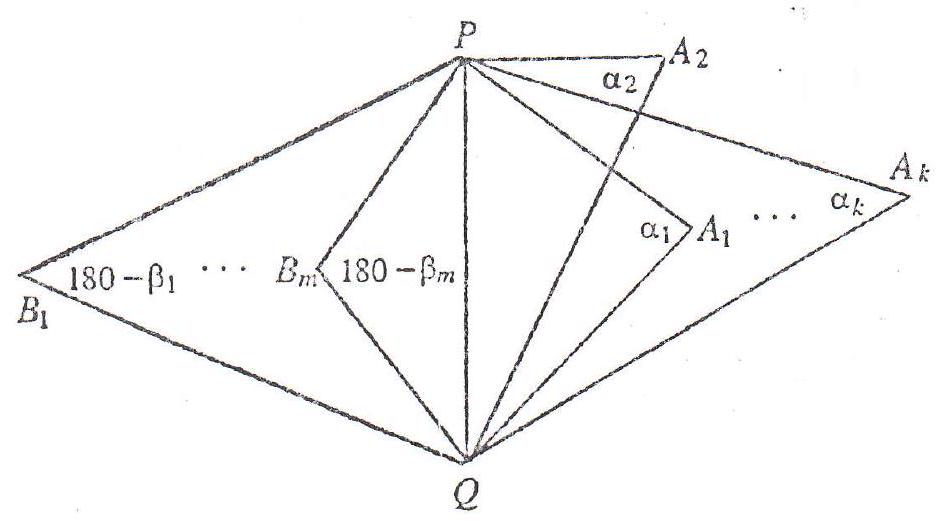
Lemma 1. Let $P$ and $Q$ be two points of $S$. The number of good circles that contain $P$ and $Q$ on their circumference is odd.
## Proof of Lemma 1.
Let $N$ be the nu... | {
"resource_path": "APMO/segmented/en-apmo1999_sol.jsonl",
"problem_match": "\nProblem 5.",
"solution_match": "# Solution "
} |
2000 | T1 | 1 | null | APMO | Compute the sum $S=\sum_{i=0}^{101} \frac{x_{i}^{3}}{1-3 x_{i}+3 x_{i}^{2}}$ for $x_{i}=\frac{i}{101}$.
Answer: $S=51$. | Since $x_{101-i}=\frac{101-i}{101}=1-\frac{i}{101}=1-x_{i}$ and
$$
1-3 x_{i}+3 x_{i}^{2}=\left(1-3 x_{i}+3 x_{i}^{2}-x_{i}^{3}\right)+x_{i}^{3}=\left(1-x_{i}\right)^{3}+x_{i}^{3}=x_{101-i}^{3}+x_{i}^{3},
$$
we have, by replacing $i$ by $101-i$ in the second sum,
$$
2 S=S+S=\sum_{i=0}^{101} \frac{x_{i}^{3}}{x_{101-i}... | {
"resource_path": "APMO/segmented/en-apmo2000_sol.jsonl",
"problem_match": "# Problem 1",
"solution_match": "# Solution\n\n"
} |
2000 | T1 | 2 | null | APMO | Given the following arrangement of circles:
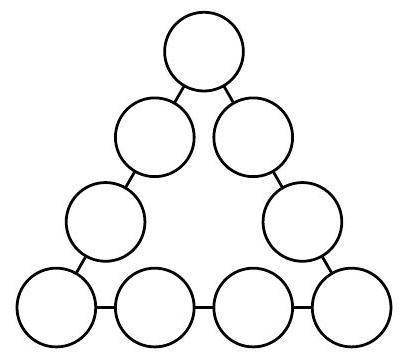
Each of the numbers $1,2, \ldots, 9$ is to be written into one of these circles, so that each circle contains exactly one of these numbers and
(i) t... | Let $a, b$, and $c$ be the numbers in the vertices of the triangular arrangement. Let $s$ be the sum of the numbers on each side and $t$ be the sum of the squares of the numbers on each side. Summing the numbers (or their squares) on the three sides repeats each once the numbers on the vertices (or their squares):
$$
... | {
"resource_path": "APMO/segmented/en-apmo2000_sol.jsonl",
"problem_match": "# Problem 2",
"solution_match": "# Solution\n\n"
} |
2000 | T1 | 3 | null | APMO | Let $A B C$ be a triangle. Let $M$ and $N$ be the points in which the median and angle bisector, respectively, at $A$ meet the side $B C$. Let $Q$ and $P$ be the points in which the perpendicular at $N$ to $N A$ meets $M A$ and $B A$, respectively, and $O$ be the point in which the perpendicular at $P$ to $B A$ meets $... | Let $A N$ meet the circumcircle of $A B C$ at point $K$, the midpoint of arc $B C$ that does not contain $A$.
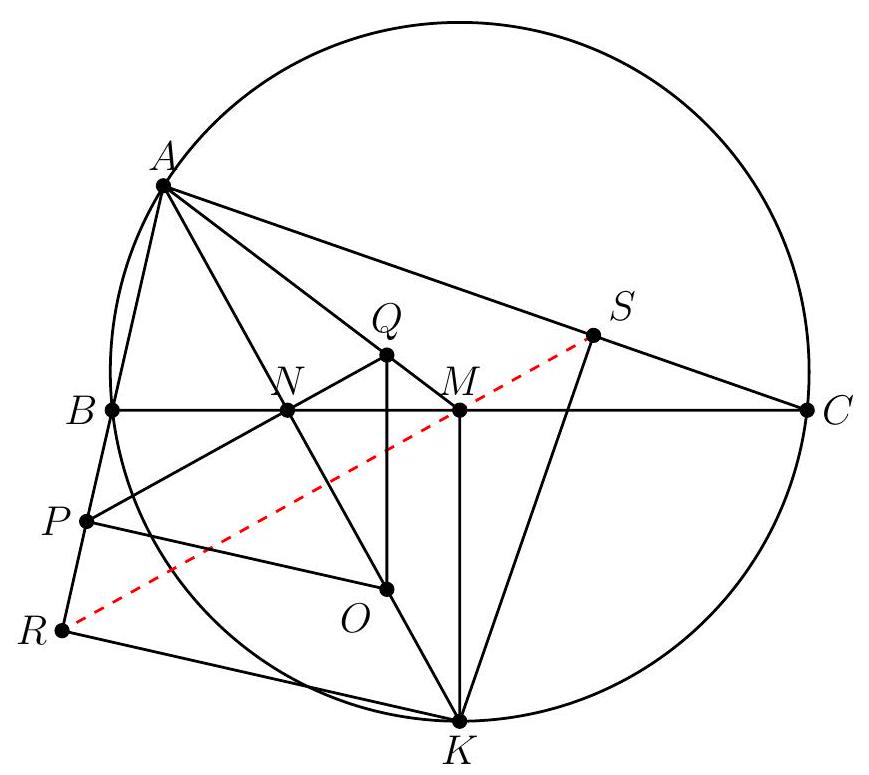
The orthogonal projection of $K$ onto side $B C$ is $M$. Let $R$ and $S$ be the or... | {
"resource_path": "APMO/segmented/en-apmo2000_sol.jsonl",
"problem_match": "# Problem 3",
"solution_match": "# Solution 1"
} |
2000 | T1 | 3 | null | APMO | Let $A B C$ be a triangle. Let $M$ and $N$ be the points in which the median and angle bisector, respectively, at $A$ meet the side $B C$. Let $Q$ and $P$ be the points in which the perpendicular at $N$ to $N A$ meets $M A$ and $B A$, respectively, and $O$ be the point in which the perpendicular at $P$ to $B A$ meets $... | Consider a cartesian plane with $A=(0,0)$ as the origin and the bisector $A N$ as $x$-axis. Thus $A B$ has equation $y=m x$ and $A C$ has equation $y=-m x$. Let $B=(b, m b)$ and $C=(c,-m c)$. By symmetry, the problem is immediate if $A B=A C$, that is, if $b=c$. Suppose that $b \neq c$ from now on. Line $B C$ has slope... | {
"resource_path": "APMO/segmented/en-apmo2000_sol.jsonl",
"problem_match": "# Problem 3",
"solution_match": "# Solution 2"
} |
2000 | T1 | 4 | null | APMO | Let $n, k$ be given positive integers with $n>k$. Prove that
$$
\frac{1}{n+1} \cdot \frac{n^{n}}{k^{k}(n-k)^{n-k}}<\frac{n!}{k!(n-k)!}<\frac{n^{n}}{k^{k}(n-k)^{n-k}} .
$$ | The inequality is equivalent to
$$
\frac{n^{n}}{n+1}<\binom{n}{k} k^{k}(n-k)^{n-k}<n^{n}
$$
which suggests investigating the binomial expansion of
$$
n^{n}=((n-k)+k)^{n}=\sum_{i=0}^{n}\binom{n}{i}(n-k)^{n-i} k^{i}
$$
The $(k+1)$ th term $T_{k+1}$ of the expansion is $\binom{n}{k} k^{k}(n-k)^{n-k}$, and all terms in... | {
"resource_path": "APMO/segmented/en-apmo2000_sol.jsonl",
"problem_match": "# Problem 4",
"solution_match": "# Solution\n\n"
} |
2000 | T1 | 5 | null | APMO | Given a permutation $\left(a_{0}, a_{1}, \ldots, a_{n}\right)$ of the sequence $0,1, \ldots, n$. A transposition of $a_{i}$ with $a_{j}$ is called legal if $a_{i}=0$ for $i>0$, and $a_{i-1}+1=a_{j}$. The permutation $\left(a_{0}, a_{1}, \ldots, a_{n}\right)$ is called regular if after a number of legal transpositions i... | A legal transposition consists of looking at the number immediately before 0 and exchanging 0 and its successor; therefore, we can perform at most one legal transposition to any permutation, and a legal transposition is not possible only and if only 0 is preceded by $n$.
If $n=1$ or $n=2$ there is nothing to do, so $n=... | {
"resource_path": "APMO/segmented/en-apmo2000_sol.jsonl",
"problem_match": "# Problem 5",
"solution_match": "# Solution\n\n"
} |
2002 | T1 | 1 | null | APMO | Let $a_{1}, a_{2}, a_{3}, \ldots, a_{n}$ be a sequence of non-negative integers, where $n$ is a positive integer.
Let
$$
A_{n}=\frac{a_{1}+a_{2}+\cdots+a_{n}}{n}
$$
Prove that
$$
a_{1}!a_{2}!\ldots a_{n}!\geq\left(\left\lfloor A_{n}\right\rfloor!\right)^{n}
$$
where $\left\lfloor A_{n}\right\rfloor$ is the greates... | Assume without loss of generality that $a_{1} \geq a_{2} \geq \cdots \geq a_{n} \geq 0$, and let $s=\left\lfloor A_{n}\right\rfloor$. Let $k$ be any (fixed) index for which $a_{k} \geq s \geq a_{k+1}$.
Our inequality is equivalent to proving that
$$
\frac{a_{1}!}{s!} \cdot \frac{a_{2}!}{s!} \cdot \ldots \cdot \frac{a... | {
"resource_path": "APMO/segmented/en-apmo2002_sol.jsonl",
"problem_match": "\n1. ",
"solution_match": "# Solution 1."
} |
2002 | T1 | 1 | null | APMO | Let $a_{1}, a_{2}, a_{3}, \ldots, a_{n}$ be a sequence of non-negative integers, where $n$ is a positive integer.
Let
$$
A_{n}=\frac{a_{1}+a_{2}+\cdots+a_{n}}{n}
$$
Prove that
$$
a_{1}!a_{2}!\ldots a_{n}!\geq\left(\left\lfloor A_{n}\right\rfloor!\right)^{n}
$$
where $\left\lfloor A_{n}\right\rfloor$ is the greates... | Assume without loss of generality that $0 \leq a_{1} \leq a_{2} \leq \cdots \leq a_{n}$. Let $d=a_{n}-a_{1}$ and $m=\left|\left\{i: a_{i}=a_{1}\right\}\right|$. Our proof is by induction on $d$.
We first do the case $d=a_{n}-a_{1}=0$ or 1 separately. Then $a_{1}=a_{2}=\cdots=a_{m}=a$ and $a_{m+1}=\cdots=a_{n}=a+1$ for... | {
"resource_path": "APMO/segmented/en-apmo2002_sol.jsonl",
"problem_match": "\n1. ",
"solution_match": "\nSolution 2."
} |
2002 | T1 | 2 | null | APMO | Find all positive integers $a$ and $b$ such that
$$
\frac{a^{2}+b}{b^{2}-a} \text { and } \frac{b^{2}+a}{a^{2}-b}
$$
are both integers. | By the symmetry of the problem, we may suppose that $a \leq b$. Notice that $b^{2}-a \geq 0$, so that if $\frac{a^{2}+b}{b^{2}-a}$ is a positive integer, then $a^{2}+b \geq b^{2}-a$. Rearranging this inequality and factorizing, we find that $(a+b)(a-b+1) \geq 0$. Since $a, b>0$, we must have $a \geq b-1$. [3 marks to h... | {
"resource_path": "APMO/segmented/en-apmo2002_sol.jsonl",
"problem_match": "\n2. ",
"solution_match": "\nSolution."
} |
2002 | T1 | 3 | null | APMO | Let $A B C$ be an equilateral triangle. Let $P$ be a point on the side $A C$ and $Q$ be a point on the side $A B$ so that both triangles $A B P$ and $A C Q$ are acute. Let $R$ be the orthocentre of triangle $A B P$ and $S$ be the orthocentre of triangle $A C Q$. Let $T$ be the point common to the segments $B P$ and $C ... | We are going to show that this can only happen when
$$
\angle C B P=\angle B C Q=15^{\circ} .
$$
Lemma. If $\angle C B P>\angle B C Q$, then $R T>S T$.
Proof. Let $A D, B E$ and $C F$ be the altitudes of triangle $A B C$ concurrent at its centre $G$. Then $P$ lies on $C E, Q$ lies on $B F$, and thus $T$ lies in trian... | {
"resource_path": "APMO/segmented/en-apmo2002_sol.jsonl",
"problem_match": "\n3. ",
"solution_match": "# Solution."
} |
2002 | T1 | 4 | null | APMO | Let $x, y, z$ be positive numbers such that
$$
\frac{1}{x}+\frac{1}{y}+\frac{1}{z}=1
$$
Show that
$$
\sqrt{x+y z}+\sqrt{y+z x}+\sqrt{z+x y} \geq \sqrt{x y z}+\sqrt{x}+\sqrt{y}+\sqrt{z}
$$ | $$
\begin{aligned}
\sum_{\text {cyclic }} \sqrt{x+y z} & =\sqrt{x y z} \sum_{\text {cyclic }} \sqrt{\frac{1}{x}+\frac{1}{y z}} \\
& =\sqrt{x y z} \sum_{\text {cyclic }} \sqrt{\frac{1}{x}\left(\frac{1}{x}+\frac{1}{y}+\frac{1}{z}\right)+\frac{1}{y z}} \quad[1 \text { mark. }] \\
& =\sqrt{x y z} \sum_{\text {cyclic }} \sq... | {
"resource_path": "APMO/segmented/en-apmo2002_sol.jsonl",
"problem_match": "\n4. ",
"solution_match": "\nSolution 1."
} |
2002 | T1 | 4 | null | APMO | Let $x, y, z$ be positive numbers such that
$$
\frac{1}{x}+\frac{1}{y}+\frac{1}{z}=1
$$
Show that
$$
\sqrt{x+y z}+\sqrt{y+z x}+\sqrt{z+x y} \geq \sqrt{x y z}+\sqrt{x}+\sqrt{y}+\sqrt{z}
$$ | Squaring both sides of the given inequality, we obtain
$$
\begin{aligned}
& \sum_{\text {cyclic }} x+\sum_{\text {cyclic }} y z+2 \sum_{\text {cyclic }} \sqrt{x+y z} \sqrt{y+z x} \\
& \quad \geq x y z+2 \sqrt{x y z} \sum_{\text {cyclic }} \sqrt{x}+\sum_{\text {cyclic }} x+2 \sum_{\text {cyclic }} \sqrt{x y} \quad \tex... | {
"resource_path": "APMO/segmented/en-apmo2002_sol.jsonl",
"problem_match": "\n4. ",
"solution_match": "\nSolution 2."
} |
2002 | T1 | 4 | null | APMO | Let $x, y, z$ be positive numbers such that
$$
\frac{1}{x}+\frac{1}{y}+\frac{1}{z}=1
$$
Show that
$$
\sqrt{x+y z}+\sqrt{y+z x}+\sqrt{z+x y} \geq \sqrt{x y z}+\sqrt{x}+\sqrt{y}+\sqrt{z}
$$ | This is another way of presenting the idea in the first solution.
Using the condition $\frac{1}{x}+\frac{1}{y}+\frac{1}{z}=1$ and the AM-GM inequality, we have
$$
\begin{aligned}
x+y z-\left(\sqrt{\frac{y z}{x}}+\sqrt{x}\right)^{2} & =y z\left(1-\frac{1}{x}\right)-2 \sqrt{y z} \\
& =y z\left(\frac{1}{y}+\frac{1}{z}\ri... | {
"resource_path": "APMO/segmented/en-apmo2002_sol.jsonl",
"problem_match": "\n4. ",
"solution_match": "\nSolution 3."
} |
2002 | T1 | 4 | null | APMO | Let $x, y, z$ be positive numbers such that
$$
\frac{1}{x}+\frac{1}{y}+\frac{1}{z}=1
$$
Show that
$$
\sqrt{x+y z}+\sqrt{y+z x}+\sqrt{z+x y} \geq \sqrt{x y z}+\sqrt{x}+\sqrt{y}+\sqrt{z}
$$ | This is also another way of presenting the idea in the first solution.
We make the substitution $a=\frac{1}{x}, b=\frac{1}{y}, c=\frac{1}{z}$. Then it is enough to show that
$$
\sqrt{\frac{1}{a}+\frac{1}{b c}}+\sqrt{\frac{1}{b}+\frac{1}{c a}}+\sqrt{\frac{1}{c}+\frac{1}{a b}} \geq \sqrt{\frac{1}{a b c}}+\sqrt{\frac{1}{... | {
"resource_path": "APMO/segmented/en-apmo2002_sol.jsonl",
"problem_match": "\n4. ",
"solution_match": "# Solution 4."
} |
2002 | T1 | 5 | null | APMO | Let R denote the set of all real numbers. Find all functions $f$ from R to R satisfying:
(i) there are only finitely many $s$ in R such that $f(s)=0$, and
(ii) $f\left(x^{4}+y\right)=x^{3} f(x)+f(f(y))$ for all $x, y$ in $\mathbf{R}$. | The only such function is the identity function on $R$.
Setting $(x, y)=(1,0)$ in the given functional equation (ii), we have $f(f(0))=0$. Setting $x=0$ in (ii), we find
$$
f(y)=f(f(y))
$$
[1 mark.] and thus $f(0)=f(f(0))=0$ [1 mark.]. It follows from (ii) that $f\left(x^{4}+y\right)=$ $x^{3} f(x)+f(y)$ for all $x, y... | {
"resource_path": "APMO/segmented/en-apmo2002_sol.jsonl",
"problem_match": "\n5. ",
"solution_match": "# Solution 1."
} |
2002 | T1 | 5 | null | APMO | Let R denote the set of all real numbers. Find all functions $f$ from R to R satisfying:
(i) there are only finitely many $s$ in R such that $f(s)=0$, and
(ii) $f\left(x^{4}+y\right)=x^{3} f(x)+f(f(y))$ for all $x, y$ in $\mathbf{R}$. | Again, the only such function is the identity function on R .
As in Solution 1, we first show that $f(f(y))=f(y), f(0)=0$, and $f\left(x^{4}\right)=x^{3} f(x)$. [2 marks.] From the latter follows
$$
f(x)=0 \Longrightarrow f\left(x^{4}\right)=0
$$
and from condition (i) we get that $f(x)=0$ only possibly for $x \in\{0... | {
"resource_path": "APMO/segmented/en-apmo2002_sol.jsonl",
"problem_match": "\n5. ",
"solution_match": "# Solution 2."
} |
2003 | T1 | 1 | null | APMO | Let $a, b, c, d, e, f$ be real numbers such that the polynomial
$$
p(x)=x^{8}-4 x^{7}+7 x^{6}+a x^{5}+b x^{4}+c x^{3}+d x^{2}+e x+f
$$
factorises into eight linear factors $x-x_{i}$, with $x_{i}>0$ for $i=1,2, \ldots, 8$. Determine all possible values of $f$. | From
$$
x^{8}-4 x^{7}+7 x^{6}+a x^{5}+b x^{4}+c x^{3}+d x^{2}+e x+f=\left(x-x_{1}\right)\left(x-x_{2}\right) \ldots\left(x-x_{8}\right)
$$
we have
$$
\sum_{i=1}^{8} x_{i}=4 \quad \text { and } \quad \sum x_{i} x_{j}=7
$$
where the second sum is over all pairs $(i, j)$ of integers where $1 \leq i<j \leq 8$. Since th... | {
"resource_path": "APMO/segmented/en-apmo2003_sol.jsonl",
"problem_match": "\n1. ",
"solution_match": "# Solution."
} |
2003 | T1 | 2 | null | APMO | Suppose $A B C D$ is a square piece of cardboard with side length $a$. On a plane are two parallel lines $\ell_{1}$ and $\ell_{2}$, which are also $a$ units apart. The square $A B C D$ is placed on the plane so that sides $A B$ and $A D$ intersect $\ell_{1}$ at $E$ and $F$ respectively. Also, sides $C B$ and $C D$ inte... | Let $E H$ intersect $F G$ at $O$. The distance from $G$ to line $F D$ and line $E F$ are both $a$. So $F G$ bisects $\angle E F D$. Similarly, $E H$ bisects $\angle B E F$. So $O$ is an excentre of $\triangle A E F$. Similarly, $O$ is an excentre of $\triangle C G H$. [2 marks] Construct these excircles with centre $O$... | {
"resource_path": "APMO/segmented/en-apmo2003_sol.jsonl",
"problem_match": "\n2. ",
"solution_match": "\nSolution 1."
} |
2003 | T1 | 2 | null | APMO | Suppose $A B C D$ is a square piece of cardboard with side length $a$. On a plane are two parallel lines $\ell_{1}$ and $\ell_{2}$, which are also $a$ units apart. The square $A B C D$ is placed on the plane so that sides $A B$ and $A D$ intersect $\ell_{1}$ at $E$ and $F$ respectively. Also, sides $C B$ and $C D$ inte... | Extend $A B$ to $I$ and $D C$ to $J$ so that $A E=B I=C J$. Let $\ell_{2}$ intersect $I J$ at $M$, and let $K$ lie on $I J$ so that $G K \perp I J$. Then, since $A E=G K, \triangle A E F$ and $\triangle K G M$ are congruent. [1 mark] Thus, since $G K=C J$ and $G C=K J$,
$$
m_{1}+m_{2}=\operatorname{perimeter}(K G M)+\... | {
"resource_path": "APMO/segmented/en-apmo2003_sol.jsonl",
"problem_match": "\n2. ",
"solution_match": "# Solution 2."
} |
2003 | T1 | 2 | null | APMO | Suppose $A B C D$ is a square piece of cardboard with side length $a$. On a plane are two parallel lines $\ell_{1}$ and $\ell_{2}$, which are also $a$ units apart. The square $A B C D$ is placed on the plane so that sides $A B$ and $A D$ intersect $\ell_{1}$ at $E$ and $F$ respectively. Also, sides $C B$ and $C D$ inte... | Without loss of generality, assume the square has side $a=1$. Let $\theta$ be the acute angle between $\ell_{1}$ (or $\ell_{2}$ ) and the sides $A B$ and $C D$ of the square. Then, letting $E F=x$ and $G H=y$, we have
$$
E A=x \cos \theta, \quad A F=x \sin \theta, \quad C H=y \cos \theta, \quad C G=y \sin \theta
$$
T... | {
"resource_path": "APMO/segmented/en-apmo2003_sol.jsonl",
"problem_match": "\n2. ",
"solution_match": "\nSolution 3."
} |
2003 | T1 | 3 | null | APMO | Let $k \geq 14$ be an integer, and let $p_{k}$ be the largest prime number which is strictly less than $k$. You may assume that $p_{k} \geq 3 k / 4$. Let $n$ be a composite integer. Prove:
(a) if $n=2 p_{k}$, then $n$ does not divide $(n-k)$ !;
(b) if $n>2 p_{k}$, then $n$ divides $(n-k)$ !. | (a) Note that $n-k=2 p_{k}-k<2 p_{k}-p_{k}=p_{k}$, so $p_{k} \nmid(n-k)$ !, so $2 p_{k} \nless(n-k)$ !. [1 mark]
(b) Note that $n>2 p_{k} \geq 3 k / 2$ implies $k<2 n / 3$, so $n-k>n / 3$. So if we can find integers $a, b \geq 3$ such that $n=a b$ and $a \neq b$, then both $a$ and $b$ will appear separately in the prod... | {
"resource_path": "APMO/segmented/en-apmo2003_sol.jsonl",
"problem_match": "\n3. ",
"solution_match": "\nSolution."
} |
2003 | T1 | 4 | null | APMO | Let $a, b, c$ be the sides of a triangle, with $a+b+c=1$, and let $n \geq 2$ be an integer. Show that
$$
\sqrt[n]{a^{n}+b^{n}}+\sqrt[n]{b^{n}+c^{n}}+\sqrt[n]{c^{n}+a^{n}}<1+\frac{\sqrt[n]{2}}{2}
$$ | Without loss of generality, assume $a \leq b \leq c$. As $a+b>c$, we have
$$
\frac{\sqrt[n]{2}}{2}=\frac{\sqrt[n]{2}}{2}(a+b+c)>\frac{\sqrt[n]{2}}{2}(c+c)=\sqrt[n]{2 c^{n}} \geq \sqrt[n]{b^{n}+c^{n}} \quad \quad[2 \text { marks }]
$$
As $a \leq c$ and $n \geq 2$, we have
$$
\begin{aligned}
\left(c^{n}+a^{n}\right)-\... | {
"resource_path": "APMO/segmented/en-apmo2003_sol.jsonl",
"problem_match": "\n4. ",
"solution_match": "# Solution."
} |
2003 | T1 | 5 | null | APMO | Given two positive integers $m$ and $n$, find the smallest positive integer $k$ such that among any $k$ people, either there are $2 m$ of them who form $m$ pairs of mutually acquainted people or there are $2 n$ of them forming $n$ pairs of mutually unacquainted people. | Let the smallest positive integer $k$ satisfying the condition of the problem be denoted $r(m, n)$. We shall show that
$$
r(m, n)=2(m+n)-\min \{m, n\}-1
$$
Observe that, by symmetry, $r(m, n)=r(n, m)$. Therefore it suffices to consider the case where $m \geq n$, and to prove that
$$
r(m, n)=2 m+n-1 . \quad[1 \text {... | {
"resource_path": "APMO/segmented/en-apmo2003_sol.jsonl",
"problem_match": "\n5. ",
"solution_match": "# Solution."
} |
2004 | T1 | 1 | null | APMO | Determine all finite nonempty sets $S$ of positive integers satisfying
$$
\frac{i+j}{(i, j)} \text { is an element of } S \text { for all } i, j \text { in } S \text {, }
$$
where $(i, j)$ is the greatest common divisor of $i$ and $j$.
Answer: $S=\{2\}$. | Let $k \in S$. Then $\frac{k+k}{(k, k)}=2$ is in $S$ as well.
Suppose for the sake of contradiction that there is an odd number in $S$, and let $k$ be the largest such odd number. Since $(k, 2)=1, \frac{k+2}{(k, 2)}=k+2>k$ is in $S$ as well, a contradiction. Hence $S$ has no odd numbers.
Now suppose that $\ell>2$ is th... | {
"resource_path": "APMO/segmented/en-apmo2004_sol.jsonl",
"problem_match": "# Problem 1",
"solution_match": "# Solution\n\n"
} |
2004 | T1 | 2 | null | APMO | Let $O$ be the circumcentre and $H$ the orthocentre of an acute triangle $A B C$. Prove that the area of one of the triangles $\mathrm{AOH}, \mathrm{BOH}$ and COH is equal to the sum of the areas of the other two. | Suppose, without loss of generality, that $B$ and $C$ lies in the same side of line $O H$. Such line is the Euler line of $A B C$, so the centroid $G$ lies in this line.
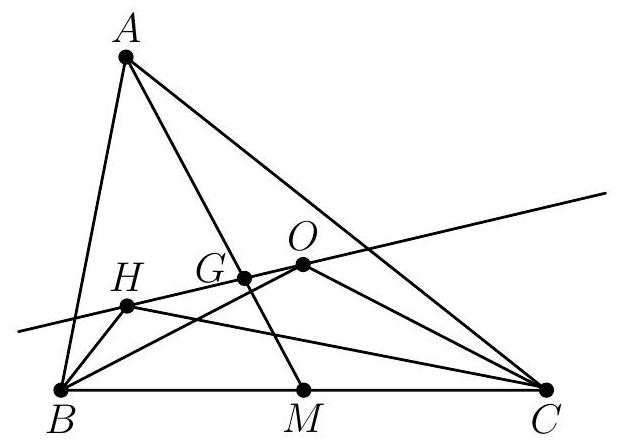
Let $M$ be the midpoin... | {
"resource_path": "APMO/segmented/en-apmo2004_sol.jsonl",
"problem_match": "# Problem 2",
"solution_match": "# Solution 1"
} |
2004 | T1 | 2 | null | APMO | Let $O$ be the circumcentre and $H$ the orthocentre of an acute triangle $A B C$. Prove that the area of one of the triangles $\mathrm{AOH}, \mathrm{BOH}$ and COH is equal to the sum of the areas of the other two. | One can use barycentric coordinates: it is well known that
$$
\begin{gathered}
A=(1: 0: 0), \quad B=(0: 1: 0), \quad C=(0: 0: 1), \\
O=(\sin 2 A: \sin 2 B: \sin 2 C) \quad \text { and } \quad H=(\tan A: \tan B: \tan C) .
\end{gathered}
$$
Then the (signed) area of $A O H$ is proportional to
$$
\left|\begin{array}{cc... | {
"resource_path": "APMO/segmented/en-apmo2004_sol.jsonl",
"problem_match": "# Problem 2",
"solution_match": "# Solution 2"
} |
2004 | T1 | 3 | null | APMO | Let a set $S$ of 2004 points in the plane be given, no three of which are collinear. Let $\mathcal{L}$ denote the set of all lines (extended indefinitely in both directions) determined by pairs of points from the set. Show that it is possible to colour the points of $S$ with at most two colours, such that for any point... | Choose any point $p$ from $S$ and color it, say, blue. Let $n(q, r)$ be the number of lines from $\mathcal{L}$ that separates $q$ and $r$. Then color any other point $q$ blue if $n(p, q)$ is odd and red if $n(p, q)$ is even.
Now it remains to show that $q$ and $r$ have the same color if and only if $n(q, r)$ is odd for... | {
"resource_path": "APMO/segmented/en-apmo2004_sol.jsonl",
"problem_match": "# Problem 3",
"solution_match": "# Solution\n\n"
} |
2004 | T1 | 4 | null | APMO | For a real number $x$, let $\lfloor x\rfloor$ stand for the largest integer that is less than or equal to $x$. Prove that
$$
\left\lfloor\frac{(n-1)!}{n(n+1)}\right\rfloor
$$
is even for every positive integer $n$. | Consider four cases:
- $n \leq 5$. Then $\left\lfloor\frac{(n-1)!}{n(n+1)}\right\rfloor=0$ is an even number.
- $n$ and $n+1$ are both composite (in particular, $n \geq 8$ ). Then $n=a b$ and $n+1=c d$ for $a, b, c, d \geq 2$. Moreover, since $n$ and $n+1$ are coprime, $a, b, c, d$ are all distinct and smaller than $n... | {
"resource_path": "APMO/segmented/en-apmo2004_sol.jsonl",
"problem_match": "# Problem 4",
"solution_match": "# Solution\n\n"
} |
2004 | T1 | 5 | null | APMO | Prove that
$$
\left(a^{2}+2\right)\left(b^{2}+2\right)\left(c^{2}+2\right) \geq 9(a b+b c+c a)
$$
for all real numbers $a, b, c>0$. | Let $p=a+b+c, q=a b+b c+c a$, and $r=a b c$. The inequality simplifies to
$$
a^{2} b^{2} c^{2}+2\left(a^{2} b^{2}+b^{2} c^{2}+c^{2} a^{2}\right)+4\left(a^{2}+b^{2}+c^{2}\right)+8-9(a b+b c+c a) \geq 0
$$
Since $a^{2} b^{2}+b^{2} c^{2}+c^{2} a^{2}=q^{2}-2 p r$ and $a^{2}+b^{2}+c^{2}=p^{2}-2 q$,
$$
r^{2}+2 q^{2}-4 p r... | {
"resource_path": "APMO/segmented/en-apmo2004_sol.jsonl",
"problem_match": "# Problem 5",
"solution_match": "# Solution 1"
} |
2004 | T1 | 5 | null | APMO | Prove that
$$
\left(a^{2}+2\right)\left(b^{2}+2\right)\left(c^{2}+2\right) \geq 9(a b+b c+c a)
$$
for all real numbers $a, b, c>0$. | We prove the stronger inequality
$$
\left(a^{2}+2\right)\left(b^{2}+2\right)\left(c^{2}+2\right) \geq 3(a+b+c)^{2}
$$
which implies the proposed inequality because $(a+b+c)^{2} \geq 3(a b+b c+c a)$ is equivalent to $(a-b)^{2}+(b-c)^{2}+(c-a)^{2} \geq 0$, which is immediate.
The inequality $(*)$ is equivalent to
$$
\... | {
"resource_path": "APMO/segmented/en-apmo2004_sol.jsonl",
"problem_match": "# Problem 5",
"solution_match": "# Solution 2"
} |
2004 | T1 | 5 | null | APMO | Prove that
$$
\left(a^{2}+2\right)\left(b^{2}+2\right)\left(c^{2}+2\right) \geq 9(a b+b c+c a)
$$
for all real numbers $a, b, c>0$. | Let $A, B, C$ angles in $(0, \pi / 2)$ such that $a=\sqrt{2} \tan A, b=\sqrt{2} \tan B$, and $c=\sqrt{2} \tan C$. Then the inequality is equivalent to
$$
4 \sec ^{2} A \sec ^{2} B \sec ^{2} C \geq 9(\tan A \tan B+\tan B \tan C+\tan C \tan A)
$$
Substituting $\sec x=\frac{1}{\cos x}$ for $x \in\{A, B, C\}$ and clearin... | {
"resource_path": "APMO/segmented/en-apmo2004_sol.jsonl",
"problem_match": "# Problem 5",
"solution_match": "# Solution 3"
} |
2005 | T1 | 1 | null | APMO | Prove that for every irrational real number $a$, there are irrational real numbers $b$ and $b^{\prime}$ so that $a+b$ and $a b^{\prime}$ are both rational while $a b$ and $a+b^{\prime}$ are both irrational. | Let $a$ be an irrational number. If $a^{2}$ is irrational, we let $b=-a$. Then, $a+b=0$ is rational and $a b=-a^{2}$ is irrational. If $a^{2}$ is rational, we let $b=a^{2}-a$. Then, $a+b=a^{2}$ is rational and $a b=a^{2}(a-1)$. Since
$$
a=\frac{a b}{a^{2}}+1
$$
is irrational, so is $a b$.
Now, we let $b^{\prime}=\fra... | {
"resource_path": "APMO/segmented/en-apmo2005_sol.jsonl",
"problem_match": "\nProblem 1.",
"solution_match": "(Solution)"
} |
2005 | T1 | 2 | null | APMO | Let $a, b$ and $c$ be positive real numbers such that $a b c=8$. Prove that
$$
\frac{a^{2}}{\sqrt{\left(1+a^{3}\right)\left(1+b^{3}\right)}}+\frac{b^{2}}{\sqrt{\left(1+b^{3}\right)\left(1+c^{3}\right)}}+\frac{c^{2}}{\sqrt{\left(1+c^{3}\right)\left(1+a^{3}\right)}} \geq \frac{4}{3} .
$$ | Observe that
$$
\frac{1}{\sqrt{1+x^{3}}} \geq \frac{2}{2+x^{2}}
$$
In fact, this is equivalent to $\left(2+x^{2}\right)^{2} \geq 4\left(1+x^{3}\right)$, or $x^{2}(x-2)^{2} \geq 0$. Notice that equality holds in (1) if and only if $x=2$.
We substitute $x$ by $a, b, c$ in (1), respectively, to find
$$
\begin{gathered... | {
"resource_path": "APMO/segmented/en-apmo2005_sol.jsonl",
"problem_match": "\nProblem 2.",
"solution_match": "(Solution)"
} |
2005 | T1 | 3 | null | APMO | Prove that there exists a triangle which can be cut into 2005 congruent triangles. | Suppose that one side of a triangle has length $n$. Then it can be cut into $n^{2}$ congruent triangles which are similar to the original one and whose corresponding sides to the side of length $n$ have lengths 1 .
Since $2005=5 \times 401$ where 5 and 401 are primes and both primes are of the type $4 k+1$, it is repr... | {
"resource_path": "APMO/segmented/en-apmo2005_sol.jsonl",
"problem_match": "\nProblem 3.",
"solution_match": "(Solution)"
} |
2005 | T1 | 4 | null | APMO | In a small town, there are $n \times n$ houses indexed by $(i, j)$ for $1 \leq i, j \leq n$ with $(1,1)$ being the house at the top left corner, where $i$ and $j$ are the row and column indices, respectively. At time 0 , a fire breaks out at the house indexed by $(1, c)$, where $c \leq \frac{n}{2}$. During each subsequ... | At most $n^{2}+c^{2}-n c-c$ houses can be saved. This can be achieved under the following order of defending:
$$
\begin{gathered}
(2, c),(2, c+1) ;(3, c-1),(3, c+2) ;(4, c-2),(4, c+3) ; \ldots \\
(c+1,1),(c+1,2 c) ;(c+1,2 c+1), \ldots,(c+1, n)
\end{gathered}
$$
Under this strategy, there are
2 columns (column numbers... | {
"resource_path": "APMO/segmented/en-apmo2005_sol.jsonl",
"problem_match": "\nProblem 4.",
"solution_match": "(Solution)"
} |
2005 | T1 | 5 | null | APMO | In a triangle $A B C$, points $M$ and $N$ are on sides $A B$ and $A C$, respectively, such that $M B=B C=C N$. Let $R$ and $r$ denote the circumradius and the inradius of the triangle $A B C$, respectively. Express the ratio $M N / B C$ in terms of $R$ and $r$. | Let $\omega, O$ and $I$ be the circumcircle, the circumcenter and the incenter of $A B C$, respectively. Let $D$ be the point of intersection of the line $B I$ and the circle $\omega$ such that $D \neq B$. Then $D$ is the midpoint of the arc $A C$. Hence $O D \perp C N$ and $O D=R$.
We first show that triangles $M N C... | {
"resource_path": "APMO/segmented/en-apmo2005_sol.jsonl",
"problem_match": "\nProblem 5.",
"solution_match": "(Solution)"
} |
2006 | T1 | 1 | null | APMO | Let $n$ be a positive integer. Find the largest nonnegative real number $f(n)$ (depending on $n$ ) with the following property: whenever $a_{1}, a_{2}, \ldots, a_{n}$ are real numbers such that $a_{1}+a_{2}+\cdots+a_{n}$ is an integer, there exists some $i$ such that $\left|a_{i}-\frac{1}{2}\right| \geq f(n)$. | The answer is
$$
f(n)=\left\{\begin{array}{cl}
0 & \text { if } n \text { is even, } \\
\frac{1}{2 n} & \text { if } n \text { is odd. }
\end{array}\right.
$$
First, assume that $n$ is even. If $a_{i}=\frac{1}{2}$ for all $i$, then the sum $a_{1}+a_{2}+\cdots+a_{n}$ is an integer. Since $\left|a_{i}-\frac{1}{2}\right... | {
"resource_path": "APMO/segmented/en-apmo2006_sol.jsonl",
"problem_match": "\nProblem 1.",
"solution_match": "(Solution)"
} |
2006 | T1 | 2 | null | APMO | Prove that every positive integer can be written as a finite sum of distinct integral powers of the golden mean $\tau=\frac{1+\sqrt{5}}{2}$. Here, an integral power of $\tau$ is of the form $\tau^{i}$, where $i$ is an integer (not necessarily positive). | We will prove this statement by induction using the equality
$$
\tau^{2}=\tau+1
$$
If $n=1$, then $1=\tau^{0}$. Suppose that $n-1$ can be written as a finite sum of integral powers of $\tau$, say
$$
n-1=\sum_{i=-k}^{k} a_{i} \tau^{i}
$$
where $a_{i} \in\{0,1\}$ and $n \geq 2$. We will write (1) as
$$
n-1=a_{k} \cd... | {
"resource_path": "APMO/segmented/en-apmo2006_sol.jsonl",
"problem_match": "\nProblem 2.",
"solution_match": "(Solution)"
} |
AI-MO Olympiad Reference Dataset
This dataset contains a structured collection of Olympiad problems and their solutions, organized by competition. Contains high quality data, prioritizing "official" solutions to problems.
Structure
<competition name>/    # Problems and solutions from the International Mathematical Olympiad
├── raw/               # Raw problem/solution statements (.pdf)
│   ├── file1.pdf
│   ├── file2.pdf
├── download_script/   # the scripts used to download raw data
│   ├── download.py
├── md/                # .md files generated from raw/ files
│   ├── file1.md
│   ├── file2.md
├── segment_script/    # the scripts used to segment the data
│   ├── segment.py
└── segmented/         # .jsonl segmented data for easier processing
    ├── file1.jsonl
    ├── file2.jsonl
    └── file3.jsonl
Each json in jsonl file follows this structure:
{
 "problem": "string",        // Mandatory: The problem statement in latex or markdown
 "solution": "string",       // Mandatory: The solution for the problem
 "year": "int",              // Optional: Year when the problem was presented
 "problem_type": "string",   // Optional: The mathematical domain of the problem. Here are the supported types:
                             //['Algebra', 'Geometry', 'Number Theory', 'Combinatorics', 'Calculus',
                             //'Inequalities', 'Logic and Puzzles', 'Other']
 "question_type": "string",  // Optional: The form or style of the mathematical problem.
                             // The supported classes are: ['MCQ', 'proof' or 'math-word-problem'].
                             // 'math-word-problem' is a problem with output.
 "answer": "string",         // Optional: final answer is the question_type is "math-word-problem".
 "source": "string",         // Optional: TODO:describe
 "exam": "string",           // Optional: TODO:describe
 "difficulty": "int",        // Optional: TODO:describe
 "other": "...",             // Optional: You can add other fields with metadata
}
Steps to collect data for formalization
1. Assign yourself a task
Check the tracker and assign yourself one line by updating columns:
- status: IN PROGRESS
- assignee: your name
2. Setup
Download data locally.
git lfs install
git clone git@hf.co:datasets/AI-MO/olympiads-ref
3. Find .pdf ressources.
First check if there are already available .pdf in https://huggingface.co/AI-MO/olympiads-0.1
- if yes upload them in
AI-MO/olympiads-ref/<competition>/raw/and continue to step 4. - if no, find sources in internet (preferably with official solution), download and upload in
AI-MO/olympiads-ref/<competition>/raw/
4. Find .md ressources.
First check if there are already available .pdf in https://huggingface.co/AI-MO/olympiads-0.1
- if yes upload in
AI-MO/olympiads-ref/<competition>/md/and continue to step 6. - if no, find sources in internet (preferably with official solution), download and upload in
AI-MO/olympiads-ref/<competition>/md/
5. Convert .pdf to .md using Mathpix
Use data_pipeline. Example:
python -m data_pipeline convert_to_md --method=pdf_to_md --input_dir="/home/marvin/workspace/olympiads-ref/IMO/raw" --output_dir="/home/marvin/workspace/olympiads-ref/IMO/md"
6. Find .jsonl ressources.
First check if there are already segmentaions available .jsonl in https://huggingface.co/datasets/AI-MO/olympiads-0.3. You can check if the segmentation has been done in this old tracker.
- if yes, check quality and upload in
AI-MO/olympiads-ref/<competition>/segmented/and continue to step 8. - if no, continue to step 7.
7. Segment the .md files into .jsonl
Write a segment.py that can be applied to your data (please do sanity checks!). Examples are this or that. Once you are fine with your segmentation upload the .jsonl in AI-MO/olympiads-ref/<competition>/segmented/ and the segment.py in AI-MO/olympiads-ref/<competition>/segment_script/.
Ask for a review.
8. Update the status in the trackers
Update the tracker with columns:
- status: DONE + a link to your generated data in hf
- problem_count: count of problems in data
- solution_count: count of solutions in data (different than problem_count since a problem can have several solutions)
- years: range of competition years covered in your data (so we can easily track if many years are missing)
- assignee: your name
Update the old tracker with this comumn:
- ref: color in green for the competition you segmented
9. Integrate the data in a base dataset
Create a ticket in git
Notes
- Image placeholders in the dataset (like:
) correspond to actual images stored in theimages.parquetfile.
- Downloads last month
- 15,056