


license: bsd-3-clause
library_name: braindecode
pipeline_tag: feature-extraction
tags:
  - eeg
  - biosignal
  - pytorch
  - neuroscience
  - braindecode
  - foundation-model
  - transformer
CodeBrain
CodeBrain: Scalable Code EEG Pre-Training for Unified Downstream BCI Tasks.
Architecture-only repository. This repo documents the
braindecode.models.CodeBrainclass. No pretrained weights are distributed here — instantiate the model and train it on your own data, or fine-tune from a published foundation-model checkpoint separately.
Quick start
pip install braindecode
from braindecode.models import CodeBrain

model = CodeBrain(
    n_chans=22,
    sfreq=200,
    input_window_seconds=4.0,
    n_outputs=2,
)
The signal-shape arguments above are example defaults — adjust them to match your recording.
Documentation
- Full API reference (parameters, references, architecture figure): https://braindecode.org/stable/generated/braindecode.models.CodeBrain.html
- Interactive browser with live instantiation: https://huggingface.co/spaces/braindecode/model-explorer
- Source on GitHub: https://github.com/braindecode/braindecode/blob/master/braindecode/models/codebrain.py#L21
Architecture description
The block below is the rendered class docstring (parameters, references, architecture figure where available).
CodeBrain: Scalable Code EEG Pre-Training for Unified Downstream BCI Tasks.
Foundation ModelAttention/Transformer.. figure:: https://raw.githubusercontent.com/jingyingma01/CodeBrain/refs/heads/main/assets/intro.png :align: center :alt: CodeBrain pre-training overview :width: 1000px
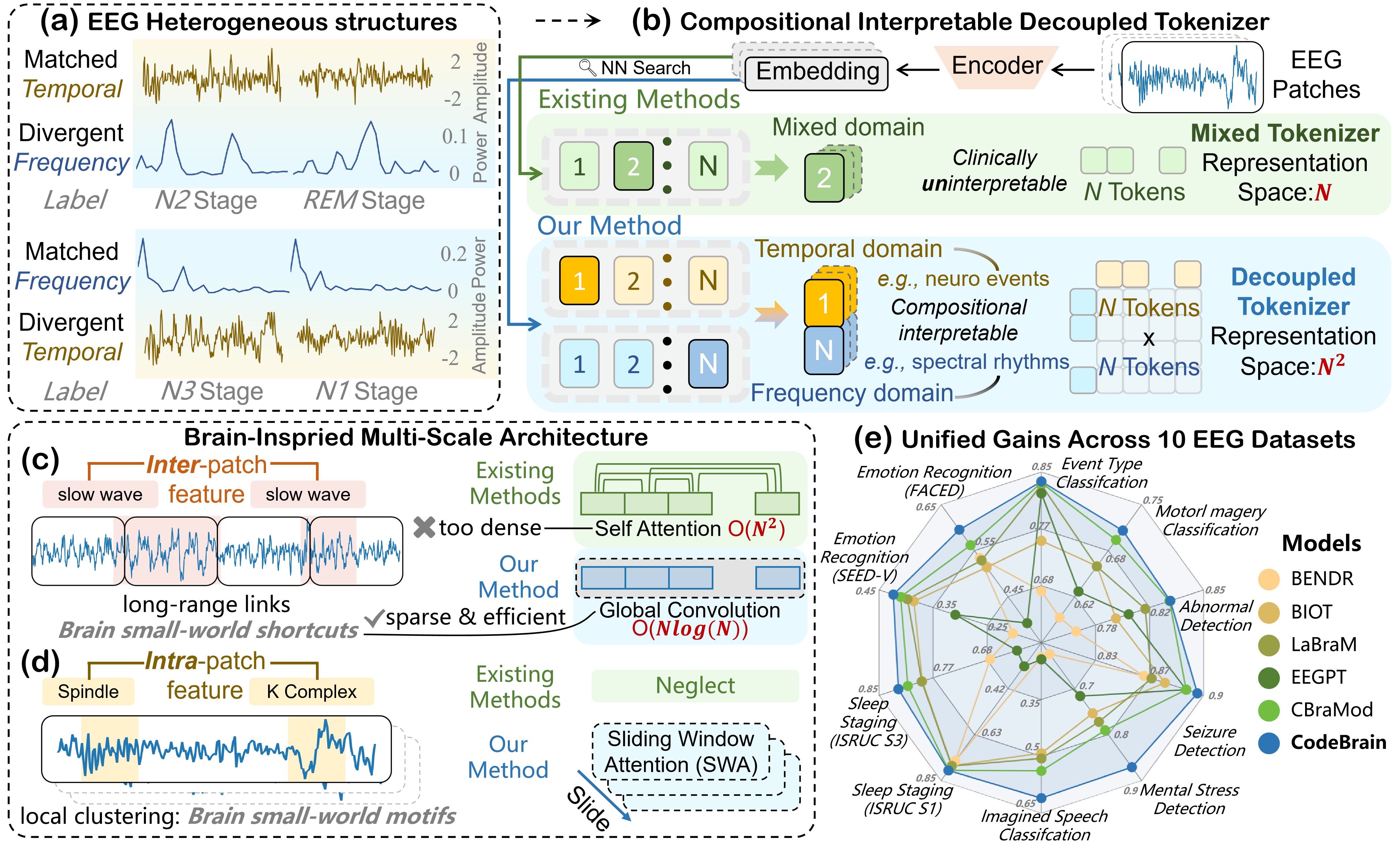
CodeBrain is a foundation model for EEG that pre-trains on large unlabelled
corpora using a two-stage vector-quantised masking strategy, then fine-tunes
on downstream BCI tasks. It segments EEG signals into fixed-size patches,
embeds them with convolutional and spectral projections, and processes them
through stacked residual blocks that combine a multi-scale convolutional
structured state-space model (_GConv) with sliding-window self-attention.
.. rubric:: Stage 2: EEGSSM Backbone (this implementation)
This class implements Stage 2 of CodeBrain — the EEGSSM backbone described
in Section 3.3 of [codebrain]_. Following :class:Labram, CodeBrain
discretises EEG patches into codebook tokens via VQ-VAE (Stage 1, not
implemented here), then trains the backbone to predict masked token indices
via cross-entropy. CodeBrain extends this with a dual tokenizer that
decouples temporal and frequency representations, as stated in the paper:
"the TFDual-Tokenizer, which decouples heterogeneous temporal and frequency
EEG signals into discrete tokens to enhance discriminative power."
.. rubric:: Macro Components
- PatchEmbedding: Splits
(batch, n_chans, n_times)into(batch, n_chans, seq_len, patch_size)patches, projects each patch with a 2-D convolutional stack, adds FFT-based spectral embeddings, and applies depth-wise convolutional positional encoding. - Residual blocks (
ResidualGroup): Each block applies RMSNorm, a_GConvSSM layer, and sliding-window multi-head attention, with gated activation and separate residual/skip paths. - Classification head (
final_layer): Flattens the output and maps ton_outputsclasses.
.. important:: Pre-trained Weights Available
This model has pre-trained weights available on the Hugging Face Hub.
You can load them using:

.. code:: python
    from braindecode.models import CodeBrain

    # Load pre-trained model from Hugging Face Hub
    model = CodeBrain.from_pretrained("braindecode/codebrain-pretrained")

To push your own trained model to the Hub:

.. code:: python
    model.push_to_hub("my-username/my-codebrain")
Parameters
patch_size : int, default=200
Number of time samples per patch. Input length is trimmed to the
nearest multiple of patch_size.
res_channels : int, default=200
Width of the residual stream inside each ResidualBlock.
skip_channels : int, default=200
Width of the skip-connection stream aggregated across blocks.
out_channels : int, default=200
Output channels of final_conv before the classification head.
num_res_layers : int, default=8
Number of stacked ResidualBlock modules.
drop_prob : float, default=0.1
Dropout rate used inside the _GConv SSM and attention layers.
s4_bidirectional : bool, default=True
Whether the _GConv SSM processes the sequence bidirectionally.
s4_layernorm : bool, default=False
Whether to apply layer normalisation inside the _GConv SSM.
Set to False to match the released pretrained checkpoint.
s4_lmax : int, default=570
Maximum sequence length for the _GConv SSM kernel. Also determines
the patch embedding dimension as s4_lmax // n_chans.
s4_d_state : int, default=64
State dimension of the _GConv SSM.
conv_out_chans : int, default=25
Number of output channels in the patch projection convolutions.
conv_groups : int, default=5
Number of groups for GroupNorm in the patch projection.
activation : type[nn.Module], default=nn.ReLU
Non-linear activation class used in init_conv and final_conv.
References
.. [codebrain] Yi Ding, Xuyang Chen, Yong Li, Rui Yan, Tao Wang, Le Wu (2025). CodeBrain: Scalable Code EEG Pre-Training for Unified Downstream BCI Tasks. https://arxiv.org/abs/2506.09110
.. rubric:: Hugging Face Hub integration
When the optional huggingface_hub package is installed, all models
automatically gain the ability to be pushed to and loaded from the
Hugging Face Hub. Install with::
pip install braindecode[hub]
Pushing a model to the Hub:
.. code:: from braindecode.models import CodeBrain
 # Train your model
 model = CodeBrain(n_chans=22, n_outputs=4, n_times=1000)
 # ... training code ...

 # Push to the Hub
 model.push_to_hub(
     repo_id="username/my-codebrain-model",
     commit_message="Initial model upload",
 )
Loading a model from the Hub:
.. code:: from braindecode.models import CodeBrain
 # Load pretrained model
 model = CodeBrain.from_pretrained("username/my-codebrain-model")

 # Load with a different number of outputs (head is rebuilt automatically)
 model = CodeBrain.from_pretrained("username/my-codebrain-model", n_outputs=4)
Extracting features and replacing the head:
.. code:: import torch
 x = torch.randn(1, model.n_chans, model.n_times)
 # Extract encoder features (consistent dict across all models)
 out = model(x, return_features=True)
 features = out["features"]

 # Replace the classification head
 model.reset_head(n_outputs=10)
Saving and restoring full configuration:
.. code:: import json
 config = model.get_config()            # all __init__ params
 with open("config.json", "w") as f:
     json.dump(config, f)

 model2 = CodeBrain.from_config(config)    # reconstruct (no weights)
All model parameters (both EEG-specific and model-specific such as dropout rates, activation functions, number of filters) are automatically saved to the Hub and restored when loading.
See :ref:load-pretrained-models for a complete tutorial.
Citation
Please cite both the original paper for this architecture (see the References section above) and braindecode:
@article{aristimunha2025braindecode,
  title   = {Braindecode: a deep learning library for raw electrophysiological data},
  author  = {Aristimunha, Bruno and others},
  journal = {Zenodo},
  year    = {2025},
  doi     = {10.5281/zenodo.17699192},
}
License
BSD-3-Clause for the model code (matching braindecode). Pretraining-derived weights, if you fine-tune from a checkpoint, inherit the licence of that checkpoint and its training corpus.