| --- |
| license: apache-2.0 |
| tags: |
| - object-detection |
| - vision |
| datasets: |
| - DocLayNet |
| widget: |
| - src: https://huggingface.co/datasets/mishig/sample_images/resolve/main/savanna.jpg |
| example_title: Savanna |
| - src: https://huggingface.co/datasets/mishig/sample_images/resolve/main/football-match.jpg |
| example_title: Football Match |
| - src: https://huggingface.co/datasets/mishig/sample_images/resolve/main/airport.jpg |
| example_title: Airport |
| --- |
| |
| # Deformable DETR model trained on DocLayNet |
|
|
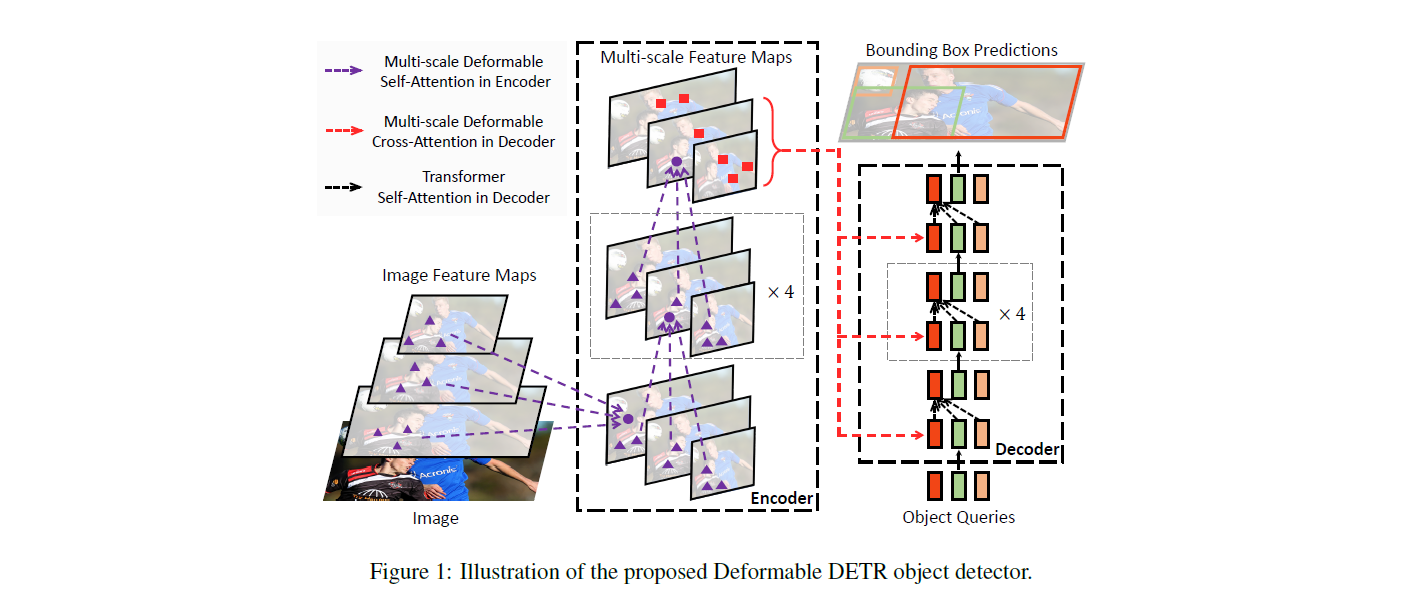
| Deformable DEtection TRansformer (DETR), trained on DocLayNet (including 80k annotated pages in 11 classes). |
|
|
| ## Model description |
|
|
| The DETR model is an encoder-decoder transformer with a convolutional backbone. Two heads are added on top of the decoder outputs in order to perform |
| object detection: a linear layer for the class labels and a MLP (multi-layer perceptron) for the bounding boxes. The model uses so-called object queries |
| to detect objects in an image. Each object query looks for a particular object in the image. For COCO, the number of object queries is set to 100. |
|
|
| The model is trained using a "bipartite matching loss": one compares the predicted classes + bounding boxes of each of the N = 100 object queries to the |
| ground truth annotations, padded up to the same length N (so if an image only contains 4 objects, 96 annotations will just have a "no object" as class and |
| "no bounding box" as bounding box). The Hungarian matching algorithm is used to create an optimal one-to-one mapping between each of the N queries and each |
| of the N annotations. Next, standard cross-entropy (for the classes) and a linear combination of the L1 and generalized IoU loss (for the bounding boxes) are |
| used to optimize the parameters of the model. |
|
|
|  |
|
|
| ## Intended uses & limitations |
|
|
| You can use the raw model for object detection. See the [model hub](https://huggingface.co/models?search=sensetime/deformable-detr) to look for all available |
| Deformable DETR models. |
|
|
| ### How to use |
|
|
| Here is how to use this model: |
|
|
| ```python |
| from transformers import AutoImageProcessor, DeformableDetrForObjectDetection |
| import torch |
| from PIL import Image |
| import requests |
| |
| url = "http://images.cocodataset.org/val2017/000000039769.jpg" |
| image = Image.open(requests.get(url, stream=True).raw) |
| |
| processor = AutoImageProcessor.from_pretrained("Aryn/deformable-detr-DocLayNet") |
| model = DeformableDetrForObjectDetection.from_pretrained("Aryn/deformable-detr-DocLayNet") |
| |
| inputs = processor(images=image, return_tensors="pt") |
| outputs = model(**inputs) |
| |
| # convert outputs (bounding boxes and class logits) to COCO API |
| # let's only keep detections with score > 0.7 |
| target_sizes = torch.tensor([image.size[::-1]]) |
| results = processor.post_process_object_detection(outputs, target_sizes=target_sizes, threshold=0.7)[0] |
| |
| for score, label, box in zip(results["scores"], results["labels"], results["boxes"]): |
| box = [round(i, 2) for i in box.tolist()] |
| print( |
| f"Detected {model.config.id2label[label.item()]} with confidence " |
| f"{round(score.item(), 3)} at location {box}" |
| ) |
| ``` |
|
|
| ## Evaluation results |
|
|
| This model achieves 57.1 box mAP on DocLayNet. |
|
|
| ## Training data |
|
|
| The Deformable DETR model was trained on DocLayNet. It was introduced in the paper [DocLayNet: A Large Human-Annotated Dataset for |
| Document-Layout Analysis](https://arxiv.org/abs/2206.01062) by Pfitzmann et al. and first released in [this repository](https://github.com/DS4SD/DocLayNet). |
|
|
| ### BibTeX entry and citation info |
|
|
| ```bibtex |
| @misc{https://doi.org/10.48550/arxiv.2010.04159, |
| doi = {10.48550/ARXIV.2010.04159}, |
| url = {https://arxiv.org/abs/2010.04159}, |
| author = {Zhu, Xizhou and Su, Weijie and Lu, Lewei and Li, Bin and Wang, Xiaogang and Dai, Jifeng}, |
| keywords = {Computer Vision and Pattern Recognition (cs.CV), FOS: Computer and information sciences, FOS: Computer and information sciences}, |
| title = {Deformable DETR: Deformable Transformers for End-to-End Object Detection}, |
| publisher = {arXiv}, |
| year = {2020}, |
| copyright = {arXiv.org perpetual, non-exclusive license} |
| } |
| ``` |