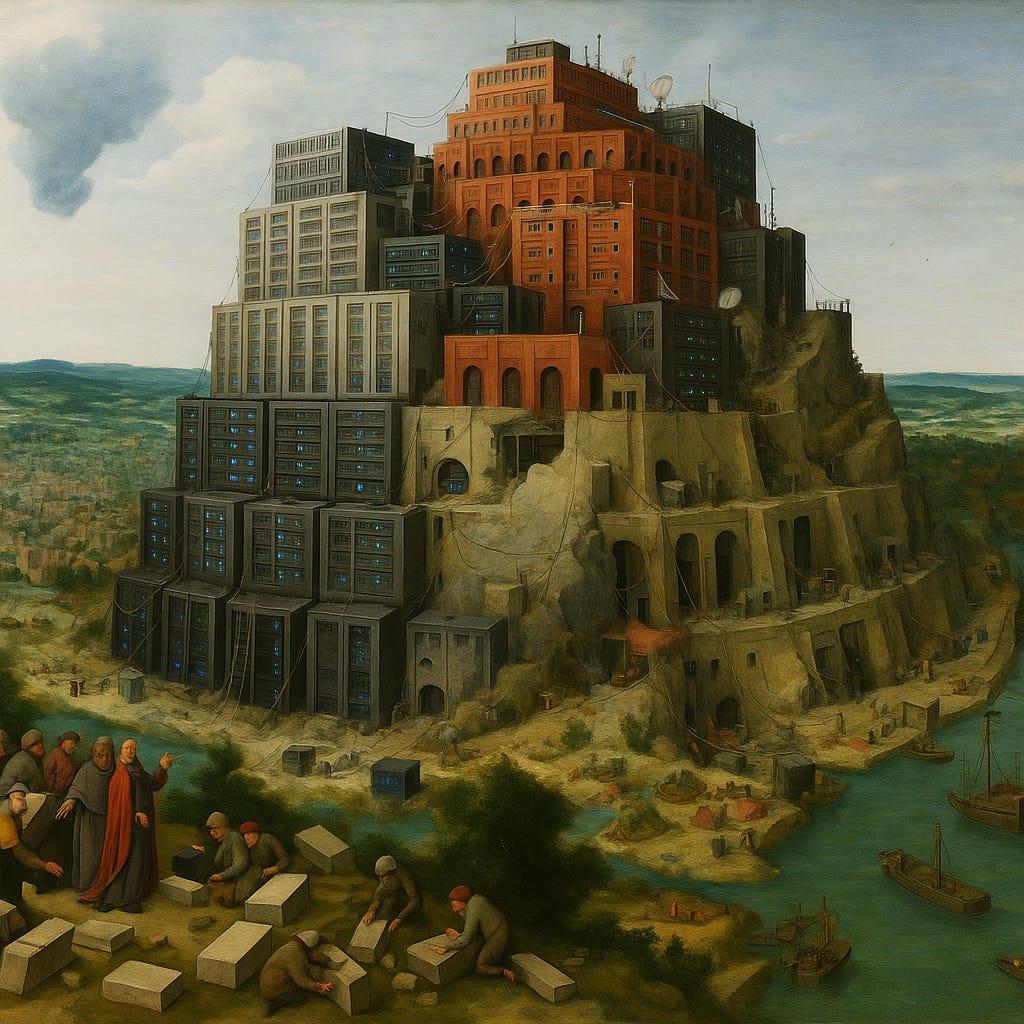
At present, there is a tension. The tension comes from hierarchy,1 and AI is the great solvent of hierarchy. This is my fear: that it will not flatten the world in any naive, egalitarian sense. It will degrade it. It will make high things low, and low things cheaper. The shimmering distinctions that animate human life, those that take decades to form and centuries to refine, will be washed away in weeks by the brute force of a silicon clerk.
This is not mere speculation. In domains where status and hierarchy matter, where the point is not simply to accomplish a task but to become someone worth accomplishing it, AI will be a cultural Tower of Babel.
Domains Affected All Have Matters of Taste, Time, and Hierarchies Embedded:
Art
Literature
Medicine
Law
Education
Domains Unaffected Are Those With Short Timer Horizons:
Finance
Technology
Governance
Finance and tech are not immune to AI, of course. They will adopt and deploy it with zeal. But the hierarchies in these fields (namely: ownership, capital, and networks of influence) are of a harder metal. No LLM will dethrone the Goldman Sachs partner or the CTO of Palantir. If anything, the gap between those who own the machines and those who merely use them will only grow.
The labor-free techno-utopia some herald2 will resemble nothing so much as a nightmare of late-stage capitalism: a landscape where human striving has been reduced to a thin aesthetic overlay on top of automated extraction machines.
Let me begin with a simple fact: human lives take decades to unfurl. We are bound in time. We grow. We apprentice. We climb. The becoming is the point. A doctor is not simply a functor that diagnoses disease. She is a person who has become a doctor, through ordeals that shape her mind and soul.
My thesis (to make it abundantly clear) is that the difficulty of learning and thinking is precisely the point. And to further the point, these machines, as reported in an Apple Paper give the Illusion of Thinking3 and so by surrendering to our thinking capacities to them hastily we will only compromise ourselves.
For most of human history, technology evolved slowly enough to preserve this cycle of becoming. To make it tangible, on the road to becoming a doctor, new procedures or medicines will come along that have to be integrated within the system of medicine but there was a system stable enough to dedicate a decade of one’s life to enter.
But today, many of our great institutional structures have already lost this connection. They no longer resemble systems designed to serve human flourishing. Rather, they serve themselves. They are not human-scaled but bureaucratically scaled.
Consider how insurance has evolved from complement of the modern medical system to its new despot. This was once a human-serving system: to pool risk and pay for medical emergencies. Now insurance is a Kafkaesque labyrinths required for all but navigable only by the semi-initiated. I see this firsthand in explaining American insurance plans to international graduate students. MBA graduates, PhDs, perfectly intelligent people rendered helpless before American paperwork and anachronistic acronyms. If this is their fate, what chance has the domestic poor or otherwise disadvantaged?
There is an old systems truism: the purpose of a system is what it does. This is not entirely true; it simplifies the world, much like the Great Man theory of history. But its underdetermined nature gives it its explanatory power. The purpose of modern insurance is not to serve customers but to sustain and even engorge itself.
Why does this happen? Because systems evolve toward local maxima.4 They get stuck. In the topology of possibilities, to move to a globally better system often requires crossing a valley — a temporary dip in performance or profits that no rational actor wishes to endure. Over time, layers of regulation, policy, and institutional inertia turn systems into thickets of local peaks surrounded by deep regulatory chasms.
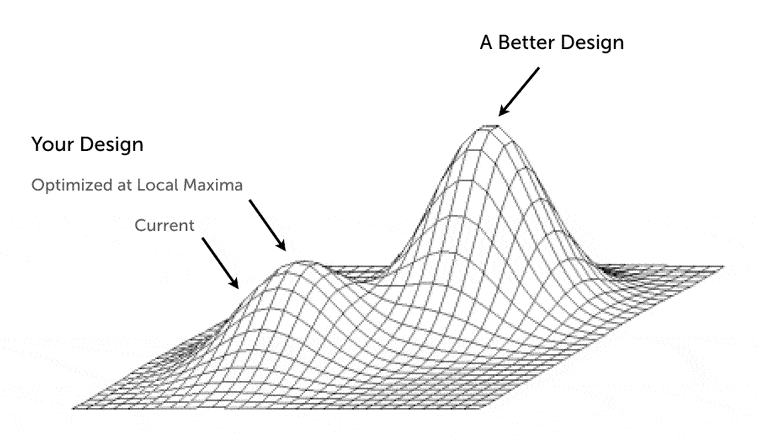
Enter my defense of consultants. If you ever wonder why they are paid so much, their utility is precisely acting as modern-day sherpas hired to navigate this ever-shifting topological minefield. The fact that an entire industry exists to decipher systems built by ostensibly rational actors should be an indictment in itself—not of consultants nor of the builders of the systems but of the systems themselves.
Now here is where AI becomes dangerous. One of its great promises is precisely to paper over this complexity. It can act as a universal lubricant, smoothing the jagged edges of institutional dysfunction. I can ask ChatGPT to explain the differences between insurance plans and ask it to explain to me as if I were five years old to make my decision. So why bother improving insurance at a systems level if we can have an AI Chatbot help everyone pick their best policy? Why reform HR policies when an AI can automate the whole department? Why overhaul the tax code when an AI assistant can file perfectly optimized returns?
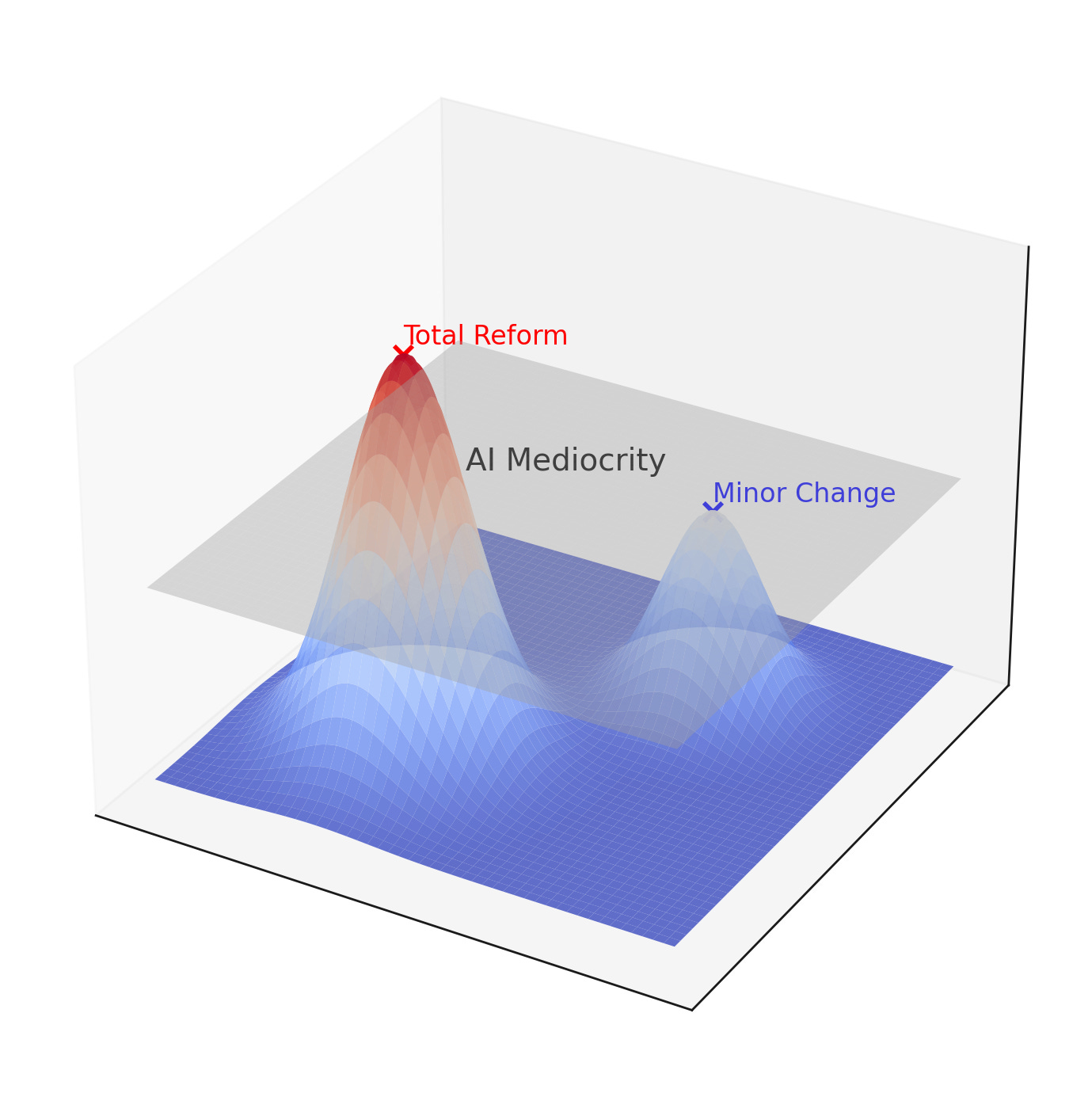
At first this sounds wonderful—help me navigate complicated systems to my benefit. But in reality, it is a trap. By patching the visible symptoms of bureaucratic decay, AI will cement that decay into place. Systems that ask to be deconstructed and rebuilt will instead be fossilized under a thin layer of digital competence.
And here is where the human cost enters. AI will not merely replace rote labor. It will augment much of the middle, the messy strata of human roles that serve as apprenticeships and ladders of social mobility. It can also make those mid-level roles more similar to the further ends, reducing the need or possibility of advancement.
Consider law. My mother was a legal secretary in her early twenties. She became a lawyer by thirty. What happens when AI can elevate a paralegal to perform 80% of the work of a competent lawyer at 20% of the cost? The entire apprenticeship chain breaks. No more legal secretaries climbing into law school. No more young lawyers earning their scars. You get a hollow profession, and, in short-term, a handful of elite partners directing armies of AI-augmented clerks.
In medicine, you learn the art of writing notes and distilling a medical story into a succinct gestalt. This skill is not academic. It is crucial. In the emergency department, it is the difference between life and death. In the span of seconds, without clear telemetry or lab values, a physician must decide if a patient is sick or not sick. This is a judgment honed through years of training and practice.
We may think we are making medical school easier, more kind and forgiving, by teaching students to rely on AI5 assistants to write notes. In doing so, we may be compromising the very quality of the physicians that emerge from the process.
Worse still, this dissolves one of the natural benefits of the medical hierarchy. Why see an MD or DO in family medicine if she is using the same chat tool as the PA or NP? If the outputs are indistinguishable, the demand for higher pay or greater trust in the MD begins to erode. The distinction itself erodes.
This is not to denigrate the role of NP. I go to one, because my student insurance covers NPs for primary care appointments. But it begs the question. Is sending someone into a primary care residency today becoming a kind of economic or professional suicide?6 Will medicine be forced to become hyper-specialized, so that there remain houses within the profession where genuine physician expertise is valued and preserved?
At times I wonder: Am I the stable hand lamenting the invention of the Model-T, fated to watch the horse industry collapse?7 I do not think so. The same pattern I describe will repeat across every vocation I initially highlighted.
In teaching, you lose the art of constructing a lecture, the slow development of theory of mind that allows a teacher to make clear what is obvious to them but opaque to the student. In the arts, you lose the discipline of sketching badly before sketching well, the very process through which artistic voice emerges. In writing, we automate the process of developing an authorial voice—after all ChatGPT is generally more palatable than most classic poets.8
But with the great leveler, hierarchies will still remain. However, rather than distinction in the practice of healing they be in the management, finance, and governance of medicine. Ossified, frozen, and brittle. They will be disconnected from the organic process of human growth that once sustained them. This is the pulling of the ladder up where a senior physician will be grandfathered in at his pay-scale but will not grow the practice—only consolidate and shrink its scope.9 It is the conversion of professions into pseudo-mid-level fields where no true masters are formed.
But a vocation, a genuine calling, should exist in every realm of human endeavor. The fifth amendment caveats (namely physician-patient, attorney-client, and clergy-practitioner privileges) all point to high vocations where one can develop virtue. To become exceptional, and even to become disruptive, one must first embed in, and submit to, a living hierarchy. It is only through this process that one earns the right to transcend it. Without this structure, there is no mastery, and without mastery, there is no excellence worth the name.
An example I think of that is quintessential to this dynamic is the discovery that Helicobacter pylori is the cause of stomach ulcers. For decades, it was medical wisdom that the stomach was too acidic for bacteria to survive. Ulcers were blamed on stress, diet, and lifestyle, a tidy consensus supported by decades of institutional inertia. But one frustrated and rogue physician, Barry Marshall, kept finding H. pylori in every pathology stain of ulcerated stomach tissue. The notion that bacteria could cause ulcers was treated as heresy.
Marshall needed to break the field out of its local maximum. So, in an act of clinical audacity, he drank an entire beaker of H. pylori. He soon developed severe gastritis and ulcers. Then he cured himself with antibiotics. The point here is not simply that he was right, but that this act took place not a century ago, but in the 1980s, after fifty years of antibiotic research and usage! The discovery did not emerge from a blank slate, but from a lone voice challenging a deeply stagnant system, one that had optimized itself into a comfortable peak and could no longer see the broader landscape. He won the Nobel Prize for this twenty years later only after the scientific consensus had moved to his theory.10
And AI will never be on the side of Marshall challenge the status quo. Because it takes inputs and probabilistically guesses based on previous evidence.11 And yet, barring a sharp course correction, it is the future we are rushing toward. AI will not reform bureaucracy. It will entrench it. It will not democratize excellence. It will simulate competence while hollowing out the structures that once produced it. It will never challenge conventional wisdom. It will regurgitate it.

And it will happen not through revolution but through gradualism, a process so incremental that no one is responsible and no one can stop it. Each administrator will shave a few costs, each manager will automate a few tasks, each regulator will allow a few new optimizations. Everyone optimizing for a local maximum never a global one. No one will notice until entire professions have been reduced to a thin managerial elite presiding over vast fields of AI-augmented mediocrity.
What we need is stewardship within fields; a conscious effort to ensure that AI, if it permitted, is used to augment systems in ways that preserve human becoming. We must ensure that within there remains a ladder worth climbing. That the map of effort still leads somewhere. That young lawyers, doctors, writers, and artists still have reason to strive.
The word virtue is the Latin version of the concept of Greek arete. Arete means excellence. But if the entire system has made smooth all the jagged points that sincerely allow for growth and eventually excellence.
Perhaps this is a naive hope. Perhaps asking for global maxima in a world ruled by local optimization is a fool’s errand. A video game analogy is apt: every hour spent grinding for short-term pleasure trades away the possibility of higher peaks of meaning.
What we are getting wrong12 is to deploy these tools eagerly, treating every difficulty as a problem in need of a solution. Not every friction is bad. Often, it is the friction itself that forms the soul. Without difficulty, there is no shaping force. Without struggle, there is no virtue. We must preserve a space where genuine excellence, arete and virtue, can still emerge. The long ladders of mastery must remain intact, with real heights worth striving toward. Otherwise, we are not optimizing the human condition. We are flattening it.
This is why hierarchy matters. Not for its own sake, but because it is the scaffold on which excellence is built. The alternative is clear. If we allow ourselves to automate away the processes by which humans become fully formed, we will not build a stairway to heaven. We will build a tower. And if the Genesis story is illustrative, it will fall, scattering us to the winds.
Substitute: Hierarchy for Chain of Command if that is more palatable
https://finance.yahoo.com/news/bill-gates-wants-tax-robots-233045575.html
https://machinelearning.apple.com/research/illusion-of-thinking
Image and mathematical thinking analogy: https://www.lennyhu.com/post/179991559076/local-vs-global-maximum
https://vocal.media/journal/bill-gates-predicts-ai-will-replace-doctors-and-teachers-within-10-years-but-humans-still-have-a-role
https://journalofethics.ama-assn.org/article/educational-debt-and-specialty-choice/2013-07
Analogy borrowed from the Sheriff of Sodium who speaks powerfully on this subject:
https://www.scimex.org/newsfeed/shakespeare-or-chatgpt-people-prefer-ai-over-real-classic-poetry
https://www.cnbc.com/2023/02/22/amazon-closes-deal-to-buy-primary-care-provider-one-medical.html
https://www.mayoclinicproceedings.org/article/S0025-6196(16)30032-5/fulltext
Maybe deep learning will hold a way out and maybe neural networks will one day emulate a full human mind with intuition and even deviance. I doubt it and especially in the short term when they might be massed deployed.
(to burry the lead)