After high school and before college, I asked my father to drive with me through the American Southwest. I had grown restless in the symmetry of suburbia, in the streets that curved back upon themselves like questions never answered. The houses all the same, their lawns clipped and watered, their lights burning against the dark as if to keep the world at bay. The air there had no weight. Even the quiet felt manufactured. I wanted to see a land that could not be tamed, to stand beneath a sky so wide it could strip a man down to what was true.
My father agreed to the trip, though it was not his kind of thing. He liked the routine of the auto shop, the precision of diagnosing problems and fixing them. Vacations, to him, were unnecessary. But he said yes, maybe because he understood this was about more than just the trip.
We visited the great landmarks: the Grand Canyon, Arches, Bryce Canyon. They were magnificent, but what stayed with me were the miles between them. The desert of Arizona and the planes of Montana unfolded endlessly, their emptiness interrupted only by a gas station or a humble roadside town. That vastness pressed down on me, not with weight but with presence. You cannot look at that much space without feeling it reconfigure something inside you.
My father did not talk much on that trip, especially when he was behind the wheel. His words came in small, deliberate portions, as if each required careful thought before it left his mouth. Once, I asked what he thought of the landscape. He looked out across the horizon and said, “It’s quiet. Lets you think.” That was all. Yet in that quiet, I began to hear him differently. His silences were not absences but choices. They were full of meaning, like the space between stars.
That journey became a point of reference for my life. It marked the end of my childhood and the beginning of something more deliberate. I learned that simplicity is not emptiness. It is clarity. The barren landscape stripped away noise and distraction until all that remained was the truth of who I was: flawed, uncertain, but alive.
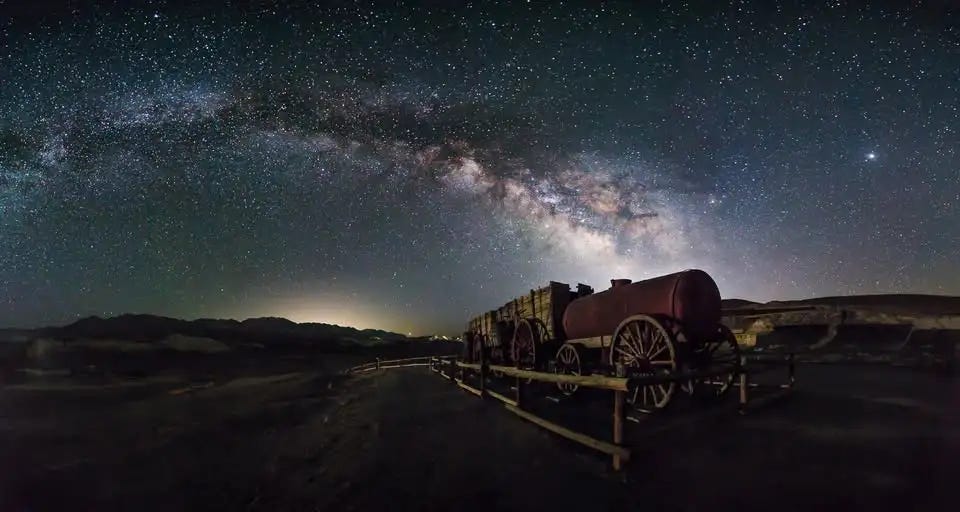
One evening near the Grand Canyon, I stepped outside after sunset. The sky had turned violet, then black, pierced by a scatter of stars so sharp they looked close enough to touch. This was not the polite glow of the suburbs but the raw expanse of the Milky Way, visible in its entirety. I felt small, yet profoundly connected. The stars did not care about me, but they acknowledged my existence by their very presence. In that moment, insignificance felt sacred.
The American West, across its many stories and mythologies, is built on this kind of clarity. The Western is not a genre of complexity but of necessity. Its heroes act because inaction means death. They do not choose simplicity for comfort but because the conditions of survival demand it. Food, shelter, safety are the stakes. There is no room for pretense or delay.
That understanding has followed me into adulthood. It explains my fascination with both space and medicine. As a child, I watched Star Wars with my father, never realizing how deeply it would connect us. Now, revisiting those films is difficult, a reminder of what is gone. My interest in space was never about fantasy. It was about edges and frontiers, the places where life is reduced to essentials.
At NASA, physicians face questions that make earthly debates feel distant. Should a three-year mission include antibiotics, or should every ounce of space go to food? There is no luxury of indecision. Medicine in space is stripped to its core, where the only metric is what works. The frontier once defined by the Western now extends beyond the atmosphere, yet the principle remains unchanged: simplicity as necessity.
I thought about this during a medical ethics seminar today. We debated language—what it means to coach rather than nudge, how authority intersects with autonomy. Such discussions have value, but sometimes they fracture meaning until only fragments remain. The pursuit of precision can dissolve understanding.
Then someone raised the question of suicide. Could a person rationally and deliberately choose to end their life without depression? The room grew tense, filled with abstract reasoning. For me, it was no longer abstract. My father’s death lingers in my mind, not as a memory but as a question I will never fully answer. Time has softened its edges, but the ache remains. Today, though, I could sit with it. I could let it exist without consuming me.
Later, biking home in the cold, I looked up at a dim sky veiled by city light. Only a few stars broke through, faint but steady. Even those sparse lights carried me back to that same sense of clarity. It is not something I rediscover; it is something that finds me. Beneath the layers of work and worry, it waits. It is quiet, constant, unshakable.
Clarity has a rhythm. It arrives when distraction falls away, revealing what has always mattered: purpose, integrity, and the courage to face truth without embellishment.
Maybe one day, I’ll see Earth from space. As a kid, I never dreamed of being an astronaut, but the vision of our planet as a fragile, luminous marble suspended in the void offers a clarity few will ever know. Astronauts call it the Overview Effect, the sudden awareness of how small our conflicts are and how inseparable our lives remain.
For me, a dream of space isn’t about escape. It’s about isolation and love—reconciling the emptiness of the universe with the beauty that persists within it. It’s about standing at the edge of everything and realizing that even the smallest choices matter. It’s about honoring my father—his strength, his honesty, and his ability to face the world as it was, without pretense.
When I read a Western, those truths return. Simplicity is not easy. It demands honesty, discipline, and the willingness to confront oneself. My father embodied that. The desert revealed it. Medicine continues to teach it. The night sky affirms it.
And perhaps, if I ever stand at the edge of the world and look back, I will see it all as it truly is: small, essential, and profoundly meaningful.