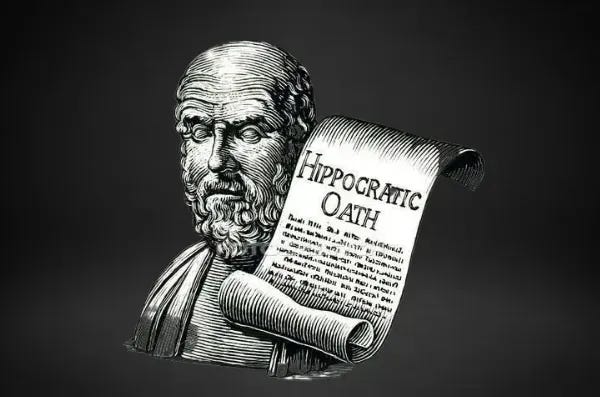
In a recent medical ethics course, there was a debate over the question of professionalism. Is it just the baseline of acceptable conduct—the thing that keeps teams functional, patients respected, and everyone more or less on the same page? Or is it something grander, a set of higher virtues unique to medicine and its practitioners?
This isn’t just a debate about definitions; it’s a deeper inquiry into the soul of modern medicine. What is this profession—a calling, or just another job?
If professionalism is a set of minimal standards, then it has to function like a rulebook: clear, enforceable, and pragmatic. As medical students, we know this version of professionalism intimately. Showing up late, wearing the wrong thing, or slipping in decorum? Unprofessional. Sanctions and warnings follow. This professionalism keeps the trains running on time; it’s the lubricant for the machine that is modern healthcare.
Think of it as compliance. Doctors and students alike align themselves with the expectations set by their superiors. In this world, you adopt a mindset best summed up by The Who: “Meet the new boss, same as the old boss.” Your attending physician’s quirks, style, and preferences largely define the line between acceptable and unprofessional. This is rooted in humility and the expectation that your superior who has gone before you knows how to operate in this high-stakes environment. Personal ambitions and conceptions of the good? Admirable, but ultimately incidental. These larger goals may be fostered by good mentors but could they ever be encompassed by the term professionalism?
There’s no denying the stakes in medicine—life and death hover over decisions—but this understanding of professionalism mirrors the systems found in any hierarchical organization. Whether you’re bolting parts on an assembly line or scrubbing in for surgery, the principle is the same: follow the standards, keep the team on track, and avoid unnecessary disruptions. When leadership fails to uphold these ethical standards, pushback is inevitable because professionalism is a two-way street. Professionalism in this framework is a minimal ethic, more about preventing chaos than fostering virtue.
Medicine, however, does have unique expectations that go beyond the assembly line. Respect for patients is paramount—it’s what builds trust, allowing people to share their most intimate vulnerabilities and agreeing to allow a surgeon to operate on them. This trust extends beyond the hospital, demanding that healthcare professionals uphold standards in their personal lives to avoid compromising it. Yes, these are elevated standards, but they remain fundamentally pragmatic. A doctor’s obligation to perform CPR on a collapsing stranger isn’t an emergent principle of medicine; it’s a recognition of shared humanity and interdependence. Medicine’s ethical principles emerge from this universal truth, not from some esoteric code.
Practical? Absolutely. Scalable? Without question. But does this focus on the mechanics flatten what medicine could be?
Here’s the counterargument: professionalism is not about floors but ceilings. It’s not just the baseline; it’s a reach for something higher—a demonstration of care, compassion, and integrity that elevates medicine into a calling.
Let’s talk about the privileges afforded to medicine. Along with law, mental health, and clergy, it’s one of the few professions granted special Fifth Amendment protections. Why? Because it touches on the intangible yet essential elements of human existence: life, liberty, and the soul. The physician who prioritizes a patient’s health over profits or challenges unjust laws to provide care exemplifies this elevated professionalism.
And consider the gauntlet that is medical education. From nursing programs to physical therapy schools to medical residencies, the barriers to entry are brutal. It’s a system designed to filter out all but the most committed. Those who opt in and endure the crucible are exceptional by definition. Their willingness to sacrifice comfort, time, and energy is itself a testament to a higher standard of dedication.
Medicine’s moral framework isn’t unique. It reflects universal principles—an ethic of life, liberty, and the pursuit of happiness—applied to the body and health. The doctor preserves life, the lawyer safeguards liberty, and the clergy nurtures the soul. Together, they operate within a shared moral ecosystem. But this view—aspirational, virtuous, and grand—risks complicating the idea of professionalism.
Here’s where it gets tricky. If we tie these lofty ideals directly to professionalism, we risk overloading the term. Professionalism, at its core, is a set of standards—a floor, not a ceiling. It ensures that the system functions smoothly. It cannot and should not be the vehicle for individual greatness.
What’s needed is a term for those loftier ambitions. Call it "vocational mastery"—a pursuit of excellence that grows organically from a practitioner’s character and dedication. Mastery can’t be enforced. Virtue, after all, loses its meaning the moment it’s mandated. It thrives in the space beyond obligation, where it is chosen freely.
That said, personal mastery has its dangers. Too much self-regard can push medicine into the realm of the Tower of Babel—a monument to hubris rather than healing. When practitioners chase recognition over good, the field risks losing sight of its proximate goal: improving health. Professionalism, with its emphasis on high but clear standards, acts as a counterweight. It keeps the focus on the patient, not the practitioner’s ego.
Professionalism, then, is the anchor. It’s the realm of "Meet the new boss, same as the old boss" and #DoTheWork, ensuring that healthcare operates efficiently and ethically. Vocational mastery is the accidental virtue—the thing that elevates a good doctor to greatness but cannot and should not be required lest it loses all meaning.
This separation preserves the integrity of professionalism while leaving room for individual aspiration. Every doctor must be professional, but not every doctor will pursue vocational mastery—although they should. And that’s okay. Virtue is meaningful only when it’s chosen, not compelled. Medicine, in the end, remains both a profession and, for some, a calling. It’s grounded in standards but open to the extraordinary heights of those who choose to go further.