---
license: apache-2.0
library_name: llama.cpp
pipeline_tag: text-generation
tags:
- 1-bit
- gguf
- llama-cpp
- cuda
- metal
- on-device
- prismml
- bonsai
base_model:
- prism-ml/Bonsai-8B-unpacked
---

Prism ML Website |
Whitepaper |
Demo & Examples |
Colab Notebook |
Discord
# Bonsai-8B-GGUF-1bit
End-to-end 1-bit language model for llama.cpp (CUDA, Metal, CPU)
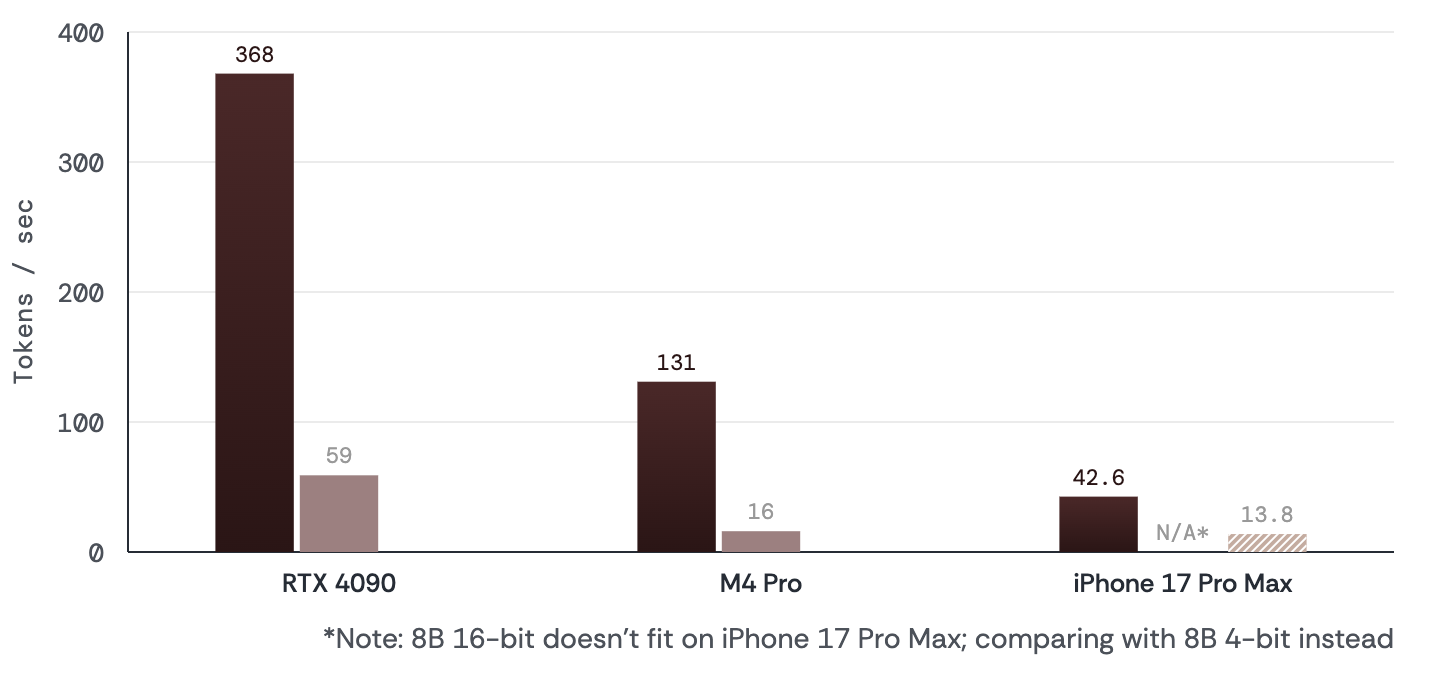
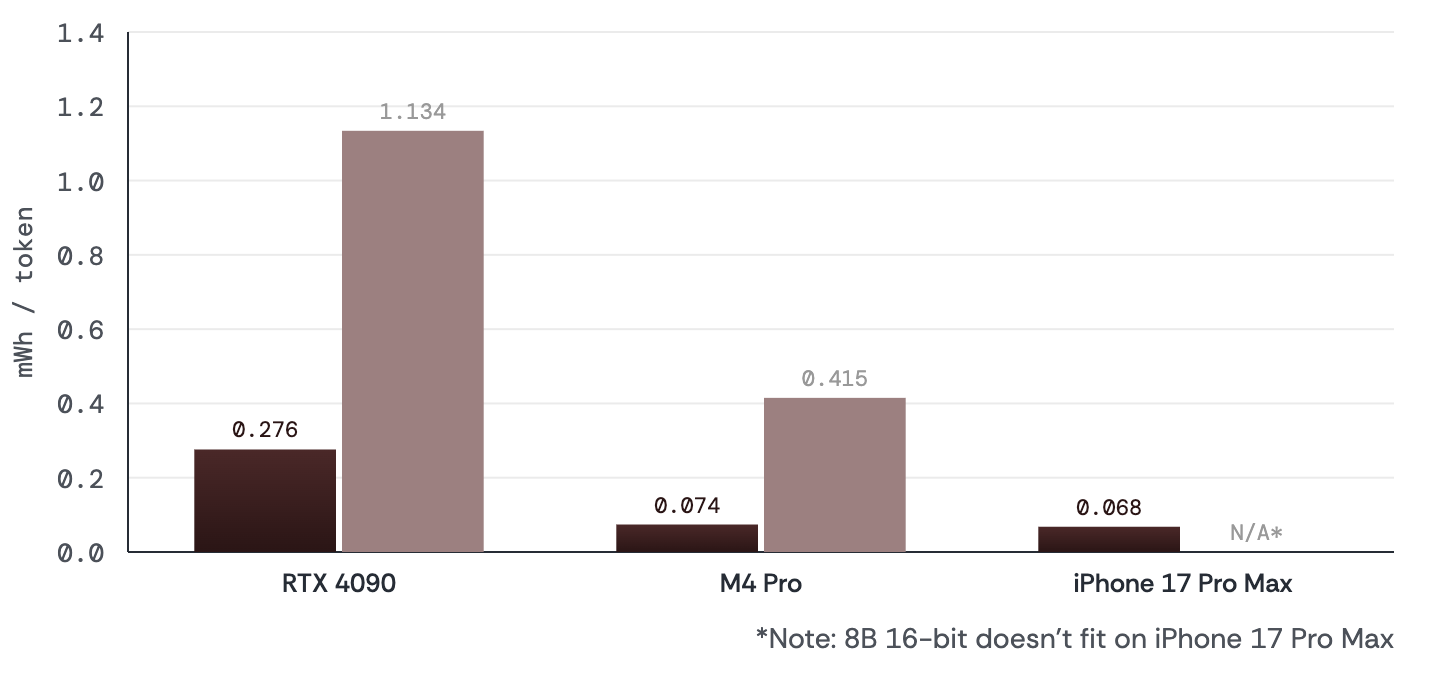
> **14.1x** smaller than FP16 | **6.2x** faster on RTX 4090 | **4-5x** lower energy/token
## Highlights
- **1.15 GB** parameter memory (down from 16.38 GB FP16) — fits on virtually any device with a GPU
- **End-to-end 1-bit weights** across embeddings, attention projections, MLP projections, and LM head
- **GGUF Q1_0 (g128)** format with inline dequantization kernels — no FP16 materialization
- **Cross-platform**: CUDA (RTX/datacenter), Metal (Mac), Android, CPU
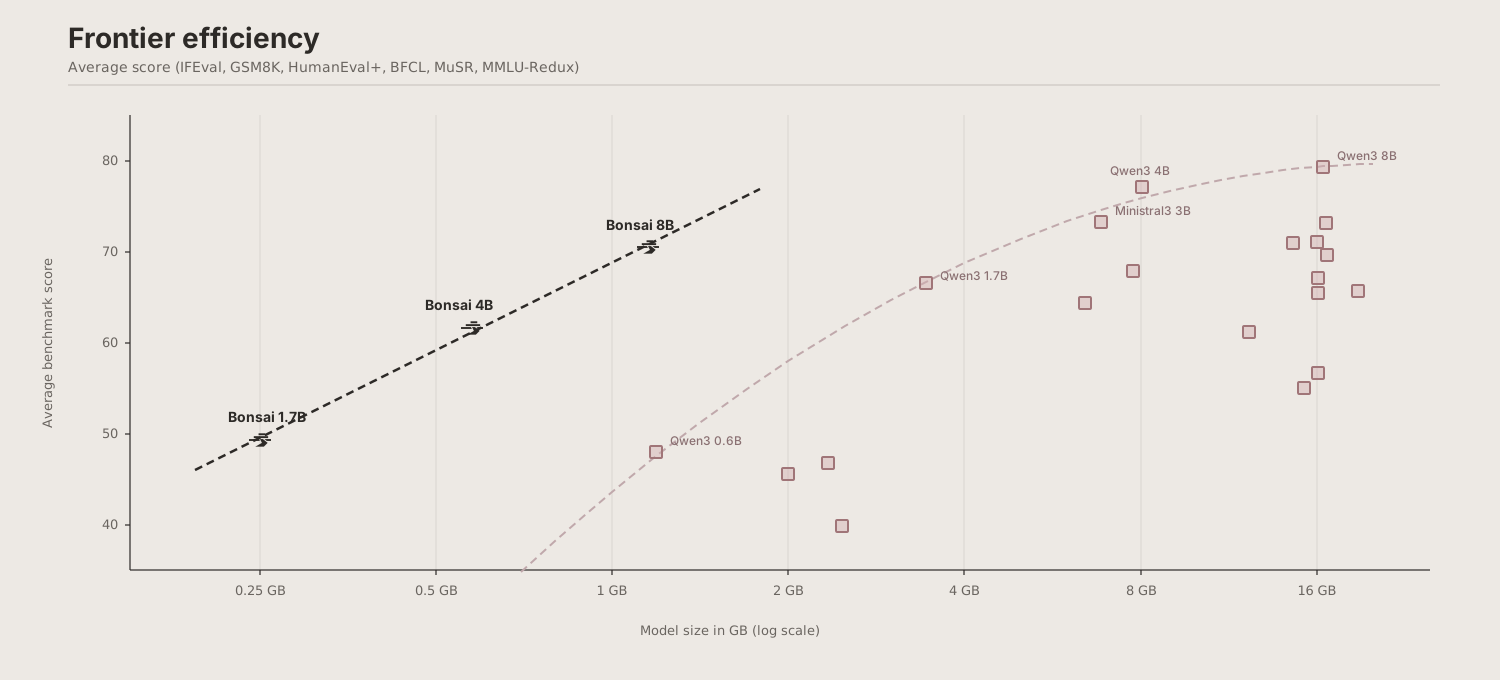
- **Competitive benchmarks**: 70.5 avg score across 6 categories, matching full-precision 8B models at 1/14th the size
- **MLX companion**: also available as [MLX 1-bit g128](https://huggingface.co/prism-ml/Bonsai-8B-mlx-1bit) for native Apple Silicon inference
## Resources
- **[Google Colab](https://colab.research.google.com/drive/1EzyAaQ2nwDv_1X0jaC5XiVC3ZREg9bdG?usp=sharing)** — try Bonsai in your browser, no setup required
- **[Whitepaper](https://github.com/PrismML-Eng/Bonsai-demo/blob/main/1-bit-bonsai-8b-whitepaper.pdf)** — for more details on Bonsai, check out our whitepaper
- **[Demo repo](https://github.com/PrismML-Eng/Bonsai-demo)** — comprehensive examples for serving, benchmarking, and integrating Bonsai
- **[Discord](https://discord.gg/prismml)** — join the community for support, discussion, and updates
- **1-bit kernels**: [llama.cpp fork](https://github.com/PrismML-Eng/llama.cpp) (CUDA + Metal) · [MLX fork](https://github.com/PrismML-Eng/mlx) (Apple Silicon) · [mlx-swift fork](https://github.com/PrismML-Eng/mlx-swift) (iOS/macOS)
- **[Locally AI](https://locallyai.app/)** — we have partnered with Locally AI for iPhone support
## Model Overview
| Item | Specification |
| :------------- | :--------------------------------------------------------------------- |
| Parameters | 8.19B (~6.95B non-embedding) |
| Architecture | Qwen3-8B dense: GQA (32 query / 8 KV heads), SwiGLU MLP, RoPE, RMSNorm |
| Layers | 36 Transformer decoder blocks |
| Context length | 65,536 tokens |
| Vocab size | 151,936 |
| Weight format | GGUF Q1_0 |
| Deployed size | **1.15 GB** (14.2x smaller than FP16) |
| 1-bit coverage | Embeddings, attention projections, MLP projections, LM head |
| License | Apache 2.0 |
## Quantization Format: Q1_0
Each weight is a single bit: `0` maps to `−scale`, `1` maps to `+scale`. Every group of 128 weights shares one FP16 scale factor.
Effective bits per weight: **1.125** (1 sign bit + 16-bit scale amortized over 128 weights).
### Memory Requirement
Parameter memory only (weights and scales loaded into memory):
| Format | Size | Reduction | Ratio |
| :----------------- | ----------: | --------: | --------: |
| FP16 | 16.38 GB | — | 1.0x |
| **GGUF Q1_0 ** | **1.15 GB** | **93.0%** | **14.2x** |
| MLX 1-bit g128 | 1.28 GB | 92.2% | 12.8x |
The GGUF file on disk is 1.16 GB (~6.6 MB larger) because the format embeds the tokenizer, chat template, and model metadata alongside the weights.
## Best Practices
### Generation Parameters
| Parameter | Default | Suggested range |
| :----------------- | :------ | :-------------- |
| Temperature | 0.5 | 0.5 -- 0.7 |
| Top-k | 20 | 20 -- 40 |
| Top-p | 0.9 | 0.85 -- 0.95 |
| Repetition penalty | 1.0 | |
| Presence penalty | 0.0 | |
### System Prompt
You can use a simple system prompt such as:
```
You are a helpful assistant
```
## Quickstart
### llama.cpp (CUDA)
```bash
# Clone the PrismML fork of llama.cpp (includes Q1_0 kernels)
git clone https://github.com/PrismML-Eng/llama.cpp
cd llama.cpp
# Build with CUDA support
cmake -B build -DGGML_CUDA=ON && cmake --build build -j
# Run inference
./build/bin/llama-cli \
-m Bonsai-8B-Q1_0.gguf \
-p "Explain quantum computing in simple terms." \
-n 256 \
--temp 0.5 \
--top-p 0.85 \
--top-k 20 \
-ngl 99
```
### llama.cpp (Metal / macOS)
```bash
# Clone the PrismML fork of llama.cpp (includes Q1_0 kernels)
git clone https://github.com/PrismML-Eng/llama.cpp
cd llama.cpp
# Build with Metal support (default on macOS)
cmake -B build && cmake --build build -j
# Run inference
./build/bin/llama-cli \
-m Bonsai-8B-Q1_0.gguf \
-p "Explain quantum computing in simple terms." \
-n 256 \
--temp 0.5 \
--top-p 0.85 \
--top-k 20 \
-ngl 99
```
### llama.cpp Server
```bash
./build/bin/llama-server \
-m Bonsai-8B-Q1_0.gguf \
--host 0.0.0.0 \
--port 8080 \
-ngl 99
```
Open the web UI at [http://127.0.0.1:8080](http://127.0.0.1:8080), or see our [llama.cpp fork](https://github.com/PrismML-Eng/llama.cpp) for more examples.
## Cross-Platform Throughput
| Platform | Backend | TG128 (tok/s) | FP16 TG (tok/s) | TG vs FP16 | PP512 (tok/s) | FP16 PP512 (tok/s) |
| :---------------- | :--------------- | ------------: | --------------: | ---------: | ------------: | -----------------: |
| RTX 4090 | llama.cpp CUDA | 368 | 59 | **6.2x** | 11,809 | 10,453 |
| RTX L40S | llama.cpp CUDA | 327 | 52 | **6.3x** | 9,592 | 8,325 |
| RTX 3060 Laptop | llama.cpp CUDA | 81 | 3.5¹ | **23x**¹ | 1,871 | 94¹ |
| M4 Pro 48 GB | llama.cpp Metal | 85 | 16 | **5.4x** | 498 | 490 |
| Samsung S25 Ultra | llama.cpp OpenCL | 19.6 | — | — | 30.4 | — |
¹ FP16 only fits partially on GPU's 6 GB VRAM; 1-bit fits entirely in VRAM.
## Energy Efficiency
| Platform | Bonsai E_tg (mWh/tok) | Baseline E_tg | Advantage |
| :----------------- | --------------------: | ------------: | --------: |
| RTX 4090 (CUDA) | 0.276 | 1.134 (FP16) | **4.1x** |
| Mac M4 Pro (Metal) | 0.091 | 0.471 (FP16) | **5.1x** |
## Benchmarks
Evaluated with EvalScope v1.4.2 + vLLM 0.15.1 on NVIDIA H100 under identical infrastructure, generation parameters, and scoring. All models are in the 6B–9B parameter range.
| Model | Company | Size | Avg | MMLU-R | MuSR | GSM8K | HE+ | IFEval | BFCL |
| :------------------ | :------------ | ----------: | -------: | -----: | ---: | ----: | ---: | -----: | ---: |
| Qwen 3 8B | Alibaba | 16 GB | **79.3** | 83 | 55 | 93 | 82.3 | 84.2 | 81 |
| RNJ 8B | EssentialAI | 16 GB | **73.1** | 75.5 | 50.4 | 93.7 | 84.2 | 73.8 | 61.1 |
| Mistral3 8B | Mistral | 16 GB | **71.0** | 73.9 | 53.8 | 87.2 | 67.4 | 75.4 | 45.4 |
| Olmo 3 7B | Allen Inst | 14 GB | **70.9** | 72 | 56.1 | 92.5 | 79.3 | 37.1 | 38.4 |
| **1-bit Bonsai 8B** | **PrismML** | **1.15 GB** | **70.5** | 65.7 | 50 | 88 | 73.8 | 79.8 | 65.7 |
| LFM2 8B | LiquidAI | 16 GB | **69.6** | 72.7 | 49.5 | 90.1 | 81 | 82.2 | 62.0 |
| Llama 3.1 8B | Meta | 16 GB | **67.1** | 72.9 | 51.3 | 87.9 | 75 | 51.5 | — |
| GLM v6 9B | ZhipuAI | 16 GB | **65.7** | 61.9 | 43.2 | 93.4 | 78.7 | 69.3 | 21.9 |
| Hermes 8B | Nous Research | 16 GB | **65.4** | 67.4 | 52.2 | 82.9 | 51.2 | 65 | 73.5 |
| Trinity Nano 6B | Arcee | 12 GB | **61.2** | 68.8 | 52.6 | 81.1 | 54 | 50 | 62.5 |
| Marin 8B | Stanford CRFM | 16 GB | **56.6** | 64.8 | 42.6 | 86.4 | 51 | 50 | — |
| R1-D 7B | DeepSeek | 14 GB | **55.1** | 62.5 | 29.1 | 92.7 | 81.7 | 48.8 | 15.4 |
Despite being **1/14th the size**, 1-bit Bonsai 8B is competitive with leading full-precision 8B instruct models.
## Intelligence Density
Intelligence density captures the ratio of a model's capability to its deployed size:
```
alpha = -ln(1 - score/100) / size_GB
```
| Model | Size | Intelligence Density (1/GB) |
| :------------------ | ----------: | --------------------------: |
| **1-bit Bonsai 8B** | **1.15 GB** | **1.062** |
| Qwen 3 8B | 16 GB | 0.098 |
| Llama 3.1 8B | 16 GB | 0.074 |
| Mistral3 8B | 16 GB | 0.077 |
Bonsai 8B achieves **10.8x higher intelligence density** than full-precision Qwen 3 8B.

## Use Cases
- **On-device assistants**: interactive AI on laptops and phones with low latency
- **Mobile deployment**: runs on a wide variety of phones due to low memory footprint
- **Edge robotics and autonomy**: compact deployment on devices with thermal, memory, or connectivity constraints
- **Cost-sensitive GPU serving**: higher throughput and lower energy per token on RTX-class and datacenter GPUs
- **Enterprise and private inference**: local or controlled-environment inference for data residency requirements
## Limitations
- No native 1-bit hardware exists yet — current gains are software-kernel optimizations on general-purpose hardware
- Mobile power measurement is estimated rather than hardware-metered
- The full-precision benchmark frontier continues to advance; the 1-bit methodology is architecture-agnostic and will be applied to newer bases
## Citation
If you use 1-bit Bonsai 8B, please cite:
```bibtex
@techreport{bonsai8b,
title = {1-bit Bonsai 8B: End-to-End 1-bit Language Model Deployment
Across Apple, GPU, and Mobile Runtimes},
author = {Prism ML},
year = {2026},
month = {March},
url = {https://prismml.com}
}
```
## Contact
For questions, feedback, or collaboration inquiries: **contact@prismml.com**